
The short version: the fastest way to tell a real AI platform from a promised one is to ask what is shipping. MangoApps runs 80+ AI agents in production today, in three types, on one operating model: it watches the work, answers in the flow, acts under your rules, and stays governed end to end. Because the data is native rather than a connected copy, the agents do not just answer. They open the req, swap the shift, and close the ticket.
Most AI-at-work announcements describe a roadmap. The fastest way to tell a real AI platform from a promised one is to ask a blunt question: what is shipping today?

Here is the answer for a platform where AI is grounded in the work rather than bolted on: 80+ production AI agents, 20+ AI capabilities across apps, three model providers, five model tiers, and 37 translation languages. In production today, and governed on arrival, because the identity, data, and permissions the AI needs already live in one place.
Because the data is native, the AI acts, not just answers
This is the line that separates grounded AI from a chatbot. A chatbot bolted onto fragmented tools can retrieve and summarize. It answers.
When the AI runs on native data instead of a connected copy, it can do the thing the answer is about. It opens the requisition, swaps the shift, closes the ticket. The difference is not a better model. It is that the AI is standing on the actual record of the business, with the identity and permissions it needs to take the action attached to that record, not fetched across a brittle integration.
One operating model behind every agent
Grounded AI is not four separate products stitched together. It is one operating model that every agent runs on. It watches the work, answers in the flow, acts under your rules, and stays governed end to end.
- Intelligence watches the work. Agents track uncovered shifts, timesheet anomalies, attendance variance, and expiring certifications, and surface what needs attention before it becomes a problem.
- Assistants answer in the flow. Ask AI is the single front door. It answers in plain language from approved sources, scoped to each person's permissions, across web, mobile, and chat. Never the open web.
- Agents act under your rules. Autonomous closers complete routine work: fill the open shift, clear the clean timesheet, recommend the time-off decision. Each carries a per-business autonomy dial and a full audit trail.
- Trust and governance keeps it accountable. Every agent is engineered through a disciplined lifecycle, with permission inheritance, customer-data separation, and audit-ready visibility.
Three types of agent, all governed on arrival

The 80+ agents come in three types, and each inherits the same permissions, data boundaries, and audit visibility as the rest of the platform. You add AI, and it arrives governed.
| Agent type | Count | What it does |
|---|---|---|
| Domain agents | 73 | One per app or workflow area |
| Read-only help agents | 4 | Answer questions, change nothing |
| Live admin agents | 3 | Take governed action for administrators |
The point of the split is control. A help agent that can only answer is a different risk profile from an admin agent that can act, and the platform treats them differently by design rather than hoping a prompt holds the line.
Adaptable, and open

Grounded AI also answers the two objections every platform evaluation raises. "It will not fit how we work" is answered by build. "We standardized on another model" is answered by connect.
Build the workflows no vendor ever shipped. The Plugin AI Builder lets you describe a widget, agent, or full plugin in plain language, then review, govern, and roll it out. It inherits the platform's identity, permissions, data, and audit trail the moment it exists. The AI Workflow Generator and AI Forms build the inspection checklist, approval chain, or intake form your business actually runs on from a description, a PDF, or an image.
Connect your choice of intelligence. Through standards-based MCP you can connect Claude, Cursor, Codex, or any MCP-compatible agent, with hundreds of scoped, permission-aware tools. You can run on OpenAI, Anthropic, or Gemini with automatic fallback, or an approved private model. Provider choice is a setting, not a re-platform, and every external call inherits the calling user's permissions and lands in the same audit log as the internal agents.
How the AI is built
For the technical buyer, one more level of rigor. Every agent moves through the same Agent Development Lifecycle, treated like enterprise software rather than a demo.
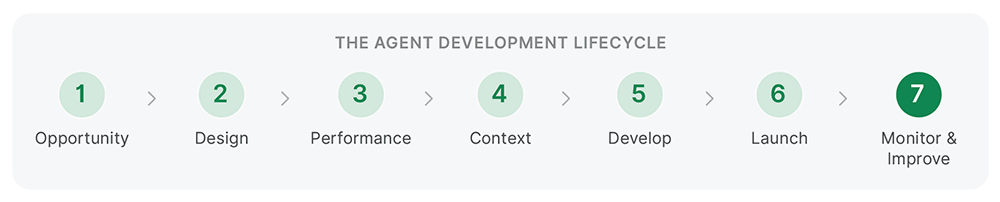
Governance is a stage in that lifecycle, not a checklist bolted on at the end. Risk review happens at design time, not after an incident. A monitor-and-improve stage tracks override rate, quality signals, and drift, and agents that stop earning their keep are retired through the same lifecycle that launched them. Sunset, not orphan. How that governance model works in full is its own subject.
Grounded, not bolted on
A chatbot bolted onto a stack of tools can talk about the work. AI grounded in the work can do it, because the identity, data, and permissions it needs are already in one place and already governed.
That is the difference between AI as a feature and AI as infrastructure, and it is the whole design of the AI-Ready Employee Platform for the Frontline.
Get the full argument
This is the AI layer in short. The full chapter, every agent type, the operating model, the openness story, and the governance model, is in the book.
Download The Employee Platform for the AI Era (Executive Edition) from the resource library here, or talk to someone who knows your industry.
Frequently asked questions
What does "AI grounded in work" mean? It means the AI runs directly on the platform's native data, identity, and permissions, rather than reaching into separate tools through integrations. Because the record it acts on is the real one, the AI can take action inside the business, not just describe it. Grounded AI opens the requisition or swaps the shift; a bolted-on chatbot can only tell you how.
What is the difference between an AI assistant and an AI agent? An assistant answers questions in plain language, scoped to what the user is allowed to see. An agent takes action: it completes routine work like filling an open shift, clearing a clean timesheet, or recommending a time-off decision. Assistants answer in the flow; agents act under your rules, with an autonomy dial and an audit trail on every action.
What are the three types of AI agents? Domain agents (one per app or workflow area, 73 in production), read-only help agents (which answer questions and change nothing, 4 in production), and live admin agents (which take governed action for administrators, 3 in production). Each type inherits the same permissions, data boundaries, and audit visibility, and each carries a different risk profile the platform enforces by design.
Can enterprise AI take action, or only answer? It depends on what the AI stands on. AI bolted onto disconnected tools can generally only answer, because it lacks the shared identity, record, and permissions needed to act safely. AI native to one platform can act, because those things are already in place, so it can change a record and leave an auditable trail. Acting safely is an architecture question, not a model question.
Can I use my own AI model? Yes. You can run on OpenAI, Anthropic, or Gemini with automatic fallback, or on an approved private model, and provider choice is a setting rather than a re-platform. You can also connect external MCP-compatible agents. In every case, the external call inherits the calling user's permissions and lands in the same audit log as the platform's own agents, so governance does not change when the model does.
How are AI agents kept governed? Every agent inherits the platform's permissions, data separation, and audit visibility, and moves through a disciplined Agent Development Lifecycle with risk review at design time. Governance is built into how the agent is created rather than added afterward, so an agent arrives permitted, scoped, and auditable. The full governance model, including the autonomy dial and kill switch, is covered separately.
What is an Agent Development Lifecycle? It is the disciplined process every agent moves through, treated like enterprise software: identifying the opportunity, designing it, setting performance and context, developing, launching, and then monitoring and improving. Governance wraps the whole lifecycle, with risk review at design time and drift tracking after launch. Agents that stop earning their keep are retired through the same lifecycle that launched them, so the AI estate is curated rather than left to sprawl.
What is an AI-Ready Employee Platform? It is an employee platform where AI is grounded in the work rather than bolted on, because the identity, data, permissions, and governance the AI needs are shared across the whole platform from the start. That is what lets AI act safely across the entire workforce and adapt to how the business actually runs. MangoApps is the AI-Ready Employee Platform for the Frontline.
The MangoApps Team
We're the product, research, and strategy team behind MangoApps — the unified frontline workforce management platform and employee communication and engagement suite trusted by organizations in healthcare, manufacturing, retail, hospitality, and the public sector to connect every employee — deskless or desk-based — to the people, tools, and information they need.
We write about enterprise AI for the workplace, internal communications, AI-powered intranets, workforce management, and the operating patterns behind highly engaged frontline teams. Our perspective is grounded in a decade of building for frontline-heavy industries and shipping AI agents, employee apps, and integrated HR workflows that real employees actually use.
For short-form takes, product news, and field notes from customer rollouts, follow Frontline Wire — our ongoing stream on AI, frontline work, and the modern digital workplace — or learn more about MangoApps.


