
The short version: the real return on a platform is not the apps. It is what happens at the seams, when every app shares one data model. Here are seven cross-app flows that only work when the work runs in one place, and why a stack of separate tools cannot copy them at any price.
Most of the platform conversation is about breadth: every app, every employee, one AI layer. Breadth is the setup. The payoff is somewhere less obvious, at the seams between the apps.
The real return on a platform is not any single app. It is what becomes possible when they all share one data model, and it grows with every capability you add. What follows are seven flows that only happen when the work runs in one place. They are not integrations. They are architecture.
Seven flows that only happen on one shared record
Each one is a single event moving cleanly across several apps, with no manual handoff between them.
- Comms → Frontline reach → Translation → Knowledge. A company update is published once. It distributes across the feed, mobile, and digital signage, auto-translates into each employee's language, and read receipts confirm who has seen it. Ask AI can then answer questions about it, grounded only in the approved version. Every employee reached in their own language, desk and frontline alike, with proof it landed.
- Safety → Learning → Scheduling. A safety certification nears expiry. The Skills Agent flags it with lead time, training auto-assigns, and scheduling stops routing that employee to roles that require the lapsed credential. The compliance gap closes before it becomes an incident.
- Talent Acquisition → HR → Performance. A candidate accepts an offer. Onboarding triggers, access provisions, first training enrolls, and initial goals are set. The new hire is ready on day one, not in week three.
- HR → Everything. A role change is entered once, in HR. Training assignments, comms targeting, OKR alignment, and succession eligibility all update at once. One entry, no manual reconciliation across five systems.
- Performance → Recognition → Learning. A manager opens a review. OKR progress, recognition history, completed training, and current certifications are already assembled. The review starts from a complete picture, not a blank form and a week of digging.
- Plugin AI Builder → Foundation → Governance. A team needs a workflow no vendor ever built. They describe it in plain language, the Plugin AI Builder creates it, and it inherits the platform's identity, permissions, data, and audit trail the moment it exists. The gap that used to justify the next procurement cycle closes from inside the platform.
- AI → Governance → Everything. An agent acts on any of the above. It works within one permission model and writes to one audit trail. Every automated action across the whole business is governed and reviewable in one place.
Why a stack of point tools cannot copy this
Each of those seven is one event moving cleanly through several apps. On a stack of separate tools, every arrow in those chains is a manual handoff. Someone re-keys the certification into the scheduler. Someone remembers to assign the training. Someone hopes the AI is reading the current policy and not last year's.
The chain breaks at every seam, and the breaks are where compliance gaps and bad data live. And when a workflow is missing entirely, the stack's only answer is another procurement cycle, which is exactly how the stack got built in the first place.
This is why the seven cannot be bought as a feature. They are not a feature. They are what a shared data model does, and no amount of integration recreates them, because the tools underneath were never built to share a record.
What consolidation looks like in practice
The precondition for all seven is the one most companies still have not met: the work running on one platform instead of a stack of separate systems.
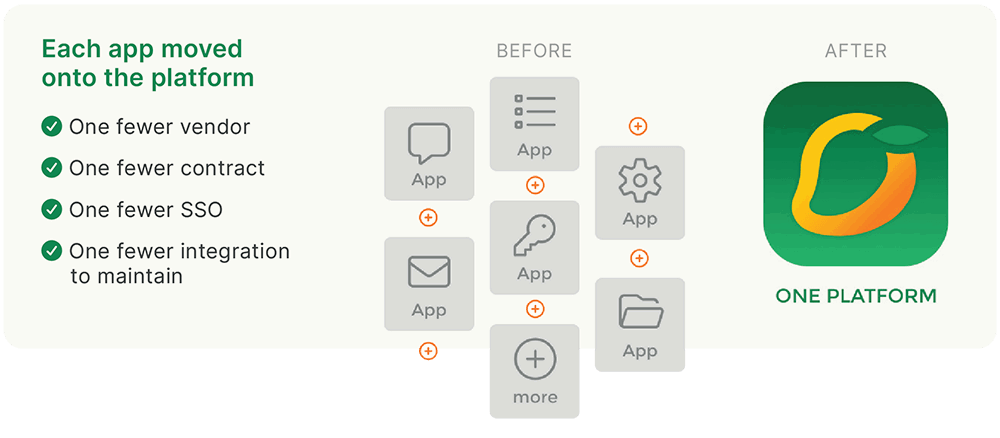
Paul Miller Auto Group is a New Jersey dealership network of 14 locations that historically ran as 14 independent businesses. Sales consultants juggled five to seven separate applications, each with its own password. Inventory was reported to corporate in different formats over email. The company directory was a printed spreadsheet, replaced by hand with each new hire.
Moving onto one platform collapsed that into a single system: single sign-on across all applications, inventory from all 14 locations in one real-time view, a live directory, a shared payroll calendar, and communications that reach every location at once.
"When you have multiple locations, it's really helpful to have a single place that everybody goes. MangoApps enables us to reach every employee, streamline processes across the business, and simplify our tech stack with single sign-on." — Hayes Miller, Director of Communications, Paul Miller Auto Group
That is not yet all seven flows. It is the precondition for them: one shared record instead of a stack, which is the point at which the seams stop being manual handoffs and start compounding.
The compounding return
This is the return on the platform decision that never shows up in a feature comparison, because it is not in any single feature. It is one event, carried across many apps, on one shared record, with the AI layer reading and writing underneath it all.

It grows with every capability you add, and it cannot be bought later, which is the entire reason the platform decision comes first. One foundation, chosen deliberately, is what turns a collection of apps into the AI-Ready Employee Platform for the Frontline.
Get the full argument
This is the compounding case in short. The full chapter, all seven flows and why a stack cannot reproduce them, is in the book.
Download The Employee Platform for the AI Era (Executive Edition) from the resource library here, or talk to someone who knows your industry.
Frequently asked questions
Why is a platform worth more than the sum of its apps? Because the highest-value outcomes happen between the apps, not inside any one of them. When every app shares one data model, a single event can move across comms, HR, learning, scheduling, and performance with no manual handoff. Those cross-app flows are the compounding return on a platform, and they grow with every capability you add. A collection of separate apps, however good each one is, cannot produce them.
Can integrations replace a shared data model? No. Integrations move data between tools that each keep their own separate record, so every cross-app step is a handoff that can break, lag, or conflict. A shared data model means there is one record that every app and agent reads and writes, so the step does not have to be handed off at all. Integrations connect systems; a shared data model removes the seam entirely.
What does "one shared data model" enable? It enables one event to trigger the right actions everywhere at once, correctly and automatically. A role change entered once in HR updates training, comms targeting, OKR alignment, and succession eligibility together. An accepted offer provisions access, enrolls training, and sets goals. A lapsing certification assigns training and stops unsafe scheduling. None of these require re-keying data between systems, because there is only one system of record.
Why can't a best-of-breed stack reproduce these workflows? Because the tools were never built to share a record. On a stack, every arrow in a cross-app workflow is a manual handoff: someone re-keys the certification, someone remembers the training, someone hopes the AI is reading the current policy. The chain breaks at each seam, and the breaks are where compliance gaps and bad data appear. When a workflow is missing entirely, the stack's only answer is to buy another tool.
What is an example of a cross-app workflow on one platform? A safety certification nears expiry. The system flags it with lead time, auto-assigns the required training, and stops scheduling that employee into roles that need the credential until it is renewed. On one platform this happens automatically across safety, learning, and scheduling. On a stack of separate tools, each of those steps is a manual task someone has to remember, and the gap between them is where an incident happens.
What is an AI-Ready Employee Platform? It is an employee platform where every app and AI agent shares one identity, one record, and one governance model, so work flows across the whole business without manual handoffs and AI can act safely on top of it. That shared foundation is what produces the compounding, cross-app outcomes a stack of separate tools cannot. MangoApps is the AI-Ready Employee Platform for the Frontline.
The MangoApps Team
We're the product, research, and strategy team behind MangoApps — the unified frontline workforce management platform and employee communication and engagement suite trusted by organizations in healthcare, manufacturing, retail, hospitality, and the public sector to connect every employee — deskless or desk-based — to the people, tools, and information they need.
We write about enterprise AI for the workplace, internal communications, AI-powered intranets, workforce management, and the operating patterns behind highly engaged frontline teams. Our perspective is grounded in a decade of building for frontline-heavy industries and shipping AI agents, employee apps, and integrated HR workflows that real employees actually use.
For short-form takes, product news, and field notes from customer rollouts, follow Frontline Wire — our ongoing stream on AI, frontline work, and the modern digital workplace — or learn more about MangoApps.
Dive Deeper


