
In a frontline scheduling workflow in MangoApps, AI agents do three concrete things: the Scheduling Agent builds coverage and surfaces gaps before shifts begin, the Attendance Agent routes exceptions in real time, and the Timekeeping Agent catches anomalies before payroll runs. What makes them agents rather than a chatbot is that they can take governed action, not just answer questions, and what makes that safe is that they run on the same platform as the work, inheriting its permissions, data boundaries, and audit logging. If you are evaluating AI for scheduling, those two properties, real action and real governance, are the whole evaluation.
A chatbot bolted onto a stack of disconnected tools can answer a question. It cannot safely act, because it cannot see across the work or be trusted with the permissions to change it. The difference below is not about a smarter model. It is about where the AI runs.
The three agents, and what each one actually does
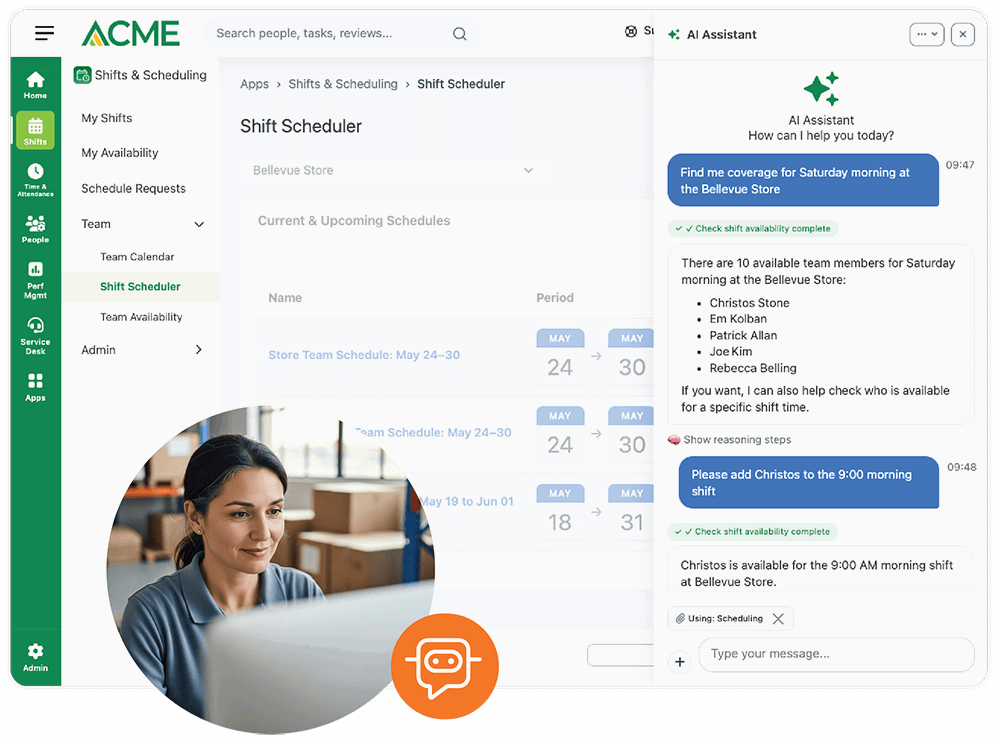
The Scheduling Agent analyzes coverage needs, availability, certifications, and history to generate a data-backed draft, so a manager never starts from a blank slate. It watches for coverage dropping below set thresholds and alerts the manager with time to act before shifts begin. And it weights preferences, seniority, and past schedules to distribute desirable and undesirable shifts fairly, which is the part managers can rarely do consistently by hand.

The Attendance Agent flags and routes late arrivals, missed punches, and unexpected absences to the responsible manager the moment they happen, not at the end of the shift. It tracks behavioral trends like escalating tardiness, so managers can act on a pattern instead of reacting to a crisis, and it routes unresolved issues through custom escalation paths by severity.

The Timekeeping Agent flags punch errors, approaching overtime thresholds, and pay-rate discrepancies before data export, so corrections happen before payroll runs rather than after. It applies configured labor rules, overtime, mandatory breaks, certification-based pay rates, to every record, and it surfaces only the records that need human attention, so managers review exceptions instead of auditing clean data.
The part that matters: autonomy is a setting
None of this means handing control to a model. For each agent, you decide how far it goes on its own, along a clear spectrum: observe only, suggest, approve, or run automatically. A cautious rollout starts an agent in observe-only or suggest mode, watches how its recommendations land, and promotes it to approve or automatic once it has earned the trust. Autonomy is a configuration you own, per agent, not a property baked into the product. That is what lets a regulated operation adopt agents without betting the schedule on them.
Governed by default, because it runs where the work runs
For a technical buyer, the agents are only as trustworthy as the foundation they run on. Here every capability and every agent inherits one governed foundation. Each respects the calling user's permissions and cannot surface anything that person could not already see. Your data stays inside your boundaries and never trains public models. Every action an agent takes is logged and reviewable. And model choice is a setting, not a re-platform: you choose OpenAI, Anthropic, or Gemini, with automatic failover, so provider strategy stays in your hands. A bolted-on chatbot cannot make these claims, because it does not sit on the same identity, data, and permission model as the work it would need to act on.

That is the real reason the platform question comes before the AI question. Agents that act safely are only possible when identity, data, permissions, and workflows already live in one place.
See the full picture: the AI section is one part of AI Scheduling for Shift-Based Teams, which lays out the five gaps a connected platform closes and the proof behind each.
Where MangoApps Fits
MangoApps is the Enterprise Workforce Platform Built for the Frontline, and its AI runs inside the same platform as scheduling, time, attendance, and leave. That is why the Scheduling, Attendance, and Timekeeping agents can take real action across the shift cycle rather than answer questions about it, and why every action stays inside your permissions, your data boundaries, and your audit logs. More than 20 AI capabilities and 80 specialist agents run in production today across the platform, all on one governed foundation, with provider choice built in.

Governed AI still only helps if the workforce uses the system underneath it, which is why the platform lives on the phone employees already carry, reaching 90%+ adoption within 90 days. The security foundation, HITRUST, SOC 2 Type II, and ISO 27001 held together, is the same one the agents inherit.
Evaluate the AI on whether it can act and whether it stays governed. On the frontline, both answers depend on the platform underneath.
See governed agents in action: we'll walk through the three agents, their autonomy settings, and the governance model. Schedule a call →
Keep reading
The MangoApps Team
We're the product, research, and strategy team behind MangoApps — the unified frontline workforce management platform and employee communication and engagement suite trusted by organizations in healthcare, manufacturing, retail, hospitality, and the public sector to connect every employee — deskless or desk-based — to the people, tools, and information they need.
We write about enterprise AI for the workplace, internal communications, AI-powered intranets, workforce management, and the operating patterns behind highly engaged frontline teams. Our perspective is grounded in a decade of building for frontline-heavy industries and shipping AI agents, employee apps, and integrated HR workflows that real employees actually use.
For short-form takes, product news, and field notes from customer rollouts, follow Frontline Wire — our ongoing stream on AI, frontline work, and the modern digital workplace — or learn more about MangoApps.


