
Ask a VP of Talent Acquisition what their biggest problem is and the first answer is usually about process. Time-to-fill has crept up. Offer acceptance slipped last quarter. The candidate experience is not where it should be.
Push a little further and the answer changes. The tools do not talk to each other. Candidate data lives in three places. Every hire takes manual coordination that nobody has time for and everybody does anyway.
Those are not two problems. They are the same problem described from two vantage points, and the second description is the accurate one. The core challenge in most recruiting organizations is not sourcing, not compensation, not even the labor market. It is infrastructure.
Every Tool in the Stack Was a Good Decision
Here is the part that gets left out of the vendor pitch: nobody built this stack carelessly.
The applicant tracking system was not producing enough qualified applicants, so a sourcing tool went in. Manual scheduling was eating a coordinator's week, so a scheduling app went in. Offers were slow, so an offer platform went in. Background checks needed to move faster, so a vendor got integrated, or half-integrated, or integrated in a way that works as long as one person remembers to export the file.
Each decision was defensible. Each vendor made a compelling case. Each purchase closed a real gap that was costing real money at the time.
That is what makes fragmentation so hard to see from inside. It does not arrive as one bad choice. It accumulates as a series of good ones.
The Bill Arrives as Coordination

What the stack produces is not a broken process. Broken would be easier to fix. What it produces is a process that works, as long as people hold it together by hand.
68% of companies operate with disconnected HR systems, and the inefficiency compounds every time a process crosses a system boundary (according to Ignite HCM). In recruiting, those boundaries are everywhere: a requisition approved in a spreadsheet, a description drafted in a doc, a req opened in the ATS, resumes reviewed in one place, interviews scheduled by email, feedback that may or may not make it back, an offer built from a template and approved in a chat thread, a background check ordered in a separate portal, and a new hire re-created from scratch by a team that never saw the candidate.
Count the logins and the number is usually four to six to move one candidate from application to offer. That coordination adds no value to the organization and no quality to the candidate experience. It is pure overhead, paid in the hours of the people you hired for their judgment.
The recruiter's day tells the story better than any dashboard. Most people go into recruiting because they are good with people: reading someone, drawing out what they can actually do, matching them to work where they will be good at it. Then the hours go to copying a candidate from one system into another, chasing an approval, reconciling two calendars, and re-keying a resume that already said everything.
That is not a talent problem. It is a wiring problem.
Get the complete playbook: End-to-End Talent Acquisition: The Modern Recruiting Playbook maps how a fragmented recruiting stack gets built one defensible decision at a time, and what changes when every step reads and writes the same record.
The Candidate Feels the Seams You Think Are Invisible
Internally, fragmentation reads as inefficiency. Externally, it reads as character.
A candidate moving through five systems gets five tones of voice, five kinds of confirmation email, and five different implied answers to the question "what kind of company is this." Then they accept, and the curated part ends. The ATS updates. HR re-creates the record. A separate platform triggers. IT gets a ticket. Day one arrives as a laptop that is not ready, a benefits portal nobody mentioned, and a manager who has been in meetings all week.

By the end of month one, a person you worked hard to win is quietly re-evaluating whether they read the company right. In a market where 51% of U.S. employees are already watching or seeking new jobs (according to Gallup), that quiet re-evaluation is expensive. Replacing a frontline or hourly worker runs roughly 40% of annual salary, and replacing a manager runs close to 200% (according to Gallup).
The stack did not intend any of this. It simply had no way to know what the other systems were doing.
Digitizing Each Step Is Not the Same as Connecting Them
The instinct at this point is to look for a better tool for the worst step. It is the wrong instinct, and it is the reason the stack got built in the first place.
Every point tool in recruiting was designed to solve one stage in isolation. They mostly do that well. What they do not do is share a data model, carry context between stages, or produce a report that spans the whole funnel. Adding a better one adds another boundary.
The productive question is not which step to upgrade. It is what changes when every step reads and writes the same record.
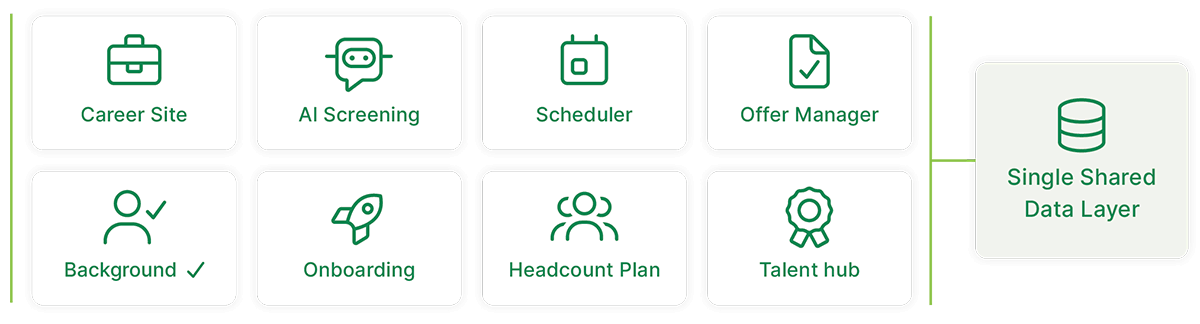
The answer is specific and mostly unglamorous. A posting feeds screening. A candidate moved to offer arrives with no re-entry. A signed offer starts onboarding on its own, provisions access, queues required training, and puts the new hire in the directory before anyone messages IT. A 90-day retention rate shows up next to the sourcing channel that produced the hire, because both facts live on the same record.
Nothing there is exotic. It is the difference between a platform designed as one system and a set of tools that share a login page.
Where MangoApps Fits
MangoApps built its Talent Acquisition Suite on a single data layer rather than assembling it from acquisitions. Eight capabilities, from career site and screening through interview scheduling, offers, background checks, and onboarding, run on the same underlying record, which is why a signature can trigger provisioning without a handoff.

Unified does not mean rigid, which is usually the next worry. Forms, fields, screening rules, approval chains, and the workflow itself are configurable without code. The requirements teams assume are too unusual for off-the-shelf software, internal versus external candidate pooling, priority funnels, group interviews for high-volume hiring, are setup options rather than exceptions.
It also does not mean starting over. Most organizations begin with keep and connect: the HRIS, payroll, and identity systems stay where they are, MangoApps connects through pre-built connectors and an open API across Workday, SAP SuccessFactors, UKG, ADP, BambooHR, and 200+ other systems, and the biggest gap gets closed first. Migration, if it ever happens, happens on your timeline.
The proof worth asking about is adoption, not architecture diagrams. MangoApps has been building for the frontline for 15+ years, runs 2M+ users, keeps 98% of its customers, and typically reaches 90%+ adoption within 90 days of launch. The Adoption Guarantee is the version of that claim with money behind it: if employees do not adopt after launch, you do not pay.
The Question Worth Asking at Your Next Stack Review
Not "which tool should we replace." Try this one instead: how many systems does one candidate touch between applying and their first day, and how many of them know that the others exist?
If the number is higher than two, fragmentation is already costing you candidates. It just is not showing up on a line item.
Start with the playbook. End-to-End Talent Acquisition: The Modern Recruiting Playbook covers the four transitions, the cost of each one, and the questions to ask any vendor. When you want it walked against your own job descriptions and approval chains, schedule a call.
Keep reading
The MangoApps Team
We're the product, research, and strategy team behind MangoApps — the unified frontline workforce management platform and employee communication and engagement suite trusted by organizations in healthcare, manufacturing, retail, hospitality, and the public sector to connect every employee — deskless or desk-based — to the people, tools, and information they need.
We write about enterprise AI for the workplace, internal communications, AI-powered intranets, workforce management, and the operating patterns behind highly engaged frontline teams. Our perspective is grounded in a decade of building for frontline-heavy industries and shipping AI agents, employee apps, and integrated HR workflows that real employees actually use.
For short-form takes, product news, and field notes from customer rollouts, follow Frontline Wire — our ongoing stream on AI, frontline work, and the modern digital workplace — or learn more about MangoApps.


