
Quick answer: Recruiting rarely fails in the middle of a stage. It fails in the four handoffs between them, where data stops moving and people start re-entering it: requisition to posting, screening to interview, interview to offer, and offer to onboarding. Each transition costs days, each day is an opening for a competing offer, and the cause is the same in all four, which is a process stitched together from systems that do not share data.

The failure is in the seams, not the stages
Most recruiting teams are good at the stages. They write solid job descriptions, run structured interviews, and make competitive offers. Diagnostic energy goes into the stages too: better sourcing, tighter screening criteria, faster decision-making.
Then the same delays keep happening, which is the signal that the stages are not the problem.
Recruiting breaks at the transitions. That is where a candidate stops being one record and becomes several, where context has to be carried by a person instead of a system, and where the elapsed time nobody owns quietly accumulates. Four transitions, each with its own failure mode.
Transition one: requisition to posting, where speed is lost before the search starts
Before a listing goes live, there are usually three handoffs. Headcount gets approved in a spreadsheet. The description gets drafted in a doc, often from the last version of a similar role. The requisition gets opened in the applicant tracking system, with somebody re-typing what the first two documents already said.
None of those steps is difficult. Together they take days, and those days are pure loss, because a competitor's posting for the same role is already collecting applicants. In a market where 51% of U.S. employees are actively watching or seeking new jobs (according to Gallup), the strongest candidates are engaged somewhere else before a fragmented process even opens the req.
Transition two: screening to interview, where you lose candidates to the calendar
This is the transition with the highest candidate-visible cost, and it is almost entirely administrative.
Resumes get reviewed in one system. Interviews get scheduled by email, across two or three interviewers with real calendars and occasionally different time zones. Feedback gets given verbally, in a hallway, or in a thread, and may never make it back to the candidate record at all.
The fastest-moving candidates are the ones with the most competing offers, which makes every day of back-and-forth an opening for someone else. A single lost finalist for a manager-level role can represent up to 200% of annual salary in eventual replacement cost (according to Gallup). The scheduling loop is not an admin inconvenience. It is a competitive event.
Transition three: interview to offer, where a week is enough to lose them
The offer sequence is where the number of systems peaks. An offer letter built from a template. Compensation reviewed by email. Approval given in chat. Signature routed through a separate e-signature vendor. Status tracked on a spreadsheet that one person maintains.
A week can pass this way, and that week is exactly when a strong candidate develops second thoughts and a faster competitor closes. Nothing in that sequence is wrong on its own. The problem is that no part of it knows the state of any other part, so "where is the offer" is a question that requires a human to answer.
Transition four: offer to onboarding, where the experience turns bureaucratic

This is the largest break and the least discussed, because two teams and two systems meet here and both consider the handoff to be the other team's beginning.
The moment a candidate says yes, the curated experience stops. The ATS updates. HR re-creates the record from the offer letter. A separate onboarding platform triggers, or gets triggered manually. IT receives a ticket. The new hire receives paperwork, which most organizations deliver instead of onboarding: a stack of forms before day one, a welcome email with twelve links, and a three-hour orientation that leaves them to figure out the rest.
The cost shows up in month one and gets attributed to fit. It is not fit. Strong onboarding produces 50% higher retention, a 62% productivity increase, and 69% of employees likely to stay (HBR 2022; Clickboarding 2020). The gap between what onboarding can do and what most programs deliver is large, and it is mostly a technology problem.
Get the complete playbook: End-to-End Talent Acquisition: The Modern Recruiting Playbook covers all four transitions in full, with the cost of each one and a four-step self-assessment for finding the transition costing you most.
What the four transitions have in common
None of these needs a catastrophe to add up. They compound through ordinary moments: a req that sat three days in a spreadsheet, a finalist who took a faster offer, an onboarding that was a stack of forms.
The cause is identical in all four. A process assembled from systems that do not share data has to be held together by people, and people hold it together at the speed of email. So the fix is identical too. Not a better tool for the worst transition. One data layer underneath all of them.
How to tell which transition is costing you most

You do not need a consulting engagement to find out. Four steps, in order.
- Count the systems a candidate touches from application to day one. This single number says more than any time-to-fill report. If it is higher than two, fragmentation is already costing you candidates.
- Find where the data actually breaks. Map sourcing through 90-day retention and look for the re-entry points. The break is usually ATS data never reaching onboarding, or offer details re-keyed into HR.
- Assess the candidate experience, not the recruiter experience. Walk the path as the candidate: does communication feel like one company, and does offer-to-onboarding feel coherent or feel like a transfer?
- Evaluate platforms that connect rather than digitize. The question is not which step could be faster in isolation. It is what changes when every step reads and writes the same record.
Step one is the diagnostic. Steps two through four are what you do with the answer.
Where MangoApps fits
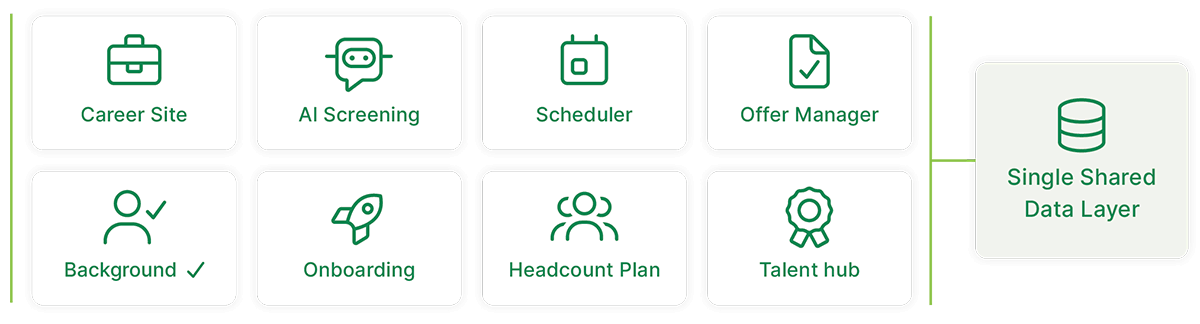
MangoApps built the Talent Acquisition Suite as one system rather than a set of connected tools, which is what makes the transitions disappear rather than get faster. A posting feeds screening. A candidate moved to offer arrives without re-entry. A signed offer triggers onboarding, provisions access, queues required training, and adds the new hire to the directory. Source, offer, onboarding status, and 90-day retention all sit on one record, so full-funnel reporting is a query rather than a project.
It works alongside what you already run. MangoApps connects to Workday, SAP SuccessFactors, UKG, ADP, BambooHR, and 200+ other systems through pre-built connectors and an open API, so the usual starting point is closing the biggest gap, not replacing the stack.
MangoApps has built for the frontline for 15+ years, serves 2M+ users, retains 98% of customers, and typically sees 90%+ adoption within 90 days of launch, backed by the Adoption Guarantee: if employees do not adopt after launch, you do not pay.
Frequently asked questions
Why do recruiting delays cluster at handoffs rather than inside stages?
Because stages have owners and handoffs do not. Inside a stage, one team is accountable for the work and the tooling supports it. At a handoff, the data has to move between systems that were bought separately, so it moves when a person moves it. Elapsed time at a handoff belongs to nobody, which is why it rarely appears in a time-to-fill breakdown.
How many systems should a candidate touch between applying and day one?
Ideally one, realistically two. Once the count reaches four to six, which is common, every stage transition becomes a manual coordination task and reporting can no longer span the funnel.
Is the offer-to-onboarding break really a technology problem rather than a process problem?
Mostly technology. The process design is usually fine on paper. What fails is that acceptance in one system cannot start work in another, so a human has to re-create the hire. When a signature triggers provisioning, document collection, training assignment, and directory access automatically, the same process produces a completely different first week.
What should we measure to know whether the transitions are improving?
Track time inside each transition separately rather than one end-to-end number, and pair it with two outcome measures: offer acceptance rate and 90-day retention by sourcing channel. Time-to-fill tells you that something is slow. Transition-level timing tells you where.
Start with the playbook. End-to-End Talent Acquisition: The Modern Recruiting Playbook is the full version of the argument above. When you want your own two worst handoffs mapped against one shared data layer, schedule a call.
Keep reading
The MangoApps Team
We're the product, research, and strategy team behind MangoApps — the unified frontline workforce management platform and employee communication and engagement suite trusted by organizations in healthcare, manufacturing, retail, hospitality, and the public sector to connect every employee — deskless or desk-based — to the people, tools, and information they need.
We write about enterprise AI for the workplace, internal communications, AI-powered intranets, workforce management, and the operating patterns behind highly engaged frontline teams. Our perspective is grounded in a decade of building for frontline-heavy industries and shipping AI agents, employee apps, and integrated HR workflows that real employees actually use.
For short-form takes, product news, and field notes from customer rollouts, follow Frontline Wire — our ongoing stream on AI, frontline work, and the modern digital workplace — or learn more about MangoApps.


