
The questions that matter in a scheduling evaluation are not about features. Every vendor's feature list looks similar in a demo. The questions that separate a platform that will still serve you in three years from one more system you rip out are about architecture: is it one shared data model or API-stitched modules, does it reach the frontline on the phone they already carry, does the AI act or only answer, is compliance applied at build time, and can you start small and expand without a second implementation. Ask those, of every vendor, including the one you already like.
Use the list below in your own evaluation. It is written to surface the decisions a demo hides.
Architecture
The single most consequential question, because it determines everything downstream. Ask: is this one shared data model, or separate modules connected by APIs? When an approved swap happens, does coverage update everywhere instantly, or does a sync have to run? API-stitched modules drift out of step, and the drift is exactly where coverage gaps and payroll errors come from.
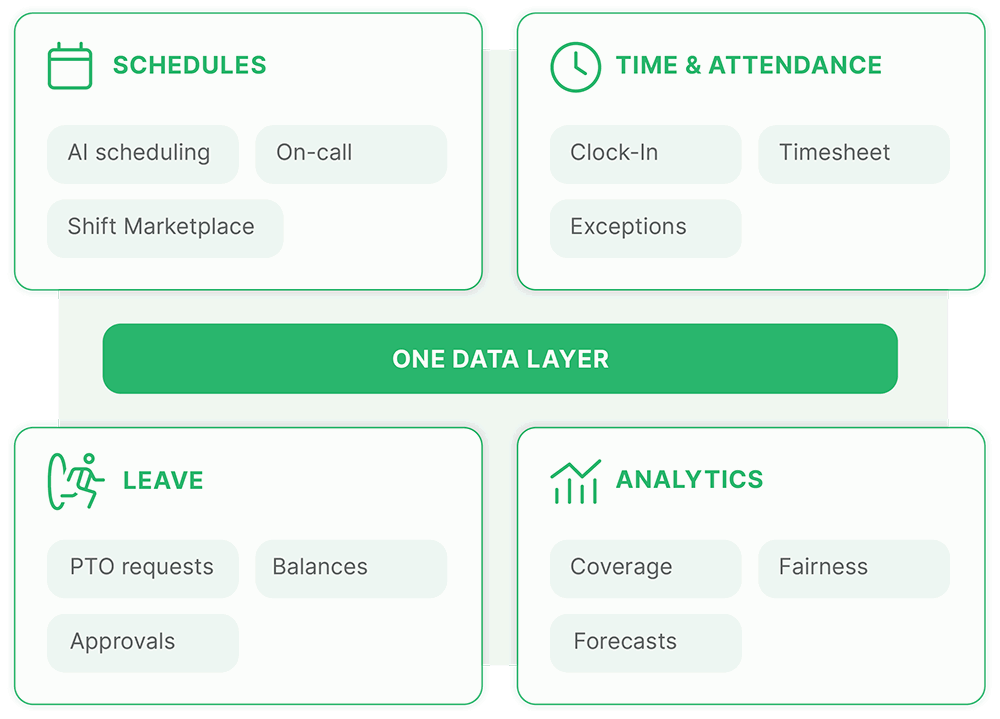
Then ask: when you add a capability later, is it a configuration on the platform you already own, or a new implementation? The answer tells you what expansion will actually cost you.
Frontline access
A scheduling tool the frontline won't open produces incomplete data, and incomplete data makes every dashboard a guess. Ask: does it work for employees with no corporate email, no company device, and no VPN, on the phone they already carry? And ask for a number: what is the actual adoption rate within 90 days, and what causes it? A vendor who can't answer the second question hasn't solved the first.

AI
AI is on every vendor's slide, so the question is what kind. Ask: does the AI run on your own operational data and permissions, or is it a generic model bolted on top? And the sharper one: can the AI take governed action, like surfacing eligible coverage and flagging exceptions, or can it only answer questions?

A chatbot that answers is not the same as an agent that acts, and only one of them takes work off your managers.
Compliance
In regulated and unionized work, this question has a cost attached to the wrong answer. Ask: are labor law, union rules, and certification requirements applied while the schedule is being built, or audited after the fact?

And: is every scheduling and timekeeping action logged and shareable with auditors or union stewards? Build-time enforcement prevents violations. After-the-fact auditing only discovers them.
Payroll
The handoff is where hours quietly turn into money. Ask: do reviewed, multi-rate hours export clean into payroll, or do exceptions get discovered after the run? Exceptions caught before export are corrections. Exceptions caught after are overpayments.

Expansion and security
Two final questions. On expansion: can you start with one gap in one location, or does the vendor require an all-at-once rollout? A platform confident in its adoption lets you start small. On security: does it hold HITRUST, SOC 2 Type II, and ISO 27001 together, with the deployment model your environment requires? Attendance and labor data deserve the same posture as financial data.

Score your shortlist
Turn the questions into a scorecard. Rate each platform you are evaluating from 1 (no) to 5 (yes, fully) on each row: one shared data model, expansion as configuration, frontline access with no corporate email or device, 90%+ adoption within 90 days, AI that runs on your data, AI that acts rather than only answers, compliance at build time, every action logged and audit-shareable, clean multi-rate payroll export, and security certifications.

A platform built on one data model, for the frontline, with AI grounded in your work, scores high across every row. A stack of point tools cannot, and the pattern of low scores clusters exactly where the architecture is stitched rather than shared.
Get the full checklist: the vendor questions and the scorecard come from AI Scheduling for Shift-Based Teams, alongside the five gaps and the cost model.
Where MangoApps Fits
MangoApps is the Enterprise Workforce Platform Built for the Frontline, and it is built to answer yes to every question above, which is why the list is worth running on it too. One shared data model, not API-stitched modules. Expansion as configuration, not re-implementation. Frontline access on the phone employees already carry, with 90%+ adoption within 90 days. AI that runs on your data and permissions and takes governed action through the Scheduling, Attendance, and Timekeeping agents. Compliance applied at build time and logged by default. Clean multi-rate payroll export. And HITRUST, SOC 2 Type II, and ISO 27001 held together, which no other unified employee platform does. AI is proof the architecture is right, not the headline.
The questions matter because the architecture they expose is the thing you actually live with. Ask them of everyone, and let the answers, not the demo, decide.
Run the scorecard with us: we'll score your shortlist against the ten criteria, including this platform. Schedule a call →
Keep reading
The MangoApps Team
We're the product, research, and strategy team behind MangoApps — the unified frontline workforce management platform and employee communication and engagement suite trusted by organizations in healthcare, manufacturing, retail, hospitality, and the public sector to connect every employee — deskless or desk-based — to the people, tools, and information they need.
We write about enterprise AI for the workplace, internal communications, AI-powered intranets, workforce management, and the operating patterns behind highly engaged frontline teams. Our perspective is grounded in a decade of building for frontline-heavy industries and shipping AI agents, employee apps, and integrated HR workflows that real employees actually use.
For short-form takes, product news, and field notes from customer rollouts, follow Frontline Wire — our ongoing stream on AI, frontline work, and the modern digital workplace — or learn more about MangoApps.


