
Almost every frontline operational failure - a coverage gap, an overtime surprise, a payroll error, a resignation - traces to one of five information gaps: the schedule doesn't reflect reality, time off and availability live apart from the schedule, hours get reconciled by hand after the fact, the coordination tax of moving between systems, and no real-time visibility. They are not five separate problems. They are the symptoms of a workforce asked to operate without the information infrastructure it needs.
Pull on any failure and you find the same root. The shift nobody covered, the overtime nobody caught, the good employee who quietly left: the manager didn't have the information the moment they needed it, because it lived somewhere else, or nowhere. Here is each gap, and a way to tell how many are open in your own operation.

Gap 1: The schedule doesn't reflect reality, and employees know it
Built by hand across availability, certifications, demand, labor law, and fairness, schedules run late, miss credentials, and distribute shifts unevenly. Employees feel it first, and they respond the way people respond to a schedule they can't trust: they disengage, then they leave. Around thirty scheduling disruptions in a year make an employee twenty percent more likely to quit (M&SOM, 2023).
Gap 2: Time off and availability live apart from the schedule
Requests arrive by text, email, and spreadsheet, get approved in one place and forgotten in another. The posted schedule rarely reflects who is actually available, so coverage gaps appear by surprise, from information that existed the whole time in a channel the schedule couldn't see.
Gap 3: Hours get reconciled by hand, after the fact
Missed punches, attendance exceptions, and creeping overtime show up in payroll data weeks after the shift, when the only thing left to do is correct them. By the time the number is visible, the money is already spent.
Gap 4: The coordination tax
Brokering swaps, chasing exceptions, and re-entering data across five to seven disconnected systems consumes the hours managers should spend on the actual job. It rarely appears as a line item. It appears as the manager who never has time to manage.
Gap 5: No real-time visibility
Operations leaders manage on yesterday's attendance and last week's coverage numbers. Decisions made on information that is twenty-four hours behind or more are reactive by definition. You can't get ahead of a problem you can only see after it happened.
Score your own operation
The gaps are not abstractions. They show up as overtime you didn't plan, coverage you didn't see coming, and hours spent reconciling instead of managing. Mark each row honestly.

-
Gap 1, the schedule. When it publishes, does it already reflect real availability and current certifications, or do you correct it after someone doesn't show? (Reflects reality at publish ←→ Corrected after the fact)
-
Gap 2, leave and availability. Do approved time off and availability changes flow into the posted schedule automatically, or live in email, text, and a spreadsheet? (Flows in automatically ←→ Tracked separately by hand)
-
Gap 3, attendance. Do exceptions reach you before payroll runs, or after, when all you can do is correct them? (Caught before payroll ←→ Surfaces weeks later)
-
Gap 4, the coordination tax. How many separate systems does a manager touch to get through one shift cycle, schedule to payroll? (One or two ←→ Five to seven)
-
Gap 5, visibility. Are coverage and labor decisions made on real-time data, or on yesterday's attendance and last week's numbers? (Real time ←→ 24 hours behind or more)
How to read your score:
-
0 to 1 gaps open. Tuned. Your infrastructure is doing the coordination. The work now is keeping it that way as you scale.
-
2 to 3 gaps open. Quietly leaking cost. The operation runs, but overtime, turnover, and manager hours are draining through gaps you can close. This is the most common score, and the most expensive one to leave alone.
-
4 to 5 gaps open. Running on intuition. Your managers are absorbing the work the system should be doing. Every number you are measured on, coverage, overtime, retention, is being set by tools that were never built for the job.
Wherever you land, the gaps are closable, and you do not have to close all five at once. Start with the one eating the most of your managers' week.
Get the complete playbook: AI Scheduling for Shift-Based Teams covers all five gaps, what leaving them open costs, and what closing them looks like, in one place.
Where MangoApps Fits
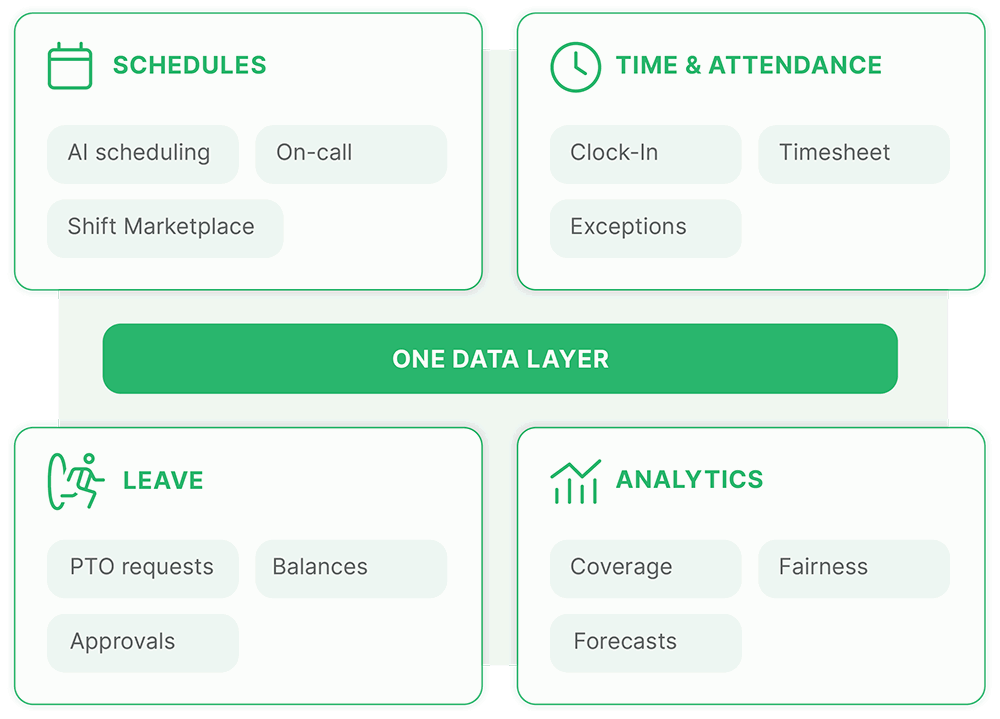
MangoApps is the Enterprise Workforce Platform Built for the Frontline, and Shifts & Schedules closes all five gaps the same way: by putting scheduling, time and attendance, leave, and analytics on one shared data layer instead of five disconnected systems. Availability and certifications are known at build time, approved leave updates the schedule automatically, exceptions surface before payroll, and leaders see real-time coverage and labor cost instead of yesterday's. Because the data is connected, the Scheduling, Attendance, and Timekeeping agents can act on it, filling coverage, routing exceptions, and cleaning timesheets before payroll runs. AI here is proof the platform matters, not the pitch.
None of it works if the frontline won't use it, which is why it lives on the phone employees already carry, with no corporate email or company device required. That is how MangoApps reaches 90%+ adoption within 90 days, on an 8-to-12-week implementation with a dedicated CSM from day one.
Frequently asked questions
What causes most frontline scheduling problems?
Most scheduling failures trace to fragmented information rather than bad managers: schedules built without live availability or certification data, time off tracked separately from the schedule, attendance reconciled after payroll, too many disconnected systems, and no real-time visibility. When the data is scattered, managers coordinate by hand and problems surface too late to prevent.
How many systems does a frontline manager actually use?
A typical frontline manager touches five to seven disconnected systems to get through one shift cycle, from building the schedule to handing hours to payroll (MangoApps). The switching itself, re-entering and reconciling across those systems, is what the coordination tax measures.
How do you fix scheduling problems without replacing everything?
You don't have to. Start with the single gap eating the most manager time, connect the systems you already run onto a shared data layer, and expand when ready. Closing one gap well beats a big-bang replacement.
Does this work for employees without a corporate email or company device?
Yes. The platform reaches frontline employees on the personal phone they already carry, onboarded by SMS invite or a QR code at the location, which is what makes adoption hold across the whole workforce rather than just the office.
Keep reading
Score your operation with us: we'll run the five-gap assessment against your real shift cycle. Schedule a call →
The MangoApps Team
We're the product, research, and strategy team behind MangoApps — the unified frontline workforce management platform and employee communication and engagement suite trusted by organizations in healthcare, manufacturing, retail, hospitality, and the public sector to connect every employee — deskless or desk-based — to the people, tools, and information they need.
We write about enterprise AI for the workplace, internal communications, AI-powered intranets, workforce management, and the operating patterns behind highly engaged frontline teams. Our perspective is grounded in a decade of building for frontline-heavy industries and shipping AI agents, employee apps, and integrated HR workflows that real employees actually use.
For short-form takes, product news, and field notes from customer rollouts, follow Frontline Wire — our ongoing stream on AI, frontline work, and the modern digital workplace — or learn more about MangoApps.


