
There is a cost in every frontline operation that never appears on a budget, because no one issues an invoice for it. It is the tax a manager pays to move between systems. A typical frontline manager touches five to seven disconnected systems to get through a single shift cycle, from building the schedule to handing hours to payroll. Each one holds a piece of the picture and none of them talk to each other, so the manager becomes the integration layer, carrying data by hand from the scheduling tool to the availability spreadsheet to the timekeeping platform to payroll. That carrying is the coordination tax, and it is almost certainly the most expensive line item your operation doesn't track.
What the Tax Actually Buys You
Nothing. That is the point. The hours a manager spends brokering swaps over text, chasing an exception across two platforms, and re-entering the same names and numbers into a fourth system produce no coverage, no fairness, no cleaner payroll. They are pure friction, the price of systems that were each built to solve one piece well without any regard for the pieces around them.

Every minute of it is a minute not spent on the parts of the job that require a human: coaching, spotting problems early, being present on the floor. The tax is not just wasted time. It is the manager's actual work, crowded out.
Why It Compounds Instead of Adding Up
If the coordination tax were merely additive, you could budget around it. The trouble is that it compounds. Each new point solution added to the stack has to be reconciled against all the others, so the friction grows faster than the tool count. Add a standalone leave tracker and now leave has to be manually reconciled against the schedule and against timekeeping. Add a separate certification spreadsheet and every schedule build has to be cross-checked against it. The organization keeps buying tools to fix pieces of the problem and keeps making the coordination worse, because the problem was never the individual pieces. It was that they were separate.
This is also why the usual fix, buy a better version of one of the systems, doesn't help. A better scheduling tool that still doesn't know your certification data or your leave approvals is a faster way to produce a schedule you still have to reconcile by hand. The tax lives in the gaps between systems, so no single system can remove it.
The Only Thing That Removes It
The coordination tax comes off exactly one way: by putting the pieces on a shared data layer so there are no gaps to carry data across. One identity model. One permission structure. One employee record that scheduling, time, attendance, and leave all read from and write to. When availability, certifications, overtime impact, and approved leave live in the same place the schedule is built, the reconciliation the manager used to do simply has nowhere to happen. It isn't automated. It is eliminated, because the data never has to move between systems in the first place.
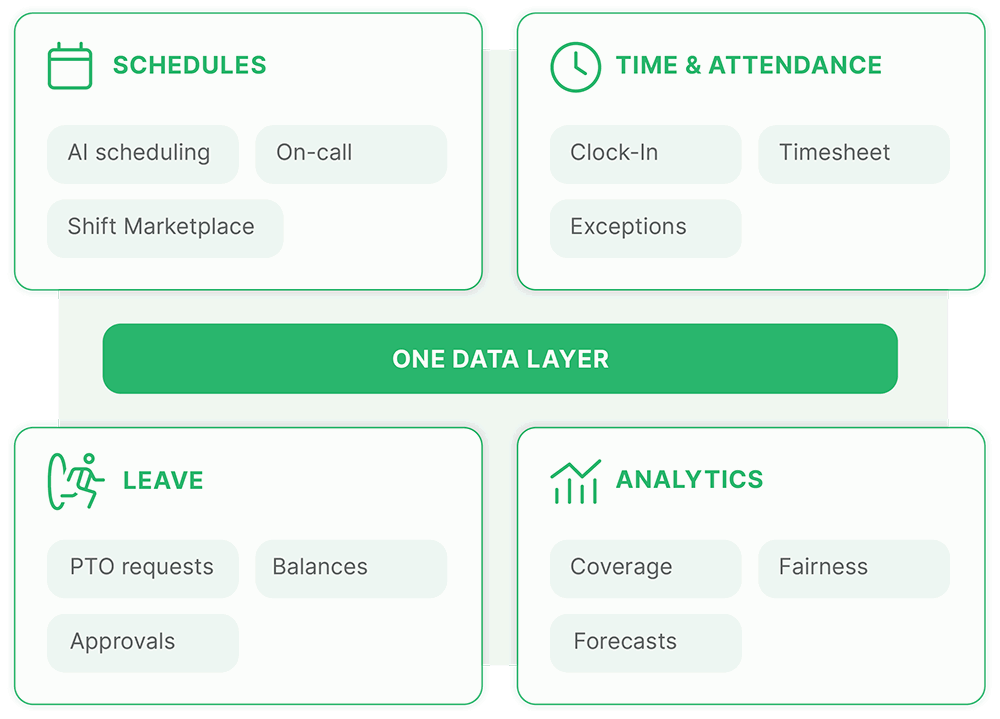
And here is the part that inverts the usual math. On a shared data layer, adding a capability lowers the tax instead of raising it, because every new workflow inherits the same identity, permissions, and employee record rather than needing to be wired to everything else. The integration burden goes down with each addition, not up. That is the opposite of what a stack of point solutions does, and it is the whole argument for consolidation over accumulation.
The Tax You Stop Paying
Think about what a manager does with the hours the tax was taking. Not more administration. The floor. The team. The problem caught before it became a coverage gap. The coordination tax is worth naming precisely because once you see it as a tax, the question stops being "which tool is best" and becomes "how many systems is my management layer being forced to reconcile by hand, and what is that costing me every week." For most multi-site operations, the answer is a full operating cost hiding in plain sight.
Read the whole argument: the coordination tax is one of five gaps in AI Scheduling for Shift-Based Teams, with the cost model and the customer proof for each.
Where MangoApps Fits
MangoApps is the Enterprise Workforce Platform Built for the Frontline, and it is built on the one thing that removes the coordination tax: a single shared data layer. In Shifts & Schedules, scheduling, time and attendance, leave, and analytics all read from and write to one employee record, so the reconciliation between systems has nowhere left to live. You can keep the systems you already depend on, too. With 200+ integrations, an existing scheduling or payroll system feeds the shared layer rather than being replaced, so the rest of the suite reads from your source of truth. Because everything is connected, the Scheduling, Attendance, and Timekeeping agents can act across the whole cycle rather than inside one silo. AI is the proof the platform matters, not the headline.
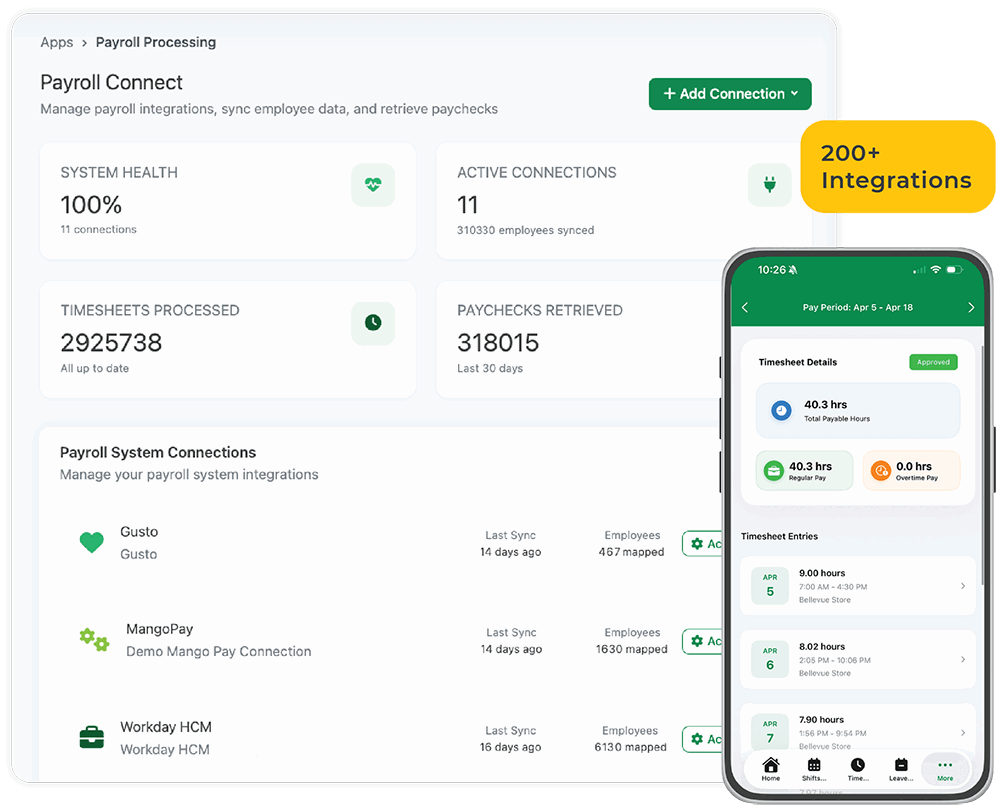
Start with one gap, in one location, and expand when ready. Each capability you turn on inherits the same foundation, so the integration tax keeps going down. It holds because it lives on the phone employees already carry, which is how MangoApps reaches 90%+ adoption within 90 days.
The coordination tax is optional. It is just the default when your systems were never built to share.
Stop paying the coordination tax: we'll map your five-to-seven systems onto one platform. Schedule a call →
Keep reading
The MangoApps Team
We're the product, research, and strategy team behind MangoApps — the unified frontline workforce management platform and employee communication and engagement suite trusted by organizations in healthcare, manufacturing, retail, hospitality, and the public sector to connect every employee — deskless or desk-based — to the people, tools, and information they need.
We write about enterprise AI for the workplace, internal communications, AI-powered intranets, workforce management, and the operating patterns behind highly engaged frontline teams. Our perspective is grounded in a decade of building for frontline-heavy industries and shipping AI agents, employee apps, and integrated HR workflows that real employees actually use.
For short-form takes, product news, and field notes from customer rollouts, follow Frontline Wire — our ongoing stream on AI, frontline work, and the modern digital workplace — or learn more about MangoApps.


