
There is a version of the frontline operations manager's job that exists on paper: build a compliant schedule, keep coverage consistent, track attendance, approve time off, hold labor cost in line. Then there is the version that actually exists. Schedules built in spreadsheets that don't know what certifications anyone holds. Swaps brokered over text and half-approved. Time-off requests that never reach the posted schedule. Attendance exceptions that surface in payroll data three weeks after the shift. The manager's primary source of real-time information is a group text. That gap, between the job on paper and the job in practice, is the whole story, and it plays out the same way every Tuesday.
The Day, As It Actually Runs
6:47 AM. A supervisor opens their phone to three texts: a call-out, a swap request, and a manager asking for coverage numbers. They open a spreadsheet, cross-reference last Tuesday, and start making calls, not sure whether the replacement holds the mandatory forklift certification.
9:30 AM. A swap two employees arranged over text last night still needs to go into the schedule. Was it approved? Does the covering employee have the right certification? Did it just push someone into overtime? Nobody is sure.
11:15 AM. A near-miss on the floor. The supervisor fills out a paper incident form and leaves it for the coordinator to type in tomorrow. Corrective action waits for next week's meeting.
2:00 PM. End of shift. The supervisor cross-references two different timekeeping platforms by hand to fix missing punches and overtime discrepancies, losing an hour to administration.

None of this is a competence problem. It is a tooling problem. A typical frontline manager touches five to seven disconnected systems to get through a single shift cycle, from building the schedule to handing hours to payroll. And schedule volatility isn't free: around thirty scheduling disruptions in a year make an employee twenty percent more likely to quit (M&SOM, 2023). The group text isn't the manager being disorganized. It is the only real-time system they were ever given.
The Same Day, Rebuilt
Same supervisor, same four moments, same Tuesday. The difference is not a better mood or a lighter load. It is that the infrastructure now does the coordination the manager used to do by hand.
6:47 AM. The call-out comes in. Instead of a spreadsheet and a phone tree, the supervisor sees a ranked list of eligible, certified replacements, already sorted by fairness history and overtime impact. The forklift certification is confirmed before the name appears. Coverage is filled in two taps and the schedule updates for everyone at once.
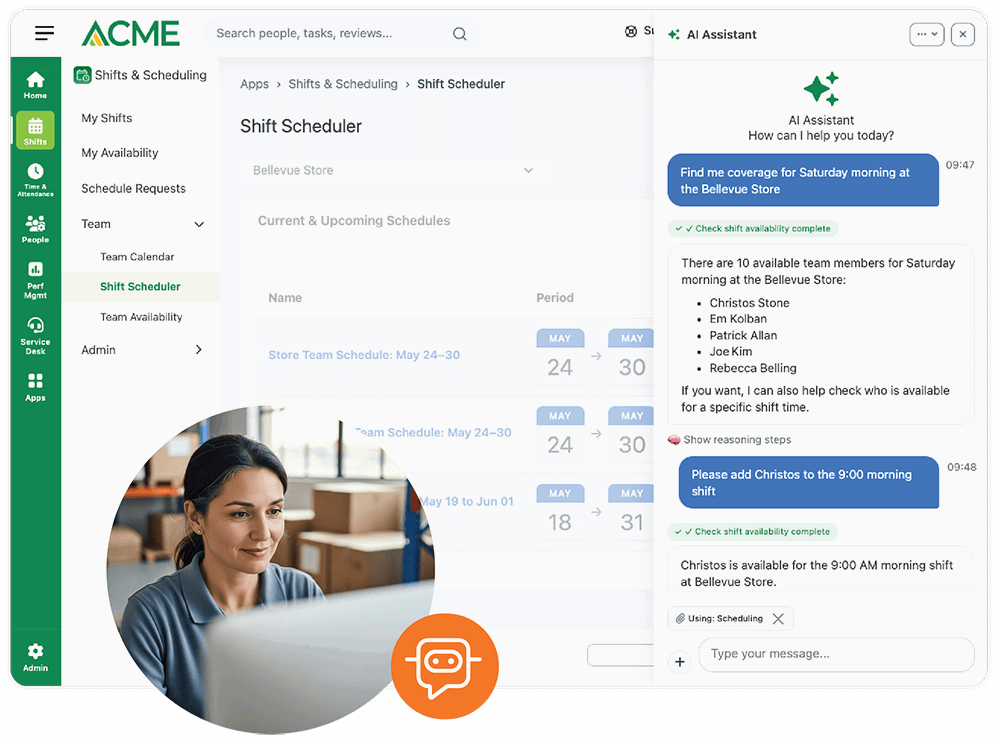
9:30 AM. The swap from last night is not a loose end. It was checked against role, location, and certification rules when it was requested and is already in the published schedule. Nobody got pushed into overtime by accident. No chase, no text chain.
11:15 AM. The near-miss gets logged on the phone at the point of work and routes instantly to the right manager with the shift, employee record, and location attached. The corrective action starts today, not in four days.
2:00 PM. No cross-referencing two platforms. Hours were compiled as they happened, exceptions flagged in real time, and only the records that genuinely need a human decision wait for sign-off. The pay period ends clean.
What Actually Changed
The work didn't get smaller. The coordination moved off the manager. That is the entire difference between the two Tuesdays, and it is why the schedule deserves to be treated as infrastructure rather than a chore someone squeezes in between shifts. When the system knows who is certified, who is available, and what a swap does to overtime before the swap is approved, the manager stops being a human integration layer between five systems and gets to spend the day on the parts of the job that actually require a manager.
The schedule is the most operational document in the building. The question is whether your managers are running it, or running around it.
Read the whole picture: this is one Tuesday. AI Scheduling for Shift-Based Teams lays out the five gaps behind it, the cost model, and the customer proof.
Where MangoApps Fits
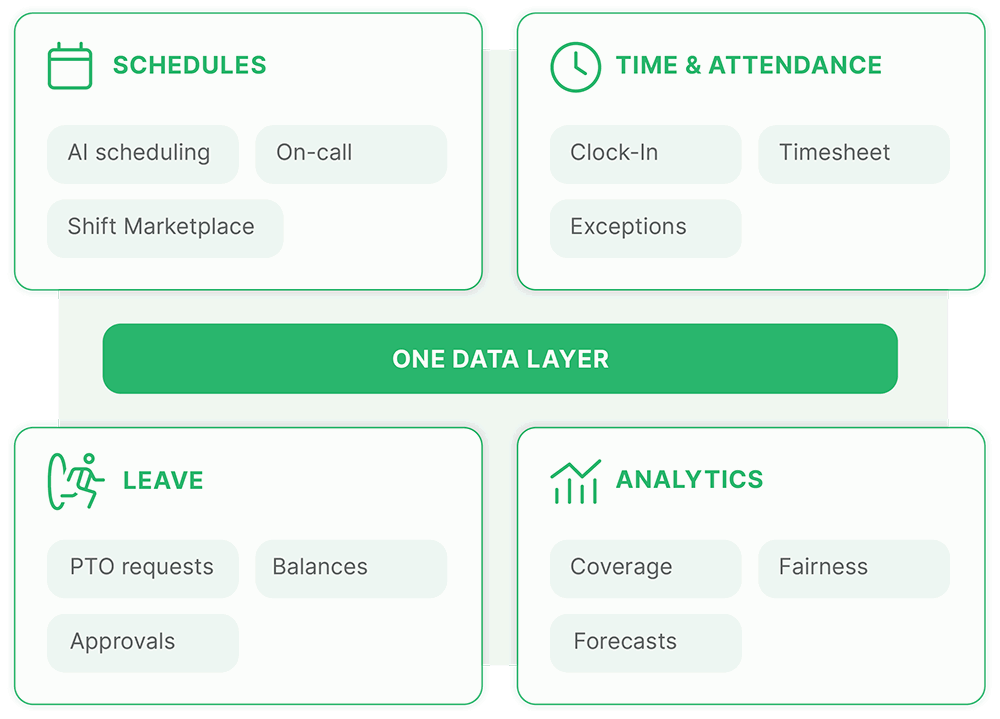
MangoApps is the Enterprise Workforce Platform Built for the Frontline, and Shifts & Schedules gives managers the infrastructure the job always assumed they had. Scheduling, time and attendance, leave, and analytics run on one shared data layer, so availability, certifications, and overtime impact are known at the moment a schedule or a swap is built, not discovered in payroll weeks later. The Scheduling Agent reads that same connected data to surface a ranked, certified, fairness-sorted list of replacements when someone calls out. The AI is not the headline. It is what one data layer makes possible.
The reason it holds on the floor is that it lives on the phone employees already carry, with no separate login, which is why MangoApps reaches 90%+ adoption within 90 days. Implementations run 8 to 12 weeks with a dedicated Customer Success Manager from day one, the same partnership behind 98% customer retention.
The first shift cycle on the platform is calmer than the last one off it, because the system finally does the coordinating.
Trade the group text for infrastructure: we'll map your Tuesday against one connected system. Schedule a call →
Keep reading
The MangoApps Team
We're the product, research, and strategy team behind MangoApps — the unified frontline workforce management platform and employee communication and engagement suite trusted by organizations in healthcare, manufacturing, retail, hospitality, and the public sector to connect every employee — deskless or desk-based — to the people, tools, and information they need.
We write about enterprise AI for the workplace, internal communications, AI-powered intranets, workforce management, and the operating patterns behind highly engaged frontline teams. Our perspective is grounded in a decade of building for frontline-heavy industries and shipping AI agents, employee apps, and integrated HR workflows that real employees actually use.
For short-form takes, product news, and field notes from customer rollouts, follow Frontline Wire — our ongoing stream on AI, frontline work, and the modern digital workplace — or learn more about MangoApps.


