
Quick answer: No. You integrate. If you just invested in UKG, ADP, or Workday, that system stays exactly where it is and becomes your source of truth. MangoApps connects to it through native integration, brings shifts and hours onto a shared data layer, and runs the frontline execution layer on top. Nothing gets ripped out, and you keep the system of record you already paid for. The most common reason to do nothing is the system already in place, so it is worth answering each version of that objection honestly rather than pretending the concern isn't real.
"We just bought UKG. Replacing it is out of the question."
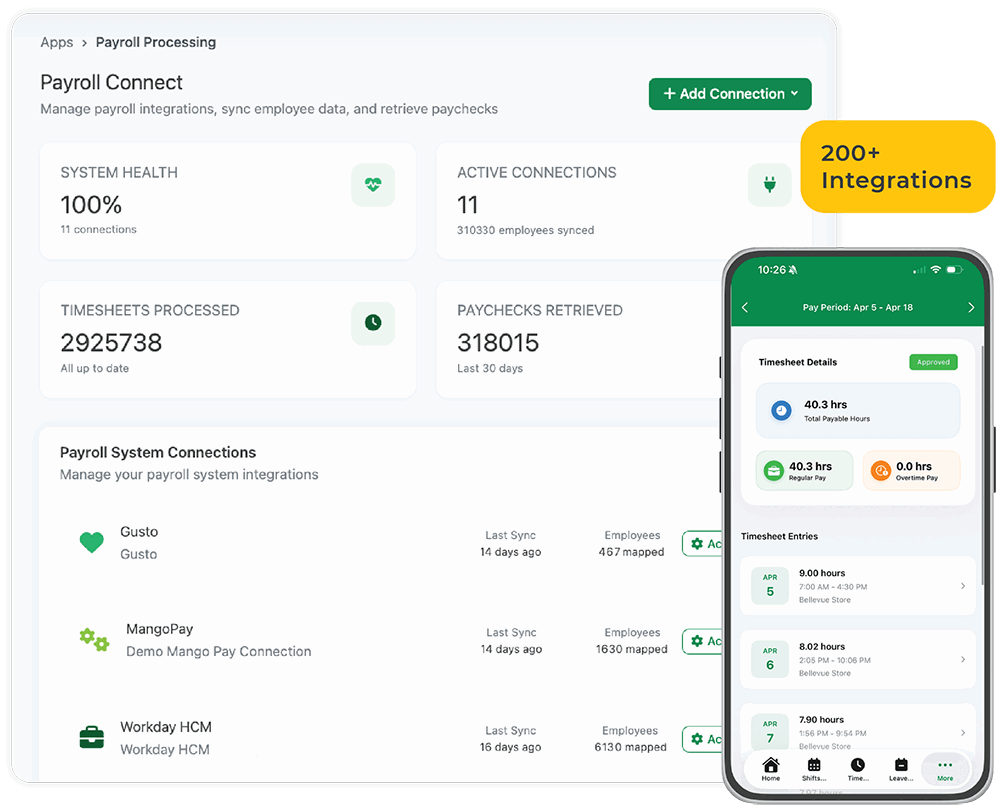
Agreed, so don't. The question is not whether your HRIS is good. It is whether the frontline execution layer on top of it, the schedule managers build, the swaps they broker, the exceptions they chase, is connected to it. With 200+ integrations across UKG, ADP, Workday, Paylocity, BambooHR, and more, your existing system feeds shifts and hours onto the shared data layer, and the rest of the suite reads from it. The system of record stays. What changes is that the daily operation finally connects to it instead of running in a parallel set of spreadsheets and group texts.
"Our schedules already work. Why change anything?"
Usually the gap is not in building the schedule. It is downstream. Time off that never reaches the posted schedule. Attendance exceptions that surface weeks late in payroll. Decisions made on last week's numbers. The schedule looking fine on Monday is not the same as the cost being controlled by Friday, and the difference is exactly the part a connected data layer closes. If your schedules truly work end to end, from availability through payroll, with no manual reconciliation, you may not need this. Most operations discover the reconciliation once they look for it.
"Will the frontline actually use it?"
Yes, and the number is the answer: 90%+ adoption within 90 days. The reason is architecture, not a launch campaign. It runs on the phone employees already carry, with no separate login, no company email, and no second device. Adoption is the whole point of the platform, because the data your HRIS reports is only as complete as the frontline participation feeding it.

"Our union and compliance requirements are complex."
That is an argument for a connected system, not against one. Labor law, union rules, break requirements, and certifications apply while the schedule is being built, not audited after, and every action is logged with who, when, and why for auditors or union stewards. Complexity is exactly what a build-time rules engine is for.

"Do we have to commit to the whole platform?"
No. Start with the one workflow that closes your biggest gap. Because everything runs on the same platform, you expand into the next workflow as a configuration when you are ready, with users, data, and history carrying forward. No new vendor, no migration, no rebuilt integrations. The platform decision comes first, and adoption grows one app at a time.
See the full picture: the integration and expansion model is one part of AI Scheduling for Shift-Based Teams, which lays out the five gaps and the proof behind each.
Where MangoApps Fits
MangoApps is the Enterprise Workforce Platform Built for the Frontline, and it is designed to sit on top of the systems you already run, not replace them. Through 200+ integrations, your HRIS and payroll stay the source of truth and sync to the shared data layer in real time, so a role change or an approved swap updates coverage and eligibility everywhere at once. Because the execution layer and the record share one platform, the Scheduling, Attendance, and Timekeeping agents can act across the whole cycle rather than inside a silo. AI is proof the platform matters, not the pitch.
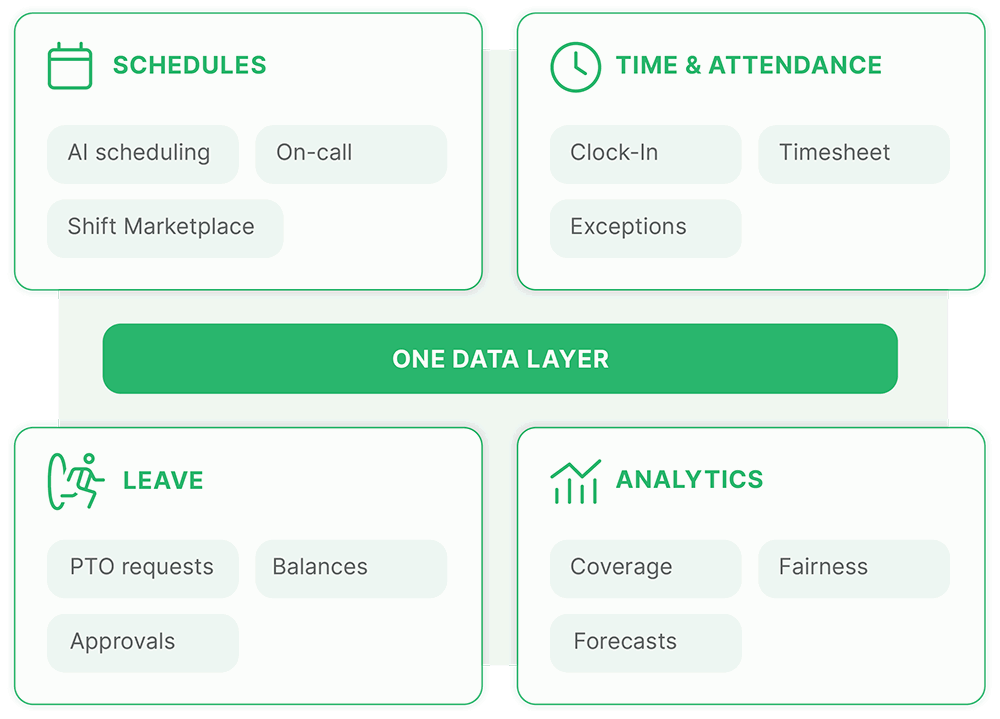
Keeping your system of record only pays off if the frontline uses the layer on top, which is why it lives on the phone they already carry, reaching 90%+ adoption within 90 days, on an 8-to-12-week implementation with a dedicated CSM from day one.
You don't replace what you just bought. You connect it, and finally put it to work on the floor.
Frequently asked questions
Does MangoApps replace UKG, ADP, or Workday?
While MangoApps has all the functionality required to replace these systems in many organizations, many of our customers see benefits from integrating with their legacy tools instead of ripping them out and replacing them wholesale. In such cases, those systems remain your source of truth and feed shifts and hours onto the shared data layer through native integration, so nothing gets ripped out.
How many systems does MangoApps integrate with?
More than 200, including UKG, ADP, Workday, Paylocity, BambooHR, Rippling, and Gusto, through pre-built connectors and an open API.
Do we have to roll out the whole platform at once?
No. You start with the single workflow that closes your biggest gap and expand into others as a configuration later, with users, data, and history carrying forward. No second implementation.
Keep reading
Map it onto your current stack: we'll show you keep-and-connect against your HRIS and payroll. Schedule a call →
The MangoApps Team
We're the product, research, and strategy team behind MangoApps — the unified frontline workforce management platform and employee communication and engagement suite trusted by organizations in healthcare, manufacturing, retail, hospitality, and the public sector to connect every employee — deskless or desk-based — to the people, tools, and information they need.
We write about enterprise AI for the workplace, internal communications, AI-powered intranets, workforce management, and the operating patterns behind highly engaged frontline teams. Our perspective is grounded in a decade of building for frontline-heavy industries and shipping AI agents, employee apps, and integrated HR workflows that real employees actually use.
For short-form takes, product news, and field notes from customer rollouts, follow Frontline Wire — our ongoing stream on AI, frontline work, and the modern digital workplace — or learn more about MangoApps.


