
Here is the number worth putting in your next budget conversation: a 5,000-person organization can spend 3,000 to 4,000 hours a year just assembling the data for performance reviews, before a single development conversation takes place. That is close to two full-time roles, and none of it appears on a line item. It shows up instead as time managers didn't spend managing, and as ratings employees didn't see coming.
Performance management has a cost problem that most budgets never capture, because the biggest costs are absorbed rather than invoiced. They hide in manager hours, in turnover, in decisions made on stale data. Here is where the money actually goes.
See the full cost model: Performance & Growth breaks down all four gaps and what each one adds up to across a 5,000-person organization.
The 3,000-hour number, and where it comes from
The figure isn't a slogan. It comes from a straightforward model. Take a 5,000-employee organization with roughly 500 managers. Run two review cycles a year. Assume each manager spends three to four hours per cycle just compiling a picture from the five or more systems where performance data lives: the goals tool, the HRIS, notes, the recognition feed, email. Multiply it out and you land between 3,000 and 4,000 hours annually, spent assembling information instead of developing people (MangoApps benchmark model). Your own numbers will land differently. The pattern holds regardless of the exact figure.

That is the visible cost, the one you can at least estimate. The recency bias that fills the gaps in a rushed reconstruction never reaches a budget line at all. It shows up in every rating an employee didn't expect, and in every good performer who quietly concludes the process isn't worth taking seriously.
The goals nobody sees between cycles
An OKR set in January and reopened in November steered nothing for ten months. That is not a scheduling inconvenience. It is ten months of work pointed by habit rather than by priority. Only 14% of employees strongly agree their reviews inspire them to improve (according to Gallup), and goals no one can see between cycles are a large part of why.

Effort still happens. It just isn't aimed. The cost is the gap between the work people did and the work the business needed, compounded across every team, every quarter.
The succession plan that was fiction the day the role opened

When a critical role opens and the pipeline that looked ready is not, the replacement costs roughly 200% of that leader's annual salary (according to Gallup). A single senior departure can dwarf the entire annual performance budget on its own. The annual talent review produces a snapshot that is accurate for about a week and slowly drifts into fiction over the following year. A live pipeline costs a fraction of that surprise, and it is current the day the role opens, which is the only day the accuracy matters.
The credential that lapsed between audits
In regulated work, the cost tail is longer than any of the above. A single certification that lapses silently can trigger an audit finding, a liability claim, or an operational shutdown. The performance budget is not even the right order of magnitude for comparison. And every succession and development decision built on a stale skills profile is a guess wearing the costume of data.

The common thread
None of these needs a disaster to add up. They compound through ordinary moments: a review built from memory, a readiness rating eighteen months stale, a credential that expired unnoticed, an OKR nobody reopened after January. Add them together and the true cost of performance management is not the software line. It is the hours, the turnover, and the decisions made on information that was already out of date. The cause is the same in every case: the data lives in separate places, so the work of pulling it together falls on people, late, under pressure.
Where MangoApps fits
MangoApps is the Enterprise Workforce Platform Built for the Frontline, and the Performance & Learning suite attacks the cost at its root by putting performance, goals, succession, and skills on one shared data layer. The October reconstruction disappears because the picture assembles itself all year. OKR progress, 360 responses, and recognition history flow into the review view automatically, so the 3,000-to-4,000-hour compilation tax largely goes away. The AI built into the suite runs on that connected data to flag retention risk and readiness gaps before they become the expensive kind of surprise. (Compensation decisions draw on the same connected record, though comp itself lives in HR Operations, not the performance suite.)
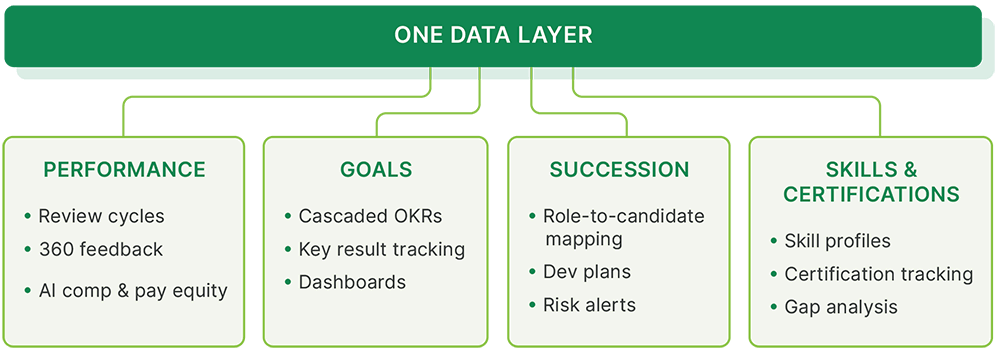
The savings only materialize if the data is complete, which is a question of adoption. MangoApps reaches 90%+ adoption within 90 days because performance lives in the app employees already open, with no separate login, and that is backed by the Adoption Guarantee: if your people don't adopt after launch, you don't pay. Implementation runs 8 to 12 weeks with a named Customer Success Manager from day one.
The cheapest review cycle you'll run is the one where nobody had to rebuild the picture first.
Build the business case for your own numbers: we'll model the compilation cost for your org size and show what a shared data layer recovers. Schedule a call →
Keep reading
The MangoApps Team
We're the product, research, and strategy team behind MangoApps — the unified frontline workforce management platform and employee communication and engagement suite trusted by organizations in healthcare, manufacturing, retail, hospitality, and the public sector to connect every employee — deskless or desk-based — to the people, tools, and information they need.
We write about enterprise AI for the workplace, internal communications, AI-powered intranets, workforce management, and the operating patterns behind highly engaged frontline teams. Our perspective is grounded in a decade of building for frontline-heavy industries and shipping AI agents, employee apps, and integrated HR workflows that real employees actually use.
For short-form takes, product news, and field notes from customer rollouts, follow Frontline Wire — our ongoing stream on AI, frontline work, and the modern digital workplace — or learn more about MangoApps.


