
Quick answer: almost every performance failure, a year-end surprise, a stalled OKR, a succession plan that turned out to be fiction, a credential that lapsed unnoticed, traces to one of four information gaps: performance data is reconstructed instead of retrieved, goals are invisible between cycles, succession is a document instead of a pipeline, and the skills picture is out of date. They are not four separate problems. They are one problem, fragmented data, showing up in four places.
Pull on any of them and you find the same root. The review that felt unfair, the quarter that drifted, the promotion that stalled: the manager didn't have the information the moment they needed it, because it lived somewhere else. Here is each gap, what it costs, and how to tell how many are open in your own organization.
Get the complete playbook: Performance & Growth covers all four gaps, the cost of leaving them open, and what closing them looks like, in one place.

Gap 1: performance data is reconstructed, not retrieved
When the year-end picture has to be compiled from five or more systems, it gets built from memory and recency bias instead. The manager isn't reviewing. They are reconstructing. And the version they reconstruct leans heavily on the last eight weeks, because that is all anyone can reliably recall. Only 14% of employees strongly agree their reviews inspire improvement (according to Gallup), and a rating assembled the night before is a large part of why.
Gap 2: goals are invisible between cycles
An OKR set in January and reopened in November steered nothing in between. For ten months, people work without a visible line to company priorities. The goals documented effort rather than directing it. Only 29% of employees strongly agree their manager's feedback helps them do better work (according to Gallup), and feedback disconnected from goals nobody can see is feedback about the wrong things.
Gap 3: succession is a document, not a pipeline
Readiness ratings reflect what was known at the last talent review, not what is true today. The slide deck looked ready. Then the role actually opened, and the person marked "ready in one year" left eight months ago, or was never as close as the annual snapshot suggested. Replacing a manager costs roughly 200% of their annual salary (according to Gallup). A plan that is accurate once a year and fiction the rest of the time is not a pipeline. It is a document.
Gap 4: the skills picture is out of date
Certifications lapse silently. Skill profiles go unmaintained. Every succession and development decision built on them is a guess. In regulated work the stakes are sharper: a single credential that lapses between audits can trigger an audit finding, a liability claim, or an operational shutdown at a cost that dwarfs the entire performance budget. Stale skills data doesn't announce itself. It surfaces at the worst possible moment.
Score your own operation
Before you decide which gap to close first, find out how many are open. Mark each honestly.
-
Gap 1, reconstruction. When a manager runs a review, is the full-year picture already assembled in one place, or compiled from several systems the week before? (Already there ←→ Rebuilt from memory)
-
Gap 2, invisible goals. Between review cycles, can an employee see their goals and their progress on any given Tuesday, or do the goals go dark until review season? (Visible daily ←→ Dormant until year-end)
-
Gap 3, succession. If a critical role opened tomorrow, would your readiness data be current, or as of the last talent review? (Current today ←→ Accurate once a year)
-
Gap 4, skills. Do lapsing certifications and stale skill profiles surface automatically, or only when someone goes looking, or when an auditor does? (Flagged automatically ←→ Found after the fact)
How to read your score:
-
0 gaps open. Rare. Your performance data is infrastructure, not an annual archaeology project. Keep it that way.
-
1 gap open. One workflow is running on reconstruction. It is dragging the other three, because the data they need flows through it. Close it before it spreads.
-
2 gaps open. The common score, and the expensive one to leave alone. Your reviews, goals, and succession decisions are all partly built on information that isn't current.
-
3 to 4 gaps open. Your performance process is running on memory. Every number your talent strategy depends on, readiness, retention risk, development spend, is being set by tools that were never built to share what they know.
What the gaps cost when you add them up
None of this needs a catastrophe to become expensive. The costs compound through ordinary moments.

In a 5,000-person organization, Gap 1 alone can mean 3,000 to 4,000 hours a year spent assembling review data instead of developing people, close to two full-time roles doing work the platform should already have done (based on MangoApps' benchmark model of 500 managers running two cycles a year at three to four hours each). Gap 3 carries the 200% replacement cost every time a pipeline turns out to be fiction. Gap 4 carries a regulatory tail that can exceed all the others combined. The cause is the same in all four. So is the fix.
Where MangoApps fits
MangoApps is the Enterprise Workforce Platform Built for the Frontline, and the Performance & Learning suite closes all four gaps the same way: by putting performance, goals, succession, and skills on one shared data layer instead of four disconnected tools. Because the data is connected, the AI built into the suite can surface retention risk, succession readiness, and certification gaps continuously, without anyone running the analysis. The intelligence isn't bolted on. It is what a single data model makes possible.
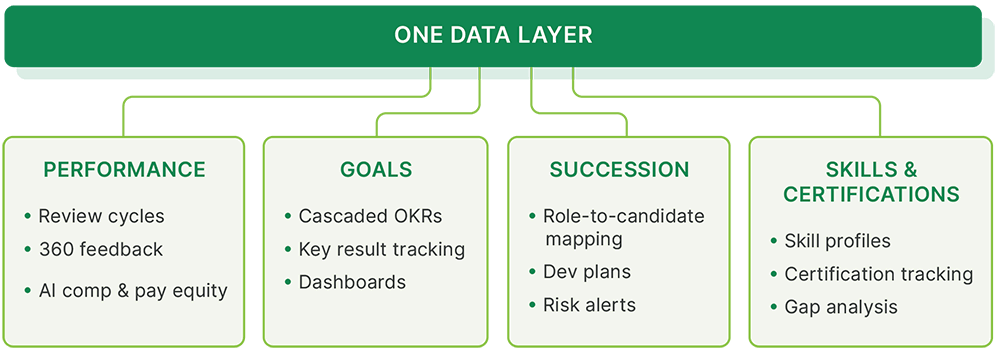
None of that matters if employees don't use it, which is why adoption is the number that anchors the rest. MangoApps reaches 90%+ adoption within 90 days because the full performance experience lives in the app employees already open, on any device, with no separate login. High adoption is not a vanity metric. It is the prerequisite for performance data you can act on, and it is backed by the Adoption Guarantee: if your people don't adopt after launch, you don't pay.
Frequently asked questions
What are the main causes of performance review failure?
Most review failures are not caused by bad managers or bad templates. They trace to fragmented information: performance data spread across five or more systems, goals that go invisible between cycles, succession plans that reflect the last talent review rather than today, and skills or certification records that are out of date. When the data is scattered, the review gets reconstructed from memory, and recency bias does the rest.
How many hours do performance reviews actually take?
In a 5,000-employee organization, just assembling the data for reviews can consume 3,000 to 4,000 hours a year, roughly 500 managers running two cycles annually at three to four hours each to compile a picture from multiple systems (MangoApps benchmark model). That is time spent gathering information, before any development conversation happens.
How do you fix a broken performance management process?
Cadence changes and new templates don't fix a reconstruction problem, because the underlying data is still scattered. The durable fix is putting performance, goals, succession, and skills on one shared data layer so the review is retrieved rather than rebuilt, and pairing that with adoption high enough that the data is actually complete.
Is this only for desk-based teams?
No. The four gaps hit frontline and deskless employees hardest, because they are the ones most often left out of desk-bound HR tools. Delivering performance, goals, and recognition on the app employees already carry is what makes the data complete across the whole workforce, not just the corporate layer.
Find out how many gaps are open in your organization: we'll walk your current process against the four gaps with you and show where the data breaks. Schedule a call →
Keep reading
The MangoApps Team
We're the product, research, and strategy team behind MangoApps — the unified frontline workforce management platform and employee communication and engagement suite trusted by organizations in healthcare, manufacturing, retail, hospitality, and the public sector to connect every employee — deskless or desk-based — to the people, tools, and information they need.
We write about enterprise AI for the workplace, internal communications, AI-powered intranets, workforce management, and the operating patterns behind highly engaged frontline teams. Our perspective is grounded in a decade of building for frontline-heavy industries and shipping AI agents, employee apps, and integrated HR workflows that real employees actually use.
For short-form takes, product news, and field notes from customer rollouts, follow Frontline Wire — our ongoing stream on AI, frontline work, and the modern digital workplace — or learn more about MangoApps.


