
Ask a VP of Talent Management to describe their performance process and you'll hear it in the present tense: quarterly check-ins, a competency framework, a 360 that pulls from peers and direct reports. Then watch one cycle run end to end. What you see is a manager rebuilding a year from memory, an employee bracing for a number, and a set of goals nobody has opened since January. The review isn't broken because managers don't care. It's broken because the information they needed was never in one place.

Only 14% of employees strongly agree their reviews inspire them to improve (according to Gallup). That is not a motivation problem. It is what happens when the picture gets assembled the night before instead of accumulating all year. Here is how the year actually runs.
January: The Goals Go In, and the Tool Goes Quiet
OKRs get entered with real intent. Leadership sets direction, teams cascade objectives, individuals write key results. Then the tool that holds them gets opened roughly twice more before the year is out. The goals are documented. They are not directing anything. By the second week of February, most people would need a login reminder to find them.
March: The Cadence Slips
The check-in rhythm that looked sustainable in the planning meeting meets the actual quarter. A reorg, a launch, a hiring push. The check-ins are the first thing to fall off. Goals quietly become a list of intentions, and the only person tracking progress is the individual contributor, in their own notes, in a format nobody else can see.
October: Five Systems, One Night
Review season arrives and the reconstruction begins. A typical manager touches five or more disconnected systems to compile a single employee's picture (according to Gallup): the goals tool, the HRIS, a spreadsheet of notes, the recognition feed if there is one, and email. None of them talk to each other. Recency bias fills every gap, because the last eight weeks are the only weeks anyone can actually remember. The full-year view doesn't exist. It gets rebuilt, imperfectly, under time pressure.
November: The Number Nobody Saw Coming
The employee sits down to a rating shaped more by the recent quarter than by the year. The manager delivers feedback assembled from fragments. The conversation that was supposed to drive growth becomes a ritual that drives compliance. Both people leave the room having spent real time on something that changed nothing. In January, the cycle starts again on exactly the same footing.
What the Calendar Is Actually Showing You
Read those four moments together and the pattern is not a series of individual failures. It is one structural fact showing up four times: performance data, goal progress, feedback, and skills history live in separate places, so the review has to be manufactured rather than retrieved. That's not a process failure. It's an infrastructure failure.
Fix the cadence and you still have the reconstruction problem. Add another survey and you add another system to the October pile. The only thing that changes the year is putting the underlying data on one layer, so the picture is already there when the manager walks in. The goal isn't to make the review easier in a cosmetic sense. It's to give managers what they should have had the whole time.
Read the whole argument: this is one year of one cycle. Performance & Growth traces all four information gaps behind it, with the cost model and the customer proof.
Where MangoApps Fits
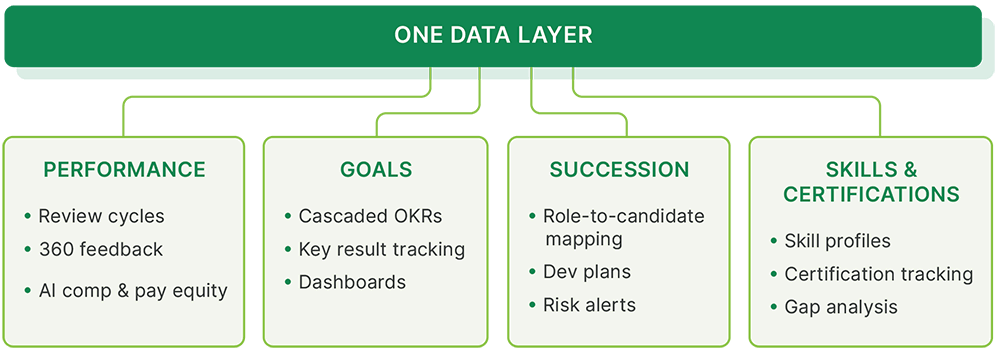
MangoApps is the Enterprise Workforce Platform Built for the Frontline, and the Performance & Learning suite runs on a single shared data layer: reviews, goals, 360 feedback, succession, and skills built as one system, not stitched together through integrations. OKR progress and 360 responses flow into the review view automatically, so October's five-system scramble simply doesn't happen. The AI built across the suite works on that same connected data, surfacing a retention risk or a widening succession gap before a talent review would catch it. AI is not the headline here. It is what a shared data layer makes possible.
The reason the data is worth trusting is that people actually use the system. MangoApps reaches 90%+ adoption within 90 days because performance lives inside the app employees already open, with no separate login. That adoption is backed by the Adoption Guarantee: if your employees don't adopt MangoApps after launch, you don't pay. No other vendor in this category makes that commitment.
The first review cycle on the platform is better than the last one off it, because the picture was assembling itself all year.
See what a review built from a record looks like: walk your own cycle through the Performance & Learning suite with our team and see where the reconstruction disappears. Schedule a call →
Keep reading
The MangoApps Team
We're the product, research, and strategy team behind MangoApps — the unified frontline workforce management platform and employee communication and engagement suite trusted by organizations in healthcare, manufacturing, retail, hospitality, and the public sector to connect every employee — deskless or desk-based — to the people, tools, and information they need.
We write about enterprise AI for the workplace, internal communications, AI-powered intranets, workforce management, and the operating patterns behind highly engaged frontline teams. Our perspective is grounded in a decade of building for frontline-heavy industries and shipping AI agents, employee apps, and integrated HR workflows that real employees actually use.
For short-form takes, product news, and field notes from customer rollouts, follow Frontline Wire — our ongoing stream on AI, frontline work, and the modern digital workplace — or learn more about MangoApps.


