
The AI story in MangoApps has never been about capability for its own sake. The platform has had AI-powered search, content generation, and intelligent assistants for years. What Spring '26 delivers is something different: AI reaching further into the employee experience than it ever has, moving from a tool that helps employees create content to one that generates entire training programs, answers questions from live business data, and governs what gets published.
Four capabilities define the AI theme in this release.
AI Course Creation
Building a training course has always been a time-intensive process. Subject matter experts write content, instructional designers structure it, someone builds the quizzes, and the whole thing gets formatted for delivery. For organizations with large training libraries or frequent compliance requirements, that process is a real bottleneck.
AI Course Creation removes most of it. Starting from a prompt or a set of uploaded files, the platform generates a complete, structured course ready for review. Here is what gets built automatically:
- Documents become content chapters with text extracted, structured into blocks, and grammar corrected.
- PDFs and PowerPoint files become presentation chapters, each with an AI-generated title and description.
- Videos become video chapters with transcripts auto-generated in the course's language.
- Quizzes are generated based on chapter content, with correct answers mapped automatically.
- Course-level metadata is handled too: title, description, cover image, estimated duration, hashtags, and categories.
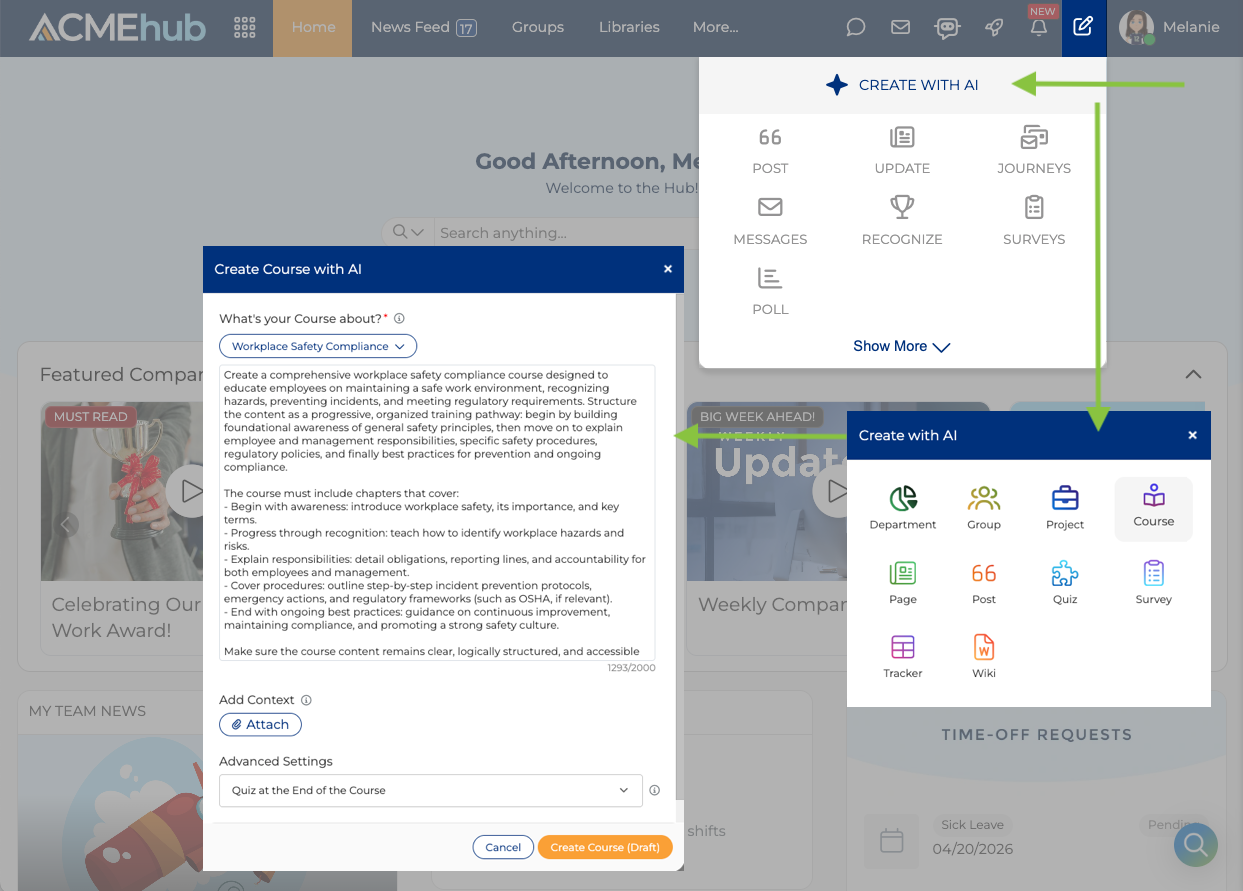
The result lands in a draft state, ready for an instructor or LMS admin to review and publish. Individual instructors can also use AI to generate single chapters within an existing course, giving the capability to teams who build content incrementally rather than all at once.
For organizations in healthcare, manufacturing, retail, and other industries where training libraries need to stay current, this changes the math on what a small L&D team can produce.
AI Agents Connected to Live Power BI Data
MangoApps AI Agents have been able to answer questions from internal knowledge bases, wikis, and documents for some time. Spring '26 adds a new category of knowledge source: live business data from Power BI.
Admins can now connect one or more Power BI workspaces as external knowledge bases in AI Studio. Once connected, an AI Agent can query that data in real time when a user asks a question, and return structured answers that include both tabular data and natural language summaries. No data is stored inside MangoApps. The query runs against the connected Power BI workspace at the moment the question is asked.
A few things make this practically useful:
- Multiple Power BI workspaces can be connected, each as its own knowledge base.
- A single AI Agent can combine Power BI data with other knowledge sources, so a question about headcount can pull from live workforce data while a question about policy pulls from an internal wiki.
- If the Power BI connection is unavailable, the agent continues responding from its other connected sources.
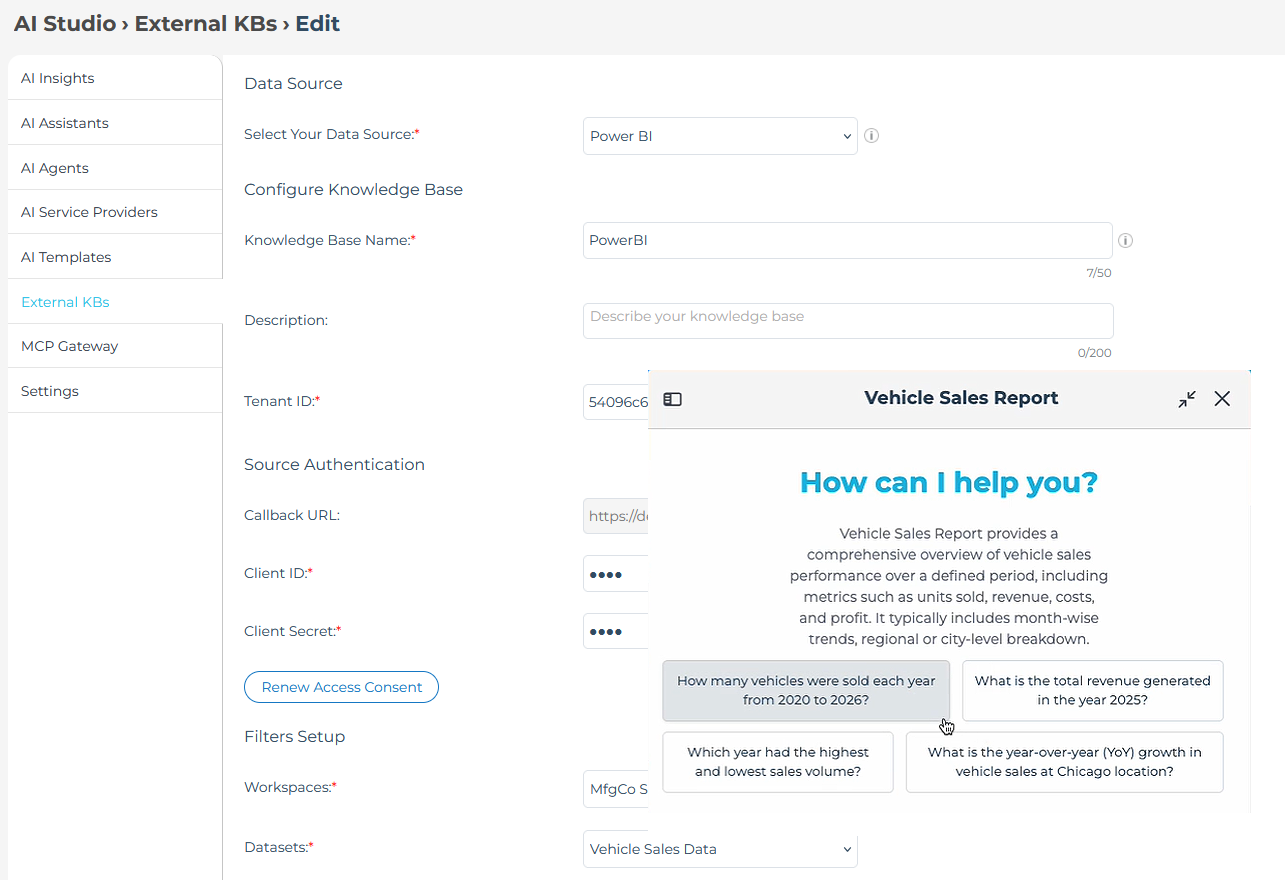
For operations, finance, and HR teams that live in dashboards, this means they can ask questions in plain language and get answers without pulling up a report.
AI-Assisted Page Approval
Governance has historically been a human-only process. A page gets submitted, it sits in a queue, a reviewer looks at it, and it either gets approved or sent back. In large organizations with high content volume, that queue backs up and the review quality varies.
Spring '26 introduces AI as the first step in a configurable page approval workflow. Before content reaches a human reviewer, AI evaluates it for quality. Admins configure the workflow from a pre-built template, and can customize:
- When it triggers: on first publish, or on publish and republish.
- Who it applies to: filtered by page author or team if needed.
- What happens after: AI approval can route to a manager, a specific individual, or a team for final sign-off before the page goes live.

The AI step adds a quality gate that catches issues before human reviewers spend time on them. Approvers receive requests via direct message or news feed, with approve, decline, and preview actions available directly from the notification. Pending approvals also surface in My Priority Items, so nothing gets missed.
Full audit logging captures the complete approval trail for every page.
Enterprise AI Management
As AI use expands across the platform, organizations need visibility and control over what it costs and how it gets used. Spring '26 introduces a token-based billing and management framework that gives admins both.
The new framework includes:
- Four model tiers: Auto, Thinking, Standard, and Instant, each reflecting a different cost and performance tradeoff. Auto lets the platform select the appropriate tier per request.
- Pre-purchased AI credits that draw down based on actual token consumption, tracked hourly.
- Usage thresholds with configurable alerts: admins set a monthly token limit and receive a notification when it is reached.
- Access controls: a separate threshold can trigger a block on new AI sessions for end users if usage exceeds a defined limit.
- A Service Usage Dashboard in the Admin Portal with per-feature breakdowns showing date, feature, item name, model used, tokens consumed, and cost.
For organizations that have been cautious about enabling AI broadly due to unpredictable cost, this provides the controls to deploy it with confidence.
What This Adds Up To
Taken together, these four capabilities represent a shift in what AI does inside the platform. Course generation automates the most labor-intensive part of building a training library. Power BI connectivity makes AI useful to teams whose work lives in data. Page approval governance makes AI a participant in editorial quality, not just a creation tool. And the enterprise management layer makes all of it governable at scale.
AI in MangoApps has always been embedded in the workflows that use it. Spring '26 extends how far into those workflows it reaches.
Learn more about the full Spring '26 Release by reading other deep dive articles linked below:
The MangoApps Team
We're the product, research, and strategy team behind MangoApps — the unified frontline workforce management platform and employee communication and engagement suite trusted by organizations in healthcare, manufacturing, retail, hospitality, and the public sector to connect every employee — deskless or desk-based — to the people, tools, and information they need.
We write about enterprise AI for the workplace, internal communications, AI-powered intranets, workforce management, and the operating patterns behind highly engaged frontline teams. Our perspective is grounded in a decade of building for frontline-heavy industries and shipping AI agents, employee apps, and integrated HR workflows that real employees actually use.
For short-form takes, product news, and field notes from customer rollouts, follow Frontline Wire — our ongoing stream on AI, frontline work, and the modern digital workplace — or learn more about MangoApps.
Dive Deeper


