Per IDC, the average employee spends 2.5 hours per day searching for information they need to do their jobs. That is not a behavior problem. It is an infrastructure problem — and for organizations with a significant frontline workforce, the benchmark understates the actual cost, because it describes employees who have full system access. Approximately 80% of the global workforce is deskless, per Emergence Capital, and the platforms most organizations call their AI or knowledge management system were built for employees with corporate email addresses and company-issued laptops. They were not built for the warehouse floor, the hospital unit, or the field vehicle.
MangoApps AI Experts close that gap structurally. Built on AI Studio, they give every employee — desk-based or deskless — a single, governed AI layer for finding information, completing tasks, and following standard operating procedures without switching between disconnected tools. This article explains how the system works, what governance and compliance controls are built in, how frontline workers access it without a corporate credential, and what the business case looks like for organizations that have moved from fragmented point solutions to a unified AI infrastructure.
Why fragmented AI tools cost more than they appear
The per-seat subscription model makes individual tools easy to justify line by line and difficult to evaluate in aggregate. Six applications at $10–15 per seat per month, multiplied across headcount, produces a monthly AI spend that frequently exceeds what a unified platform would cost — before accounting for the productivity cost of context switching between them.
Fragmentation has a measurable operational cost. Per Social Edge Consulting, 91% of organizations operate an intranet, but only 13% of employees use one daily, and nearly a third never log in at all. Per SWOOP Analytics, the average daily time an employee spends using intranet tools is six minutes. These numbers describe employees who have full access to those systems. For the 80% of the global workforce that is deskless, the access problem is structural, not behavioral — the tools were not designed for them, and no adoption initiative changes that.
The consequence is predictable: employees who cannot find what they need improvise, ask managers, or proceed without the information. All three outcomes are slower, more error-prone, and harder to audit than a functioning AI layer would be. At scale, that drag is calculable. The question for any organization evaluating AI investment is whether the platform they are considering closes the access gap for the entire workforce or only for the 20% who already had full access.
How AI Experts work: RAG on your organization's data
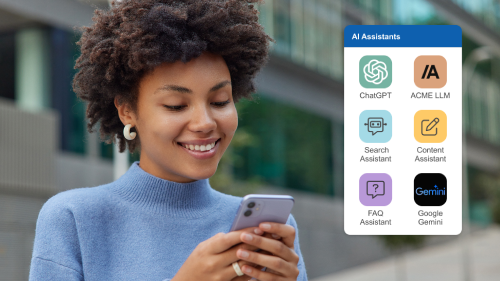
AI Experts are configurable AI assistants trained on your organization's private content using Retrieval Augmented Generation (RAG). Each Expert pulls answers exclusively from approved internal knowledge sources — HR policies, SOPs, training materials, compliance documents — rather than generating generic responses from a public model.
The distinction matters practically. An employee asking about the correct procedure for handling a specific equipment malfunction needs your SOP for that scenario, not a generalized explanation of what equipment malfunction procedures typically look like. RAG-based retrieval means the answer is drawn from the document your operations team wrote and approved. The source is your organization's content, governed by your organization's policies.
AI Studio, the underlying configuration layer, connects to third-party large language models via API consumption-based pricing. This makes advanced AI accessible as a shared organizational resource rather than a per-seat line item, and it means organizations choose which model powers each Expert. As the LLM market evolves, organizations can swap models without rebuilding knowledge architecture or retraining employees.
Configuration requires no IT development cycles. Business owners build and update Experts directly in a no-code environment. The HR team can create a new benefits Expert, update a policy guide, or retire an outdated onboarding document without submitting a development request. Deployment timelines that traditionally take months compress to days.
Frontline access without email or a desk
The platforms most organizations deploy for knowledge access — SharePoint, legacy intranets, enterprise wikis — require a corporate email address, a VPN, or both. Frontline workers in distribution, healthcare, retail, and field operations typically have neither. The result is a knowledge infrastructure that effectively covers 20% of the workforce and leaves the remaining 80% to depend on whatever their supervisor happens to know at the moment they need to know it.
AI Experts run on the employee app on any mobile device, without a corporate credential. A retail associate asking about a return policy, a warehouse worker checking a safety protocol, or a field technician looking up equipment specifications gets the same governed, organization-specific answer as a corporate knowledge worker — from the same application, on a device they already carry.
Platforms built for frontline-first deployment consistently report adoption rates of 90% within the first six months of launch. That benchmark reflects how access architecture drives adoption: when the barrier is removed, usage follows without a change-management program. The six-minute daily average from traditional intranet tools is an access problem. When employees can reach the platform from the device they carry, without credentials they do not have, the engagement metric changes accordingly.
Governance that makes AI safe to deploy at scale
Deploying AI across an enterprise creates a content operations challenge that most organizations underestimate until they are mid-deployment: the AI is only as accurate as the knowledge sources it retrieves from. Stale content produces stale answers. Unauthorized content produces unauthorized answers. Role-based access and data sovereignty are baseline requirements — but the governance question that determines whether AI deployment stays accurate over time is content ownership: who can publish, update, or retire the knowledge sources AI Experts draw from.
MangoApps addresses this through its content governance engine, which controls which content is eligible to train each Expert, who can modify those sources, and when content expires or requires review. A compliance or safety update reaches frontline employees through the same application they use for everything else, reflecting the current approved version. Content governance means the AI answers what the organization has authorized it to answer — not what was true six months ago.
The full governance layer covers role-based access controls that assign AI capabilities by job function, PII detection that automatically flags personally identifiable information in AI interactions before issues escalate into compliance incidents, audit trails that log AI interactions for regulated-industry review, and data sovereignty controls that ensure corporate content never trains public LLMs and is never stored outside the organization's environment. For organizations in healthcare, financial services, or government, these are not differentiating features — they are preconditions for deployment.
The productivity and business case
The calculation starts with the IDC benchmark: 2.5 hours per employee per day lost to information search. Across a 500-person frontline workforce at an average hourly cost of $20, that is $50,000 in daily productivity loss from information retrieval alone — before accounting for manager time spent answering questions that a functioning AI layer would resolve directly.
Organizations deploying AI-assisted, mobile-accessible knowledge tools have reported onboarding speed improvements of 50% for new hires. At scale — tens of thousands of employees distributed across facilities and geographies — the cumulative impact on support ticket volume, onboarding throughput, and turnover among newly reached frontline employees compounds into the class of outcomes that enterprise buyers measure in tens of millions of dollars in annual cost avoidance.
The Gallup's 2026 State of the Global Workplace documents how persistent exclusion from organizational information systems is a reliable early indicator of disengagement — and disengagement's cost extends well beyond productivity into turnover, quality errors, and the coordination overhead that accumulates when managers become the information layer because the platform cannot reach their teams. Closing the access gap is the structural intervention. The engagement and retention outcomes follow from that, not from the culture program built on top of a broken infrastructure.
AI Experts vs. traditional knowledge bases
The core difference between AI Experts and a traditional knowledge base is the interaction model. A knowledge base is a search interface: the employee navigates to a system, constructs a keyword query, filters results, opens a document, and reads until they locate the specific answer. An AI Expert is a conversation interface: the employee asks a question and receives the answer, drawn from the same document, without navigating to or reading the document.
For a desk-based knowledge worker with uninterrupted time, the knowledge base workflow is manageable. For a frontline worker with thirty seconds and a task in progress, it is not. The interaction model that works for 20% of the workforce does not work for the 80% the platform was not designed to serve.
The content freshness dynamic matters equally. A knowledge base stores the last published version of every document. An AI Expert retrieves from the current approved version, with content governance determining when that version changes and who authorizes the change. The answer an employee receives reflects today's policy, not the version that was indexed before the last compliance update.
Traditional knowledge bases also require employees to know what to search for — to translate "what I want to know" into the keyword that surfaces the relevant document. AI Experts accept the question in natural language and return the answer directly. The translation burden disappears, and so does the gap between having information in a document library and having employees actually access it.
For organizations evaluating this transition, the IDC MarketScape 2024 vendor assessment provides independent context for how AI-integrated workspace platforms are evaluated against enterprise requirements — including the frontline accessibility criteria that most enterprise AI evaluations still treat as secondary to desk-worker use cases.
The MangoApps Team
We're the product, research, and strategy team behind MangoApps — the unified frontline workforce management platform and employee communication and engagement suite trusted by organizations in healthcare, manufacturing, retail, hospitality, and the public sector to connect every employee — deskless or desk-based — to the people, tools, and information they need.
We write about enterprise AI for the workplace, internal communications, AI-powered intranets, workforce management, and the operating patterns behind highly engaged frontline teams. Our perspective is grounded in a decade of building for frontline-heavy industries and shipping AI agents, employee apps, and integrated HR workflows that real employees actually use.
For short-form takes, product news, and field notes from customer rollouts, follow Frontline Wire — our ongoing stream on AI, frontline work, and the modern digital workplace — or learn more about MangoApps.
Dive Deeper