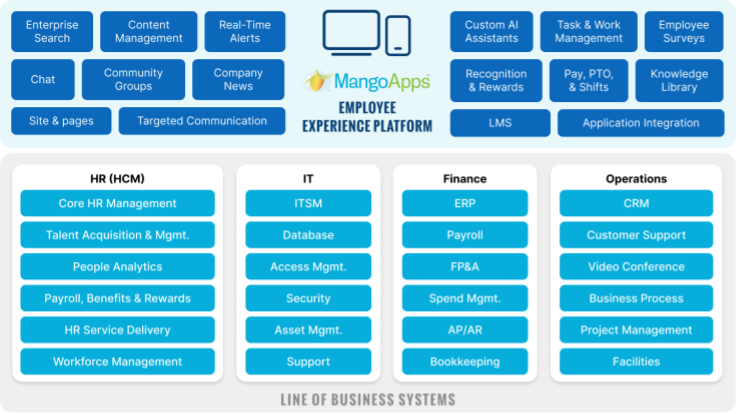
At MangoApps, we often get questions about how our platform fits in with other systems companies use, especially Human Capital Management (HCM) systems. With seemingly overlapping features, it's essential to understand the unique roles these platforms play in your organization. The short answer: HCM systems manage HR data and processes; MangoApps is an employee engagement software layer that connects, informs, and activates your workforce — and the two work best when deployed together.
The Primary Focus and Functionality
Human Capital Management (HCM) systems are designed primarily as business solutions focused on managing HR processes and employee data. Their core aim is to streamline HR tasks, making the administrative experience efficient and productive. HCM systems excel in handling employee records, payroll, benefits administration, and compliance. They are built to enhance the productivity of the HR team, ensuring that all HR-related processes run smoothly.
In contrast, MangoApps is an Employee Experience Platform centered on enhancing employee engagement and communication across the organization. Our platform offers a comprehensive suite of tools for collaboration, real-time interaction, and productivity, particularly for frontline employees. While administrative efficiency is essential, MangoApps places equal emphasis on the employee experience, fostering a collaborative and inclusive workplace where communication flows effortlessly.
The scale of the gap these platforms address is significant. Per IDC, employees spend an average of 2.5 hours per day searching for information — time that neither an HCM self-service portal nor a static intranet is designed to recover. Meanwhile, per Social Edge Consulting, 91% of organizations operate an intranet, yet only 13% of employees use it daily, and nearly a third never log in at all. Per SWOOP Analytics, the average employee spends just six minutes per day in intranet tools. These numbers illustrate why an HCM's employee self-service module alone rarely closes the engagement gap.
Complementary Roles: HCM vs. Employee Experience Platforms
It's important to recognize that HCM systems and Employee Experience Platforms like MangoApps serve different yet complementary roles. Using an HCM system as a replacement for MangoApps, or vice versa, is not advisable because each system is optimized for specific functions.
Think of it this way:
- HCM as the system of record, MangoApps as the system of engagement. An HCM stores the authoritative data about your workforce — headcount, compensation, compliance records. MangoApps surfaces that data in context, delivering the right message to the right employee at the right moment.
- HCM as the back office, MangoApps as the front door. Payroll runs in the background; employees experience the company through the communications, recognition, and knowledge tools they touch every day.
- HCM for the HR team, MangoApps for every employee. HCM workflows are optimized for HR administrators. MangoApps is built for the 80% of the global workforce that is deskless, per Emergence Capital — workers who may never open an HR portal but will engage with a mobile-first employee app on their personal device.
These distinctions highlight how HCM systems and MangoApps relate to each other. While an HCM system manages HR processes efficiently, MangoApps ensures that employees are engaged, informed, and connected — including frontline workers who can access the platform on personal devices without a corporate email address, VPN, or a desk, removing the access barrier HCM self-service portals typically require.
How the Two Systems Compare
| Capability | HCM System | MangoApps EXP |
|---|---|---|
| Payroll & benefits administration | ✓ Core function | Not applicable |
| Compliance & employee records | ✓ Core function | Not applicable |
| Company-wide communications & intranet | Limited / static | ✓ Core function |
| Frontline mobile access (no corporate email) | Rarely supported | ✓ Core function |
| Real-time collaboration & messaging | Minimal | ✓ Core function |
| Employee engagement surveys & questionnaires | Basic | ✓ Purpose-built |
| AI-personalized content surfacing | Not available | ✓ Core function |
| Training and employee engagement programs | Basic LMS links | ✓ Embedded workflows |
| Role-based permissions synced from HRIS | Via HCM | ✓ Synced via SSO/SAML |
For a deeper look at how MangoApps is evaluated against other intranet and employee experience platforms, see the ClearBox Consulting's 2026 Intranet and Employee Experience Platforms Report.
How to Implement Both Together
The most effective deployments treat HCM and MangoApps as a connected stack, not competing choices. Here is a practical four-step approach:
1. Sync employee data from your HCM to MangoApps via API or SSO. MangoApps supports SAML 2.0, OAuth 2.0, and SSO, with role-based permissions synced directly from your HRIS. When a new hire is provisioned in your HCM, their MangoApps profile, group memberships, and content permissions are created automatically — no duplicate data entry, no governance risk. You can explore how this works through our employee data management capabilities.
2. Use MangoApps for frontline communications while your HCM handles payroll and compliance. Frontline employees rarely interact with HCM portals. MangoApps delivers shift updates, safety alerts, policy changes, and recognition through a mobile-first interface accessible on personal devices — no VPN required. Your HCM continues to process payroll and track compliance in the background without interruption.
3. Layer employee engagement surveys and training on top of HCM data. MangoApps enables targeted employee engagement surveys, questionnaires, and employee engagement training programs that can be scoped by department, location, or role — data that lives in your HCM. This means engagement initiatives reach the right cohorts without manual list management. For context on why embedded learning matters, see Why Your Learning and Development Strategy Fails (and How to Fix It).
4. Consolidate your tool sprawl. Organizations that consolidate communications, HR self-service, and operations into one platform have reduced the number of systems IT manages by 3–4x compared to running point solutions alongside an HCM. Traditional intranets and HCM employee self-service modules can take months to deploy and often deliver static, ungoverned content that becomes stale — a gap purpose-built employee experience platforms are designed to close. Most MangoApps customers reach full adoption within 90 days.
The Business Case: Why the Combination Matters Financially
The cost of getting this wrong is concrete. Replacing a single frontline employee costs between $4,400 and $15,000 in recruiting, onboarding, and lost productivity. Poor engagement and disconnected tooling are leading drivers of that turnover. Organizations that have launched a branded employee app on top of their HCM stack have reported 87% workforce engagement within a few months of go-live — a result no HCM self-service module alone has replicated at scale.
AI-powered personalization is part of what makes that possible. MangoApps integrates with OpenAI, Gemini, and Anthropic to surface the right content to the right employee without IT intervention — filling the engagement gap that HCM reporting dashboards leave. An HCM tells you that engagement is low; MangoApps helps you do something about it in real time.
For a broader view of where workforce technology is heading, the 2026 HR Trends eBook covers how leading organizations are structuring their HCM and EXP investments together.
Conclusion: Use Each System for What It Does Best
HCM systems and Employee Experience Platforms are not competitors — they are complements with clearly defined lanes. Your HCM is the authoritative system of record for HR data, payroll, and compliance. MangoApps is the engagement and communication layer that makes that data actionable for every employee, including the frontline workers your HCM portal was never designed to reach.
The practical path forward is straightforward: keep your HCM for what it does best, connect it to MangoApps via API or SSO, and use MangoApps as the unified intranet and employee app your workforce actually opens every day. Organizations that make this pairing work reduce tool sprawl, improve retention, and close the engagement gap that neither system can close alone.
To see how this plays out in practice, review MangoApps Included in Leading Research Firm's Intranet Platforms Evaluation or explore our workforce management solutions to understand how the full platform connects to your existing HR stack.
Frequently Asked Questions
Will adding MangoApps create security or compliance risk alongside our HCM?
No. MangoApps is built to enterprise security standards — SAML 2.0, OAuth 2.0, SSO, and role-based permissions synced from your HRIS. When an employee's role or status changes in your HCM, access rights in MangoApps update automatically. This means IT does not manage a separate permission layer, and your governance posture stays intact. The employee directory is always current because it draws from the same source of truth as your HCM.
How long does it take to deploy MangoApps alongside an existing HCM?
Most customers reach full adoption within 90 days. This contrasts with traditional intranet or HCM portal customization projects, which routinely take six to twelve months and still deliver static content that becomes outdated. The integration with common HCM platforms is handled through standard API connectors and SSO, so IT effort is concentrated at the start rather than ongoing.
What if our HCM already includes an employee engagement survey module?
HCM engagement modules are typically annual or semi-annual pulse tools tied to the HR workflow. MangoApps supports continuous employee engagement surveys, targeted questionnaires, and employee engagement training programs that can be triggered by events — a new manager, a policy change, a safety incident — rather than a calendar. The two can coexist: use your HCM module for formal annual reviews and MangoApps for the real-time feedback loop that drives day-to-day engagement. For trends shaping how organizations approach this, see the 2026 Internal Communications Trends eBook.
The MangoApps Team
We're the product, research, and strategy team behind MangoApps — the unified frontline workforce management platform and employee communication and engagement suite trusted by organizations in healthcare, manufacturing, retail, hospitality, and the public sector to connect every employee — deskless or desk-based — to the people, tools, and information they need.
We write about enterprise AI for the workplace, internal communications, AI-powered intranets, workforce management, and the operating patterns behind highly engaged frontline teams. Our perspective is grounded in a decade of building for frontline-heavy industries and shipping AI agents, employee apps, and integrated HR workflows that real employees actually use.
For short-form takes, product news, and field notes from customer rollouts, follow Frontline Wire — our ongoing stream on AI, frontline work, and the modern digital workplace — or learn more about MangoApps.


