
There are two ways a manager can walk into a performance review. They can arrive with a year assembled in front of them: goals and their progress, peer feedback, recognition, the arc of the last twelve months already in one view. Or they can arrive the way most managers do, having spent the night before reconstructing that year from memory and a handful of open tabs. Same meeting, same form, same rating scale. Completely different conversation. A review is only ever as good as the record it's built on, and most reviews are built on almost none.

Only 14% of employees strongly agree their reviews inspire them to improve (according to Gallup). That number doesn't come from managers who don't care. It comes from reviews built the second way.
What the Night-Before Review Actually Is
When performance data, goal progress, 360 input, and recognition all live in separate places, none of them arrive on their own. The manager has to go get them, and there is never enough time, so they don't get most of them. What fills the gap is memory, and memory is dominated by the last eight weeks. A strong performer who had a quiet October gets a quiet-October review. A steady contributor who shipped the hardest work in the spring gets a spring nobody remembers.
This is recency bias, and it isn't a character flaw. It is what happens when the only available record is the one in the manager's head. Only 29% of employees strongly agree the feedback they receive helps them do better work (according to Gallup), and feedback assembled from the most recent thing that happened is feedback about the wrong things.
What Changes When the Record Is Already There
A record changes the starting point. Instead of reconstructing the year, the manager reviews it. Structured cycles run on standardized rating scales and competency frameworks, so a review in one team is comparable to a review in another. Probationary and ad-hoc reviews use the same framework as the annual one, so a new hire's first review isn't improvised. None of that requires the manager to be more diligent. It requires the data to be in one place before the meeting starts.
The difference an employee feels is trust. A rating drawn from a visible, year-long record is one they can see the basis for. A rating drawn from the last thing they did is one they brace for.
The 360 That's Already in the View
Multi-directional feedback is where the memory-versus-record gap gets widest, because 360 input is exactly the kind of data that evaporates if it isn't captured in context. Feedback from peers, direct reports, and cross-functional partners is worth far more than any single reporting-line view, but only if it reaches the manager at the moment of the review rather than as a separate exercise nobody connects back.

The version that works surfaces 360 responses directly in the manager's review view, alongside OKR data and recognition history, with no import and no manual compilation. Anonymity is configurable by review type and respondent group, so candor doesn't cost accountability. The point is not that there is more feedback. The point is that it is already where the decision gets made.
The Manager's Actual Job
Give a manager a year they have to rebuild and you turn a coach into a records clerk. Give them a year that assembled itself and you give the hours back to the only part of the review that was ever supposed to matter: the conversation about what happens next. That is the whole case for a shared record. It doesn't make managers work harder at the review. It stops asking them to manufacture the inputs first.
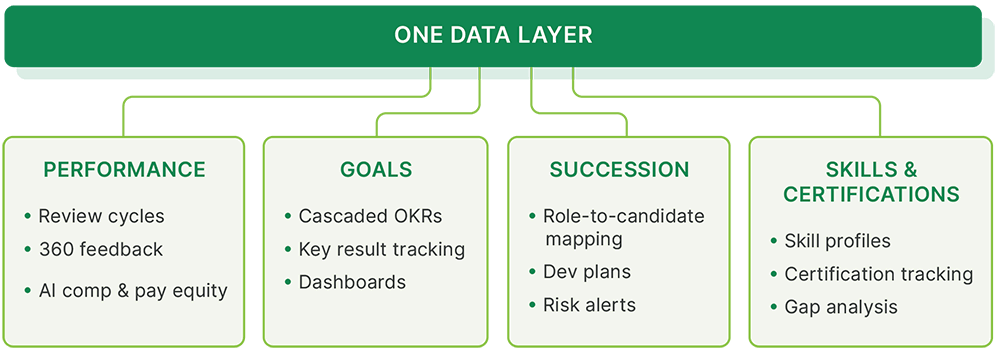
Read the whole argument: the review is one of four gaps in Performance & Growth, alongside goals, succession, and skills, with the cost model and the customer proof for each.
Where MangoApps Fits
MangoApps is the Enterprise Workforce Platform Built for the Frontline, and the Performance & Learning suite is built so the review is retrieved, not rebuilt. Reviews, goals, 360 feedback, recognition, and skills run on one shared data layer, so OKR progress and 360 responses land in the review view automatically. Because the data is connected, the AI built into the suite can read the full-year record continuously and flag a retention risk building on a team that looks fine on the surface. AI isn't the headline here. It is what a shared record makes possible.
A record only works if it's complete, which comes down to whether people use the system all year. MangoApps reaches 90%+ adoption within 90 days because performance lives in the app employees already open, with no separate login, and that is backed by the Adoption Guarantee: if your people don't adopt after launch, you don't pay.
The best review you'll run is the one you didn't have to reconstruct the night before.
See a review built from a record: we'll walk your own cycle through the Performance & Learning suite and show where the reconstruction disappears. Schedule a call →
Keep reading
The MangoApps Team
We're the product, research, and strategy team behind MangoApps — the unified frontline workforce management platform and employee communication and engagement suite trusted by organizations in healthcare, manufacturing, retail, hospitality, and the public sector to connect every employee — deskless or desk-based — to the people, tools, and information they need.
We write about enterprise AI for the workplace, internal communications, AI-powered intranets, workforce management, and the operating patterns behind highly engaged frontline teams. Our perspective is grounded in a decade of building for frontline-heavy industries and shipping AI agents, employee apps, and integrated HR workflows that real employees actually use.
For short-form takes, product news, and field notes from customer rollouts, follow Frontline Wire — our ongoing stream on AI, frontline work, and the modern digital workplace — or learn more about MangoApps.


