
The succession plan looked ready. It was a clean slide, reviewed at the last talent meeting: every critical role with a name beside it, a readiness rating, a tidy sense that the organization was covered. Then a role actually opened, and the plan turned out to be fiction. The person marked "ready in a year" had left eight months ago. The rating nobody had touched since the review reflected an impression, not a trajectory. The document was accurate for about a week, and slowly stopped being true every day after.

That is the difference between a document and a pipeline. A document is right on the day you make it. A pipeline is right on the day the role opens, which is the only day that counts.
Why the Annual Snapshot Drifts
A once-a-year plan drifts for a simple reason: it is built from a moment, and people are not moments. Readiness set by who spoke up in the talent review, or by seniority, or by recency of impression, starts decaying immediately. Skills change. High performers get poached. Development stalls or accelerates. None of that shows up in a slide that won't be opened again until next year. By the time the plan is consulted in a real vacancy, the only thing it reliably documents is how the room felt twelve months ago.
The cost of that gap is not abstract. Replacing a leader runs roughly 200% of their annual salary (according to Gallup), and a single senior departure that catches the pipeline unprepared can dwarf the entire year's talent budget on its own.
What a Pipeline Does That a Document Can't
A pipeline is grounded in data that keeps moving. Readiness ratings drawn from performance history, OKR achievement, recognition patterns, and completed development milestones, not from who was visible in the meeting. Multiple candidates mapped per role at different readiness levels: ready now, ready in twelve to eighteen months, in early development. And, critically, readiness that advances on its own. When a candidate completes a development milestone or a certification, their rating updates without anyone editing a cell.

That last property is what makes it a pipeline rather than a prettier document. The plan maintains itself, because it reads from the same performance and skills data everything else does. The candidate can see their own trajectory too, which turns a private HR artifact into a concrete path someone is actually walking.
The Roles Nobody Mapped
The most dangerous line in any succession review is not the role with a weak candidate. It is the role with no candidate at all, the single point of failure nobody flagged because the annual process was busy rating the people who were already visible. A live pipeline surfaces those directly: which roles are well-covered, which are at risk, and which have no identified successor, updated continuously rather than discovered in a crisis. The alert that seventeen roles have no successor is worth more than any rating on the roles that do.

And because the underlying data is continuous, readiness signals surface as they emerge. A high-potential employee gets identified by their trajectory, not by whether they happened to catch a senior leader's attention. Flight risk on a succession candidate gets flagged before the resignation confirms it, not after.
Read the whole argument: succession is one of four gaps in Performance & Growth, alongside reviews, goals, and skills, with the customer proof for each.
Where MangoApps Fits
MangoApps is the Enterprise Workforce Platform Built for the Frontline, and the Performance & Learning suite treats succession as live infrastructure, not an annual deliverable. Because succession runs on the same shared data layer as reviews, goals, and skills, readiness ratings update automatically as development milestones and certifications are completed, and pipeline health stays current without manual compilation. The AI built into the suite reads that connected data to surface readiness and retention signals as they develop, so the picture is ready the day a talent review or a vacancy demands it. AI is the proof the platform decision matters, not the headline.
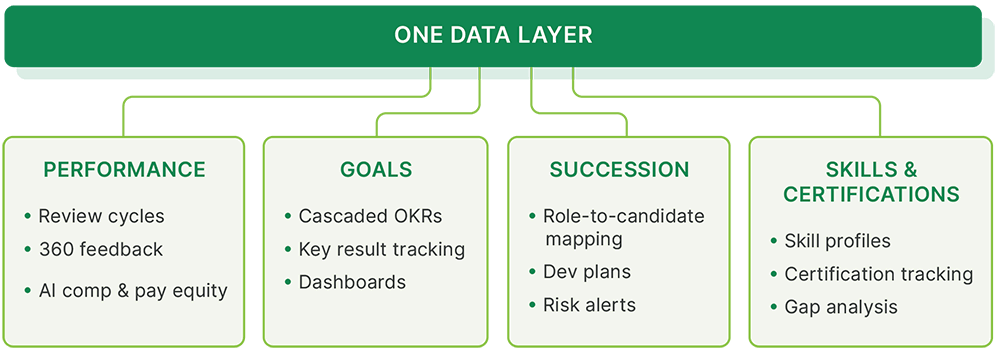
A pipeline is only trustworthy if the data feeding it is complete, which comes back to adoption. MangoApps reaches 90%+ adoption within 90 days because the whole experience lives in the app employees already open, backed by the Adoption Guarantee: if your people don't adopt after launch, you don't pay.
The plan you can trust in a vacancy is the one that was never a document to begin with.
See a pipeline that stays current: we'll map your critical roles through the Performance & Learning suite and show where the annual snapshot becomes a live view. Schedule a call →
Keep reading
The MangoApps Team
We're the product, research, and strategy team behind MangoApps — the unified frontline workforce management platform and employee communication and engagement suite trusted by organizations in healthcare, manufacturing, retail, hospitality, and the public sector to connect every employee — deskless or desk-based — to the people, tools, and information they need.
We write about enterprise AI for the workplace, internal communications, AI-powered intranets, workforce management, and the operating patterns behind highly engaged frontline teams. Our perspective is grounded in a decade of building for frontline-heavy industries and shipping AI agents, employee apps, and integrated HR workflows that real employees actually use.
For short-form takes, product news, and field notes from customer rollouts, follow Frontline Wire — our ongoing stream on AI, frontline work, and the modern digital workplace — or learn more about MangoApps.


