
The short version: most enterprises are deploying AI with no governance underneath it. Governing AI by design means governance is not a policy written later. It is how the AI is built. Every agent arrives permitted, scoped, and auditable, with an autonomy dial you set per agent, a kill switch that nests from platform-wide down to a single agent, data boundaries you can defend, and human approval required on high-impact decisions.
The exposure is already inside the building. Employees are using AI whether or not IT has sanctioned it, and the cost of that gap is measurable: shadow AI adds roughly $670K to the cost of a breach it is involved in, according to IBM's 2025 research. Unsanctioned app use is widespread, and most organizations still have no policy in place to manage AI or detect shadow AI.
Set against that, most enterprises are doing the riskiest possible thing: deploying AI on top of the same fragmented tools, with governance treated as something to write up later. Governing AI by design is the opposite approach, and for a CISO or compliance lead it is the only version that holds.
Governance as architecture, not policy
There are two ways to govern AI. One is to build the AI first and write the controls afterward, which leaves a gap between what the AI can technically do and what it is supposed to do. The other is to make governance part of how the AI is built, so every agent arrives already permitted, scoped, and auditable.
The second is the only one that survives contact with a real enterprise, because a policy document does not stop an ungoverned agent from returning data it should not, and an audit after the fact does not undo the exposure. Governance has to be in the architecture, not in the appendix.
Data boundaries you can defend
Governing by design starts with boundaries a security team can actually stand behind:
- Your data never trains public models. The exclusion is contractual and architectural. Calls route through governed connections under enterprise agreements, never into any third party's training.
- Permissions are enforced by the platform, not the prompt. An agent cannot return data the user is not authorized to see, even when asked directly. The control lives in the platform, so it does not depend on how the question is phrased.
- Customer data stays separated. No cross-customer sharing of outputs or cached results.
- PII detection and compliance dashboards. Automatic flagging, surfaced in one console.
- Opt-in, not opt-out. No agent is on by default. Administrators enable each one by license, role, and region.
- Human-in-the-loop for high-impact decisions. Compensation changes, hiring and offer decisions, bulk administrative actions, and all-employee broadcasts all require explicit human approval.
The tell in that list is the second item. Permissions enforced by the prompt are a suggestion. Permissions enforced by the platform are a control.
The autonomy dial and the nested kill switch
Governing by design does not mean locking AI down until it is useless. It means calibrating oversight to earned trust, and being able to stop instantly if something is wrong.

The autonomy dial is set per business and per agent, across four levels:
Observe → Suggest → Approve → Auto
You lower the oversight burden as outcomes earn it, never before. An agent starts by observing, then suggesting, and only moves toward acting on its own once it has demonstrated it should.
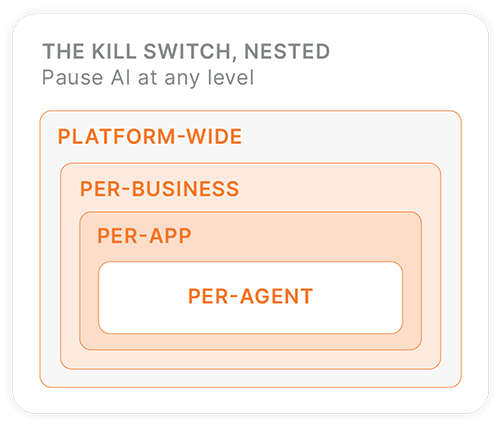
The kill switch nests, so you can pause AI at any level:
Platform-wide → Per-business → Per-app → Per-agent
You are never in a position where the only options are "leave it running" or "shut everything off." A single misbehaving agent can be paused without taking down the rest.
Why regulated buyers care
For regulated buyers in healthcare, financial services, and government, the deciding fact is that AI governance is not a separate program stood up later. It is the same governance the rest of the platform already runs on, extended to AI: your data never trains public models, every agent action is audit-ready in one console, and PII detection runs automatically.
That governance sits inside a platform carrying HITRUST, SOC 2 Type II, ISO 27001, and FedRAMP ATO, with HIPAA-ready and GDPR posture. The compliance the enterprise already relies on does not stop at the edge of the AI. It covers it.

Governance is a stage, not a checklist
The discipline shows up earliest in how agents are built. Risk review happens at design time, not after an incident, as a stage in the same lifecycle every agent moves through. Drift is tracked after launch, and agents that no longer meet the bar are retired rather than left running unmonitored.
The result is simple to state and hard to fake: you can only govern AI you designed to be governed.
The point
AI deployed on a fragmented stack, with governance written afterward, is the exposure this article opened with. AI built on one platform, governed by design, is the answer to it: every agent permitted on arrival, every action auditable in one place, and a dial and a kill switch that keep a human in control.
That is what governance looks like on the AI-Ready Employee Platform for the Frontline.
Get the full argument
This is the governance model in short. The full chapter, the data boundaries, the autonomy dial, the kill switch, and compliance at scale, is in the book.
Download The Employee Platform for the AI Era (Executive Edition) from the resource library here, or talk to someone who knows your industry.
Frequently asked questions
What is AI governance in the enterprise? AI governance is the set of controls that determine what AI agents are allowed to do, what data they can see, and how their actions are recorded and reviewed. Done well, it covers permission enforcement, data boundaries, human approval for high-impact actions, autonomy limits, and auditability. The key distinction is whether those controls are built into how the AI works or written up separately as policy after the fact.
What does "governed by design" mean? It means governance is part of how the AI is built, not a policy added later. Every agent arrives already permitted, scoped to the right data, and auditable, because those controls are inherited from the platform rather than layered on afterward. Governance by design closes the gap between what an agent can technically do and what it is supposed to do, which is exactly the gap that policy-after-the-fact leaves open.
How do you stop AI from exposing data a user should not see? By enforcing permissions in the platform rather than in the prompt. When the control lives in the platform, an agent cannot return data the user is not authorized to see, even if asked directly, because the restriction does not depend on how the question is worded. Prompt-based restrictions are a suggestion the model can be talked around; platform-enforced permissions are a control it cannot.
Does our data train public AI models? On a platform governed by design, no. The exclusion is both contractual and architectural: calls route through governed connections under enterprise agreements and never enter any third party's training. Customer data also stays separated, with no cross-customer sharing of outputs or cached results.
What is an AI autonomy dial? It is a per-business, per-agent setting that controls how much a given agent can do on its own, across four levels: observe, suggest, approve, and auto. It lets you lower the oversight burden as an agent's outcomes earn trust, and never before. High-impact decisions such as compensation, hiring, bulk actions, and all-employee broadcasts always require explicit human approval regardless of the dial.
What is an AI kill switch? It is the ability to pause AI instantly, and a well-designed one nests: platform-wide, per-business, per-app, and per-agent. That means a single misbehaving agent can be stopped without shutting down every other agent, so you are never forced to choose between leaving a problem running and taking the whole system offline.
What is shadow AI, and why is it a risk? Shadow AI is employees using AI tools that IT has not sanctioned or governed. It is a risk because ungoverned tools can expose sensitive data, sit outside compliance controls, and raise breach costs materially: IBM's 2025 research put the added cost of a breach involving shadow AI at roughly $670K. The underlying cause is the absence of a sanctioned, governed alternative, which is what governing AI by design provides.
How do you govern AI in a regulated industry? By extending the compliance framework the business already runs on to the AI itself, rather than standing up a separate AI program. That means the AI inherits the platform's certifications and controls (such as HITRUST, SOC 2 Type II, ISO 27001, and FedRAMP ATO), keeps data out of public model training, records every agent action in an audit-ready console, and enforces PII detection automatically. When AI governance is the same governance as everything else, regulated buyers can defend it.
What is an AI-Ready Employee Platform? It is an employee platform built so AI can act safely across the whole workforce, because governance is part of the architecture rather than a policy added later. Every agent inherits the platform's permissions, data boundaries, and audit visibility, and administrators control autonomy and can pause any agent at any level. MangoApps is the AI-Ready Employee Platform for the Frontline.
The MangoApps Team
We're the product, research, and strategy team behind MangoApps — the unified frontline workforce management platform and employee communication and engagement suite trusted by organizations in healthcare, manufacturing, retail, hospitality, and the public sector to connect every employee — deskless or desk-based — to the people, tools, and information they need.
We write about enterprise AI for the workplace, internal communications, AI-powered intranets, workforce management, and the operating patterns behind highly engaged frontline teams. Our perspective is grounded in a decade of building for frontline-heavy industries and shipping AI agents, employee apps, and integrated HR workflows that real employees actually use.
For short-form takes, product news, and field notes from customer rollouts, follow Frontline Wire — our ongoing stream on AI, frontline work, and the modern digital workplace — or learn more about MangoApps.


