
The short version: AI at work keeps getting handed to IT as a tooling question, which assistant to roll out, which model to standardize on. But the consequences land on outcomes the C-suite owns directly: security, workforce execution, retention, and the return on years of software spend. Choosing the model is a procurement question. Choosing the foundation the model stands on is a strategy question, and it belongs at the top of the house.
AI at work keeps landing on one desk by default. IT's. It arrives framed as a tooling question: which assistant do we roll out, which model do we standardize on, which copilot do we pilot first.
Those are real questions. They are also being asked one or two levels below where the answer's consequences land. Because the results of this decision do not stay inside IT. They show up in security exposure, workforce execution, retention, and the return on thirty years of software spend, all outcomes the C-suite owns directly.
This is not a knock on IT. It is a scoping error. A decision about the foundation of the business is being handled as a procurement task, and that mismatch is the whole problem.
The stakes do not stay in IT
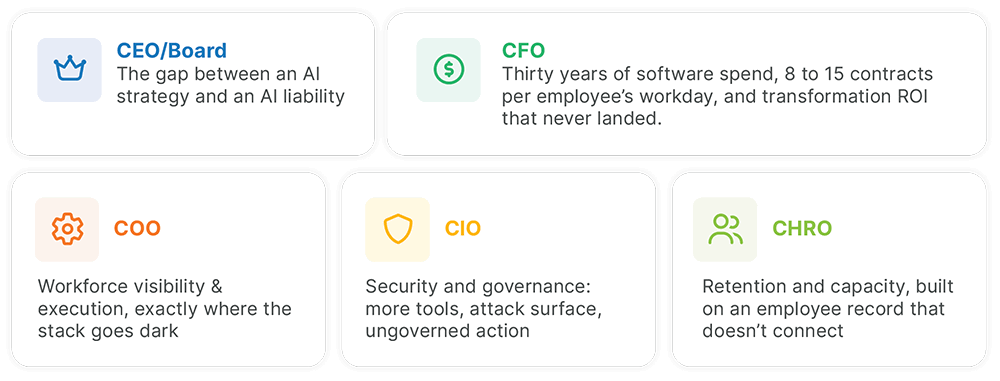
Look at where the consequences actually land, seat by seat.
| Seat | What is actually at stake |
|---|---|
| CEO / Board | The gap between an AI strategy and an AI liability. |
| CFO | Thirty years of software spend, 8 to 15 contracts per employee's workday, and transformation ROI that never landed. |
| COO | Workforce visibility and execution, exactly where the stack goes dark. |
| CIO | Security and governance: more tools, more attack surface, more ungoverned action. |
| CHRO | Retention and capacity, built on an employee record that does not connect. |
Every line is a top-of-house outcome. Not one of them is an IT-only concern. The rule of thumb writes itself: the person who owns the consequence should own the decision.
Why "let IT pick a tool" breaks down
The foundation decision determines whether AI can act across the business at all. That is not a thing you can settle one tool at a time.
Handed down as a series of separate tool choices, it defaults to fragmentation, the exact condition the first part of this series described, which the entire leadership team then spends the next several years governing. Nobody chose that outcome. It was the byproduct of never treating the foundation as a decision in the first place.
Here is the distinction that keeps getting collapsed: choosing the model is a procurement question. Choosing the foundation the model stands on is a strategy question. When the two are treated as one, the strategy question quietly disappears into the tool selection, and the business inherits whatever foundation happened to come attached.
IT is essential to evaluating and running any of this. That is not in question. What does not belong to IT alone is the decision about whether AI can touch the business at all.
What the C-suite actually owns
Not which model. The foundation the model stands on.
It helps to see the real alternative clearly. It is rarely one competitor. It is a stack assembled over years: an HRIS here, a separate HCM, a workforce management tool, a learning system, a performance system, a comms app, a help desk, each from a different vendor, each a reasonable purchase on its day. No one ever chose that stack as a strategy. It accreted, one sensible decision at a time, into the thing an AI strategy now has to sit on top of.
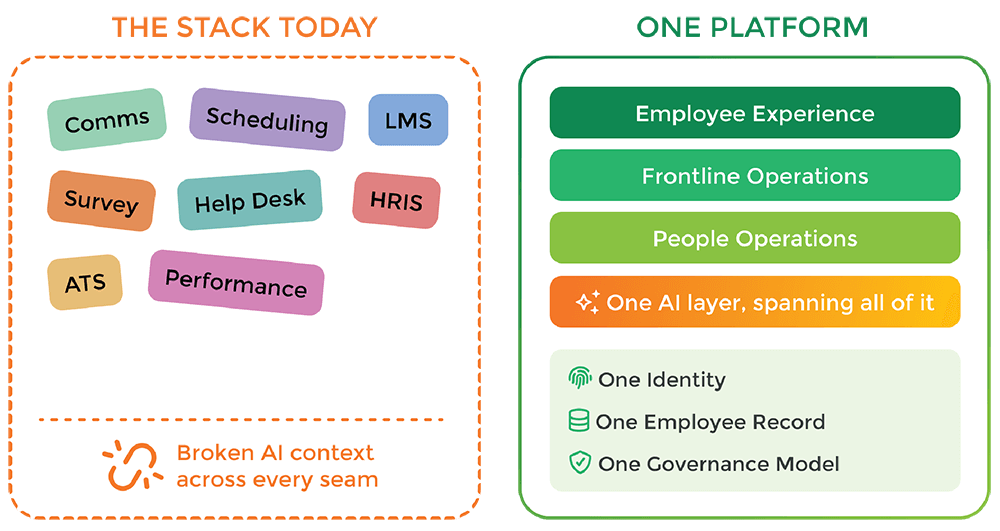
So the job the C-suite actually owns is narrow and decisive: turn the foundation from an accident into a decision. Made deliberately once, it compounds, because every capability added later inherits the same identity, data, and governance. Made by default, it accretes into the liability line already on the table.
The questions to settle before the tool conversation
Before the discussion turns to which assistant or which model, a leadership team can settle the decision that actually matters with a short list of questions, answered together across seats:
- What does our AI actually stand on: a shared foundation, or a stack of separate systems?
- Can it act across the business, or only answer within one tool?
- Who governs what it does, and can we see it and stop it?
- Does it reach the whole workforce, or only the people at desks?
That is the level a leadership team decides on, not a feature checklist. Get those four right and the tool questions get easier. Skip them and no tool choice will save you.
It is also a more bounded decision than it looks. The right foundation can be de-risked on commercial terms a CFO recognizes: an Adoption Guarantee, where employees have to actually adopt the platform or you do not pay, alongside 98% retention and an NPS of 78. Those turn a decision that feels like a bet into one with a floor under it.
The decision belongs in the room where it lands
AI at work is not a tool IT rolls out. It is a decision about the foundation of the business, and it belongs in the room where its consequences land.
The case for the AI-Ready Employee Platform for the Frontline is built to be made there: seat by seat, in the language each owner already uses, at the level the decision actually gets made.
Get the full argument
This is the ownership argument in short. The full case, laid out seat by seat for the CEO, CFO, COO, CIO, and CHRO, is in the book. It is built to be read in a leadership meeting, not skimmed at a desk.
Download The Employee Platform for the AI Era (Executive Edition) from the resource library here, or talk to someone who knows your industry.
Frequently asked questions
Is adopting AI at work an IT decision or a leadership decision? It is a leadership decision. IT is essential to evaluating and running it, but the choice of foundation determines whether AI can act across the business at all, and the consequences land on outcomes the C-suite owns directly: security exposure, workforce execution, retention, and the return on years of software spend. Scoped as an IT procurement task, the strategy question disappears into the tool selection.
Who owns AI strategy in an enterprise? The C-suite and the board own AI strategy, because AI strategy is really a decision about the foundation the business runs on, not about a single tool. The CEO owns the gap between an AI strategy and an AI liability. The CFO owns the spend and the return. The COO owns execution. The CIO owns security and governance. The CHRO owns retention and the employee record. IT executes and operates, but no single function should scope whether AI can touch the business.
Why should AI at work not be delegated entirely to IT? Because delegating it as a series of tool choices defaults to fragmentation. The foundation decision, whether AI can act across the whole business inside one set of rules, cannot be made one tool at a time. Handed down piece by piece, it produces a stack of disconnected systems that the entire leadership team then spends years governing, which is the opposite of a strategy.
What is the difference between an AI strategy and an AI liability? An AI strategy is a deliberate choice of foundation that lets AI act across the business safely, under governance the leadership team can see and control. An AI liability is what accretes when that choice is never made: AI deployed on top of disconnected tools, acting faster on data nobody fully governs, with no single place to audit or stop it. The same technology becomes one or the other depending entirely on the foundation beneath it.
How does the choice of AI foundation affect the CFO, COO, CIO, and CHRO? Directly, and differently for each. The CFO carries the cost of duplicated contracts and stalled transformation ROI. The COO loses visibility exactly where the stack goes dark, on the frontline. The CIO absorbs the added attack surface and the risk of ungoverned action every new tool introduces. The CHRO tries to drive retention and capacity on an employee record split across systems that never agree. A shared foundation improves all four at once. A fragmented one degrades all four at once.
What should a leadership team decide about AI before choosing tools? Four things, answered together: what the AI stands on (a shared foundation or a stack), whether it can act across the business or only answer within one tool, who governs it and whether it can be seen and stopped, and whether it reaches the whole workforce or only the people at desks. Settle those and the tool selection becomes straightforward. Skip them and no tool choice compensates.
What role does IT play if AI is a C-suite decision? A central one, in execution. IT evaluates vendors, runs security review, manages integration and rollout, and operates the platform day to day. What changes is scope: IT should not be the seat that decides, alone and one tool at a time, whether AI can act across the business. That is a strategy decision the leadership team owns, with IT as an essential partner in making and running it well.
Why is choosing an employee platform a board-level decision? Because the platform is the foundation every future AI capability inherits, and that foundation shapes outcomes the board is accountable for: risk, workforce execution, retention, and the return on software spend. Chosen deliberately, it compounds as the company adds capabilities. Chosen by default, it becomes a liability the board has to answer for later. That is why choosing an AI-Ready Employee Platform belongs on the board's agenda, not buried in a procurement cycle.
The MangoApps Team
We're the product, research, and strategy team behind MangoApps — the unified frontline workforce management platform and employee communication and engagement suite trusted by organizations in healthcare, manufacturing, retail, hospitality, and the public sector to connect every employee — deskless or desk-based — to the people, tools, and information they need.
We write about enterprise AI for the workplace, internal communications, AI-powered intranets, workforce management, and the operating patterns behind highly engaged frontline teams. Our perspective is grounded in a decade of building for frontline-heavy industries and shipping AI agents, employee apps, and integrated HR workflows that real employees actually use.
For short-form takes, product news, and field notes from customer rollouts, follow Frontline Wire — our ongoing stream on AI, frontline work, and the modern digital workplace — or learn more about MangoApps.


