What B2B Community Management Platforms Actually Do — and Why Learning Infrastructure Determines Whether Yours Succeeds
B2B software companies lose customers not at renewal but at onboarding — when customers who purchased the product can't figure out how to use it, can't find answers without opening a support ticket, and have no peer community to ask. Per McKinsey research, 89% of frontline workers stay with their companies when leaders genuinely listen to their feedback. The same mechanism operates for customers: those who feel supported through a structured post-sale experience stay; those who don't find alternatives at their next renewal.
Most B2B community platforms are built to solve the engagement problem — forums, discussion channels, peer networks. Fewer are built to solve the learning problem that determines whether a customer reaches the value that justified the purchase in the first place. That gap between product launch and full adoption is where churn originates, and it's where a community platform either earns its budget or doesn't.
MangoApps Community Suite was built specifically to close that gap — by combining structured customer learning, community engagement, behavioral analytics, and a feedback-to-roadmap pipeline in a single environment. Whether it's the right fit for your organization depends on how you answer the evaluation criteria in this article.
What a B2B customer community platform actually needs to do
A community platform earns its budget by reducing three costs: support overhead (customers who find answers in the community rather than opening tickets), time-to-value for new customers (onboarding that works without continuous hand-holding), and involuntary churn from customers who never fully adopted the product. Each of these is addressable — but only through a combination of learning infrastructure, behavioral analytics, and community engagement working in coordination.
Platforms that produce measurable retention outcomes share a structural property: they connect learning completion to community engagement to product usage in a single customer view. A customer success manager who can see which accounts haven't completed onboarding, which are disengaged in the community, and which haven't activated key product features has something actionable. One who only sees forum posts doesn't.
Per McKinsey research, 81% of leading companies effectively use data and analytics tools to drive business decisions. The question for any B2B community platform purchase is whether the tool becomes one of those analytics-driven systems — or sits alongside them as a separate, under-connected silo that requires manual reconciliation.
The four components of MangoApps Community Suite
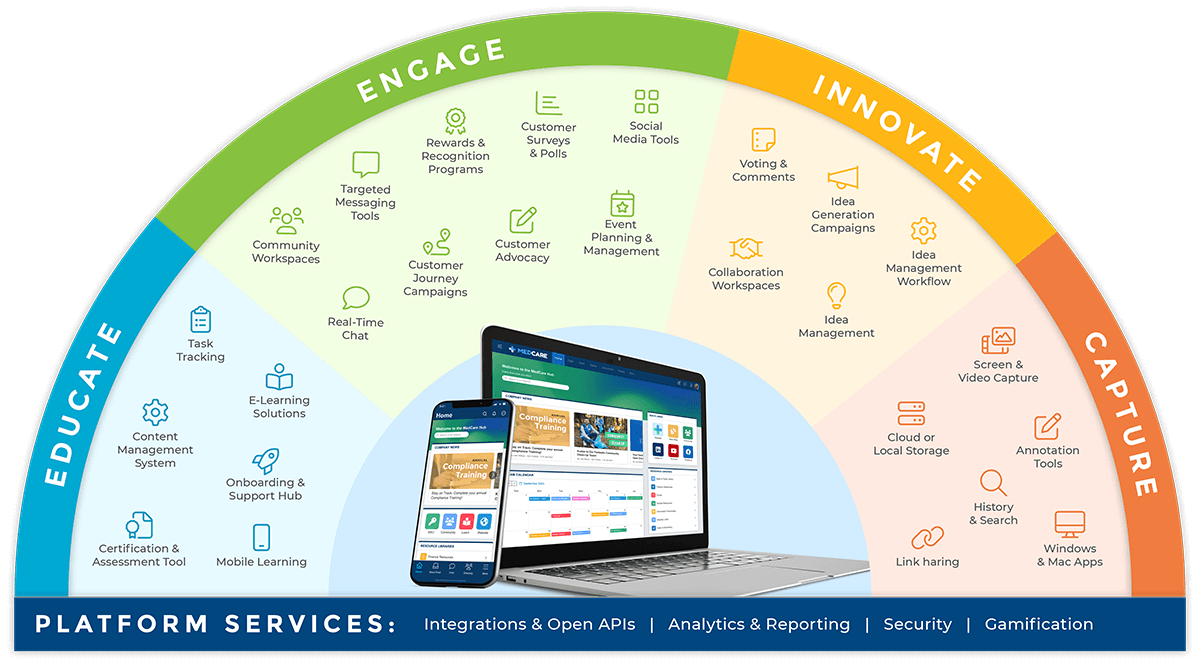
MangoApps Community Suite is organized around four components addressing distinct stages of the post-sale customer journey.
Educate is a structured learning layer — a learning experience platform (LXP) purpose-built for post-sale customers. Customers access onboarding modules, product training, and ongoing courses from the moment they sign up. Acknowledgement tracking records which customers have completed critical onboarding steps and viewed compliance-sensitive product updates, enabling targeted follow-up rather than blanket re-sends. Organizations that also run internal training programs can share infrastructure between employee learning and customer learning, reducing vendor overhead as both programs scale. For the structural analysis of why learning programs often fail to connect to actual job performance — a pattern that affects both internal and external programs in similar ways — Why Your Learning and Development Strategy Fails covers the common design failures directly.
Engage provides community spaces where customers exchange knowledge, ask questions, and build peer relationships. Sentiment analysis derived from in-community interactions surfaces satisfaction signals without requiring explicit survey responses — passive measurement that captures signals customers often won't self-report on a feedback form. Stronger peer networks reduce churn by deepening customer investment in the product ecosystem beyond the direct vendor relationship; when customers know other customers in the same community, switching costs increase meaningfully.
Innovate structures the feedback-to-product-roadmap pipeline. A unified customer data layer connecting community activity, learning progress, and product usage gives customer success teams full context for every interaction — not just an unstructured feedback queue. Per McKinsey research, 86% of customer-facing teams lack sufficient in-the-moment insights to make good decisions; the Innovate component is designed to surface those signals proactively. The goal is to shift customer success from reactive support toward identifying churn risk before it surfaces in a renewal conversation.
Capture carries forward the platform's original screen recording and annotation functionality, used for creating training content, documenting product walkthroughs with visual context, and sharing bug reports with enough detail to act on without back-and-forth clarification.
Where B2B community investments consistently underdeliver
The business case for community investment is not in dispute. Highly engaged workplaces see a 23% increase in productivity and 78% less absenteeism, per gallup.com. The underlying mechanism — people who feel heard and connected perform better and stay longer — applies to customer relationships as directly as it does to employee relationships. Per Gallup's 2026 State of the Global Workplace research, consistent acknowledgment and responsiveness to feedback are among the strongest predictors of retention across engagement contexts.
The problem isn't the premise. It's the execution gap between launching a community and reaching the retention outcomes the premise promises.
Most community platforms address one dimension well — typically the engagement layer, with discussion forums and peer networking — while treating learning infrastructure and behavioral analytics as secondary features or separate integration projects. The result is predictable: a community customers log into occasionally, don't use to complete onboarding, and don't treat as a meaningful substitute for direct support. The platform doesn't change churn behavior because it hasn't closed the gap between community activity and actual product adoption.
The differentiating factor for Community Suite is integration across all four components. When a customer success manager opens an account view, they see learning completion rates, community engagement trends, and product usage in context — not scattered across three separate tools. That integrated view is what enables a different kind of work: proactive retention rather than reactive ticket management. Without it, even well-designed community programs tend to plateau at engagement metrics that don't correlate with renewal rates.
Criteria for evaluating a B2B community platform
Learning infrastructure depth. If post-sale education is a priority, the platform requires more than a discussion forum. Evaluate whether it supports course sequencing, completion tracking, acknowledgement records, and content updates that don't require rebuilding entire module structures from scratch. For compliance-sensitive onboarding in regulated industries — healthcare, financial services, professional certifications — acknowledgement tracking is a requirement, not an enhancement.
Behavioral analytics. Passive data (login activity, post counts) is table stakes. The differentiator is whether the platform converts behavioral signals into actionable customer health indicators: which segments are disengaged before they report it, which accounts haven't reached onboarding milestones, which are approaching churn risk based on declining activity patterns over time. Per the IDC MarketScape: Worldwide Experience-Centric Intelligent Digital Workspaces 2024 Vendor Assessment, the leading platforms on analytics are those connecting community activity to broader engagement and product usage data rather than reporting on forum metrics alone.
Integration with existing systems. A community platform that operates independently of your CRM, product analytics stack, and internal communication infrastructure creates a second data silo. Evaluate the integration architecture before committing. For organizations already on Microsoft 365, the MangoApps & Microsoft Integration Guide documents the connection points without requiring separate content management workflows on both sides.
Multilingual support. For global B2B technology companies serving customers across languages and time zones, native multilingual content delivery — not manual translation workarounds — is a concrete differentiator. Confirm whether the platform supports translated onboarding modules and community content natively, and what the operational cost to maintain translated content looks like at scale.
Onboarding timeline. A 9-month average deployment timeline — the benchmark from the dormakaba case study for complex intranet projects — is too slow for a community platform expected to affect onboarding outcomes for new customers immediately. Ask vendors for a specific time-to-first-active-community milestone and what structured onboarding support is included in the contract.
Who should evaluate MangoApps Community Suite
The platform fits most directly for B2B software and technology companies that need structured post-sale education alongside a customer community — particularly where acknowledgement tracking, compliance-sensitive onboarding, or behavioral analytics are requirements rather than optional features. Organizations already using MangoApps for internal employee engagement can extend the same platform infrastructure to their customer base without adding a second vendor relationship or a second data environment to manage.
It is a less natural fit for companies whose primary requirement is a lightweight discussion forum, or for organizations without a dedicated customer success function to manage moderation, content creation, and community health on an ongoing basis. Community platforms require sustained operational investment alongside the technical infrastructure — a forum with no one actively curating it doesn't reduce support tickets or improve retention outcomes.
The infrastructure question that determines ROI
Community platforms fail for the same structural reason that internal communication tools fail: the channel launches without the learning infrastructure, behavioral signals, and feedback loops that make engagement valuable. A forum without structured onboarding produces customers who browse occasionally and churn predictably. The productivity and retention improvements Gallup measures in highly engaged organizations don't come from launching a community — they come from building the conditions that make engagement a habitual part of the customer's workflow rather than an optional activity.
The question isn't whether to invest in a B2B customer community. It's whether the platform you choose connects learning, engagement, and analytics into a single retention mechanism — or leaves those connections as integration projects to be addressed in a future phase that rarely arrives on schedule.
The MangoApps Team
We're the product, research, and strategy team behind MangoApps — the unified frontline workforce management platform and employee communication and engagement suite trusted by organizations in healthcare, manufacturing, retail, hospitality, and the public sector to connect every employee — deskless or desk-based — to the people, tools, and information they need.
We write about enterprise AI for the workplace, internal communications, AI-powered intranets, workforce management, and the operating patterns behind highly engaged frontline teams. Our perspective is grounded in a decade of building for frontline-heavy industries and shipping AI agents, employee apps, and integrated HR workflows that real employees actually use.
For short-form takes, product news, and field notes from customer rollouts, follow Frontline Wire — our ongoing stream on AI, frontline work, and the modern digital workplace — or learn more about MangoApps.
Dive Deeper