What AI-Powered Scheduling Actually Changes for Frontline Operations
Per Emergence Capital, 80% of the global workforce is deskless. Yet most scheduling software has been designed for the 20% with assigned desks, calendar tools, and time between meetings to log into a browser-based system. For the other 80%—warehouse associates, clinical staff, retail employees—the schedule is not a productivity artifact. It is the primary interface between employer and employee. How it gets built, distributed, and adjusted determines whether that relationship is one of trust or managed frustration.
MangoApps has added AI-powered scheduling and shift swap capabilities to its platform, now available through the MangoApps App Marketplace. But this analysis is not a feature announcement. It is about what the release actually changes for frontline operations leaders who live inside scheduling decisions every week—and why the scheduling layer is the correct place to start measuring employee experience in sectors where desk-based platforms have never achieved meaningful adoption.
Why scheduling is where frontline trust gets built—or eroded
Consider a district manager overseeing six retail locations. Each week, she builds schedules across 120 employees using two spreadsheets and a shared document, manually cross-references labor law requirements for two states, and fields 30 to 40 text messages from employees requesting shifts, trading coverage, and reporting last-minute absences. The schedule publishes Friday afternoon. By Monday morning, 15 percent of it has already changed.
This is not an edge case. It is the default operating state for frontline teams that have not automated the scheduling layer. The cost is not only the time consumed by manual operations—it is the trust damage that accumulates when employees cannot see how their shifts are assigned, cannot easily trade with a colleague, and have no structured path for signaling availability constraints. Opacity in scheduling is one of the most underweighted contributors to voluntary turnover in shift-work environments.
When employees experience scheduling as something that happens to them rather than something they can influence, the employer-employee relationship starts at a deficit before the first shift ever begins. The practical consequence shows up in absenteeism first—workers calling out because trading a shift was too cumbersome—and then in attrition data months later, after the accumulated frustration of invisible, unpredictable scheduling decisions has made leaving feel easier than staying.
The three capabilities—and what they actually do in shift work management
The release adds three distinct tools to MangoApps' existing shifts and schedules foundation:
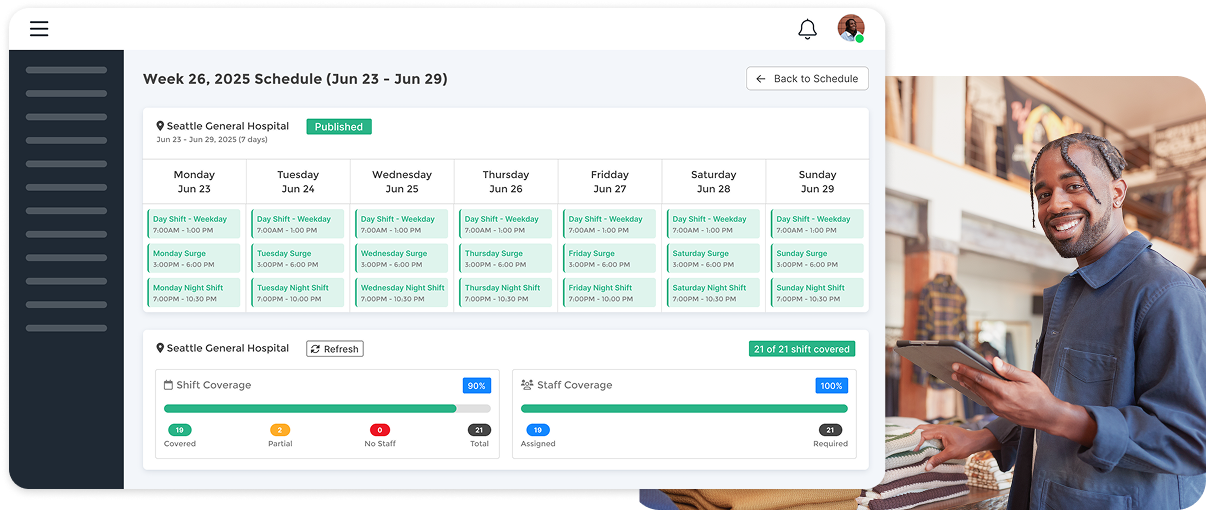
AI Smart-Schedule Builder ingests employee preferences, skills, union rules, labor law constraints, and forecasted demand to generate an optimized draft. Managers review and publish rather than build from scratch. For organizations with configurable compliance rules by location—a requirement for multi-region or unionized environments—the engine applies those rules before the schedule reaches any manager's screen.
Shift Marketplace and Mobile Swaps let employees pick up, drop, or trade shifts from any device. Auto-approval rules enforce compliance on routine exchanges without manager involvement. A swap that previously required three text messages, a callback, and a manual edit now resolves in two taps. Per Beekeeper's shift-swap benchmarks, automated shift-swap workflows reduce absenteeism on day one—a specific outcome the manual operations alternative cannot match because the friction itself drives the avoidance behavior.
Fairness Scoring is the least obvious of the three features and potentially the most consequential for retention. Each employee receives a transparent score—based on seniority, attendance, and manager feedback—that the scheduling algorithm incorporates when distributing shifts. Workers can see their score and understand exactly how to improve it. That visibility changes the dynamic between the scheduling system and the workforce. When the logic is accessible rather than opaque, employees engage with scheduling as a system they can influence rather than one they must endure.
Together, these three capabilities constitute a named shift work management layer embedded inside a broader employee experience platform—a distinction that matters more than it might appear at first.
What changes when scheduling lives inside a unified platform
Per IDC, employees spend an average of 2.5 hours per day searching for information they cannot easily find. In frontline environments, that search time concentrates around the highest-friction moments of the workday: confirming a shift start time, finding a colleague willing to cover, locating the policy that governs a swap request. When scheduling lives in a separate tool from task management, training, and team communication, every one of those moments requires switching context, logging into a different system, or sending a text to a supervisor.
The MangoApps architecture puts scheduling, task coordination, training, and communication inside the same platform layer. A new hire can complete onboarding, view their first schedule, and request a swap without changing applications. That is a structurally different user experience than deploying a point solution alongside five other tools—and it produces structurally different adoption outcomes.
Per Social Edge Consulting, 91% of organizations already operate an intranet. But only 13% of employees use it daily, and nearly a third never log in at all. Per SWOOP Analytics, the average employee spends just six minutes per day using intranet tools. Those figures describe what happens when organizations give frontline employees a platform designed for desk workers and expect the adoption curve to follow. A mobile-first scheduling system with built-in shift swaps and fairness scoring is not a scheduling module layered on top of a desk-worker intranet. It is a different product category serving a different user profile with different access constraints.
Compliance without the manual review
For organizations managing unionized workforces or multi-region teams, scheduling compliance is not a feature—it is a liability management requirement. A schedule that violates a collective bargaining agreement creates a grievance, a manager investigation, and potentially arbitration before any operational disruption even surfaces.
The AI Smart-Schedule Builder applies configurable compliance rules per location before publication. A manager in a unionized distribution center in California and a manager in a non-unionized retail location in Texas can use the same platform with entirely different guardrails, without either having to manually consult an operations manual before publishing. Managing a unionized workforce requires software that handles these rules differently—and the Smart-Schedule Builder is built with that constraint as a first-order requirement rather than a configuration footnote.
The same architecture applies to HRIS and payroll integration. When scheduling syncs automatically with employee role data and availability, the manual data entry errors that generate overtime exceptions and payroll discrepancies are removed at the source rather than caught—and corrected—downstream.
What frontline adoption looks like at scale
Efficiency claims about scheduling automation remain directional without customer evidence. The Raley's Companies case study documents what this platform architecture produces at 20,000 employees across a regional grocery operation—a frontline workforce with complex shift patterns, no assigned workstations, and scheduling requirements that vary across store formats, departments, and seasonal demand shifts. The case provides a concrete reference point for buyers evaluating whether the unified-platform approach delivers different outcomes than the multi-tool alternative.
For organizations actively evaluating scheduling and shift swap tools, three questions will sharpen the business case faster than any product demonstration:
First: How many tools does a manager currently touch to build, publish, and adjust a weekly schedule? If the answer is more than two, consolidation produces immediate time savings and reduces manual operations errors before any AI optimization is applied.
Second: Which compliance rules are currently enforced by reviewing an operations manual? Automated guardrails only deliver value if the platform's rule configurability matches your jurisdiction requirements. Request a demo scoped to your actual union agreements or state-specific labor laws, not a generic walkthrough.
Third: What does adoption look like in comparable customer deployments—specifically among workers without corporate email credentials? That population is where the gap between a deskless-first platform and a desk-worker platform with a mobile wrapper becomes visible. Adoption rates among office workers with full enterprise licenses do not transfer to frontline environments where the onboarding and access model are fundamentally different.
The schedule as a proxy for the employee relationship
"For frontline employees, the schedule is the foundation on which trust is built," said Anup Kejriwal, CEO of MangoApps. "Your scheduling practices dictate the tenor of the relationship. If you don't cater to employee needs and preferences, people find other jobs."
That framing is the correct lens for evaluating any scheduling technology investment. The specific features a platform offers—AI optimization, mobile swaps, fairness scoring—matter less than whether the system is designed for how frontline workers actually operate: starting from a personal mobile device, without a corporate email address, during the active working hours when they have the least availability for navigating a complex interface.
A platform built for that operating profile produces different retention outcomes than one built for office workers and extended to frontline teams as an afterthought. Evaluating the difference requires asking for adoption data from the right population—not aggregate session metrics, but specifically among deskless workers in comparable industries.
For HR and operations leaders building or refreshing their frontline technology stack, the 2026 Workforce Operations Trends eBook includes category benchmarks across scheduling, task management, and communication, with measurement frameworks for evaluating where your current stack leaves the most time, trust, and operational efficiency unrealized.
The MangoApps Team
We're the product, research, and strategy team behind MangoApps — the unified frontline workforce management platform and employee communication and engagement suite trusted by organizations in healthcare, manufacturing, retail, hospitality, and the public sector to connect every employee — deskless or desk-based — to the people, tools, and information they need.
We write about enterprise AI for the workplace, internal communications, AI-powered intranets, workforce management, and the operating patterns behind highly engaged frontline teams. Our perspective is grounded in a decade of building for frontline-heavy industries and shipping AI agents, employee apps, and integrated HR workflows that real employees actually use.
For short-form takes, product news, and field notes from customer rollouts, follow Frontline Wire — our ongoing stream on AI, frontline work, and the modern digital workplace — or learn more about MangoApps.