MangoApps Workplace for SMBs: Intranet, Collaboration, and Security in One Platform
Per IDC, employees spend 2.5 hours per day searching for information that should be easy to find. For small and medium-sized businesses, that overhead compounds quickly — and unlike large enterprises with dedicated IT teams, SMBs rarely have the resources to architect integrations between separate chat, file storage, survey, and task management tools. The usual approach is to pick the cheapest tool that covers the most ground and accept the gaps.
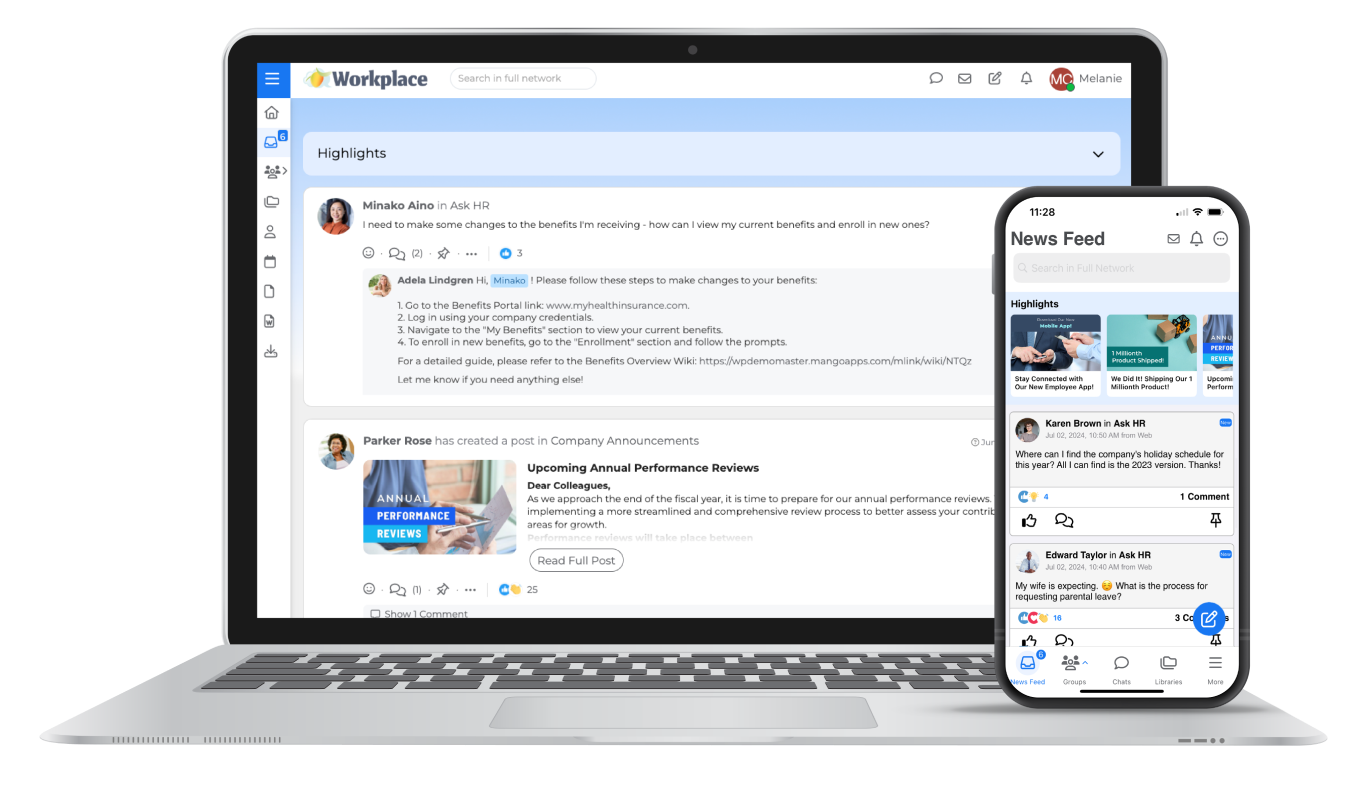
That calculation changed in 2024 when MangoApps launched MangoApps Workplace — an intranet and employee communications platform built specifically for SMBs. It consolidates the functions most SMBs piece together with multiple vendors into a single environment, with enterprise-grade security included by default, not priced as a premium add-on.
Why SMBs are stuck between two bad options
The employee intranet and collaboration market broadly divides into two categories that do not serve SMBs well.
Enterprise platforms — Unily, Simpplr, and their peers — are engineered for organizations with thousands of employees, dedicated IT departments, and implementation budgets that reflect their complexity. The tools are capable. The deployment timelines, contract sizes, and admin overhead are not sized for a 75-person logistics company or a 200-person healthcare practice.
General-purpose chat tools go the other direction. They are fast to deploy and familiar, but they are not intranets. They do not support structured content publishing, employee recognition workflows, or org-wide news feeds with read receipts. SMBs typically wrap them with separate tools for file management, surveys, and task tracking — recreating the point-solution fragmentation they were trying to escape.
Per Social Edge Consulting, 91% of organizations operate an intranet, yet nearly a third of employees never log in. Only 13% use one daily. Per SWOOP Analytics, the average employee spends just six minutes per day in intranet tools. These numbers do not describe a workforce that lacks willingness — they describe tools built for desktop access that fail the majority of workers who are not sitting at one. Per Emergence Capital, 80% of the global workforce is deskless.
An intranet that requires a corporate email login excludes most of those workers before they ever open the app.
What enterprise-grade security means for an SMB
Five major competitors in the SMB intranet market now position secure intranet as a core differentiator, leading with SAML 2.0, OAuth 2.0, and SSO support in their buyer materials. For SMBs in financial services, healthcare, and other regulated industries, these are increasingly non-negotiable — organizations face the same compliance scrutiny as large enterprises, with fewer compliance resources to manage it.
MangoApps Workplace inherits the same security architecture as the enterprise tier of the MangoApps platform. SAML 2.0, OAuth 2.0, SSO, and role-based permissions are standard across all packages — Basic, Standard, and Pro — not reserved for a premium tier. The audit trail and permission structures that enterprise deployments depend on are present from day one, which matters for SMBs building toward compliance requirements they will face in 18 months, not just meeting current ones.
This architecture also applies to AI features. MangoApps connects to OpenAI, Gemini, and Azure OpenAI for AI-assisted search, content generation, and workflow automation. For SMBs evaluating AI-native platforms, the question of data governance — who controls the data, what audit structures exist — is increasingly central to the buying conversation. MangoApps' existing permission model applies to AI features by default.
The frontline access problem most intranets ignore
Access architecture matters as much as the feature set. SMBs with retail associates, healthcare aides, warehouse workers, or field technicians often find that their intranet reaches office staff and misses everyone else. SWOOP Analytics' six-minutes-per-day figure is the outcome of tools built for desktop access deployed across workforces that do not primarily work at desks.
MangoApps Workplace supports mobile access without requiring a corporate email address. This is not a workaround — it is the default. For industries where a significant share of the workforce is hourly, shift-based, or field-based, the access model determines whether the platform reaches the full team or only headquarters staff.
The adoption data shows what is possible when mobile access is built in from the start. Enterprise deployments of MangoApps have reached 90% frontline adoption within the first six months — a benchmark that reflects what happens when the access barrier is removed rather than routed around. The retention math follows: replacing a disengaged frontline employee costs between $4,400 and $15,000 depending on role and industry. A platform that reaches 40% of the workforce is not solving the retention problem — it is documenting it.
What MangoApps Workplace includes
MangoApps Workplace is organized around four functional areas:
Communication — Real-time messaging and group channels, personalized news feeds segmented by role or location, and announcements with read receipts. Managers can verify that critical communications reached specific employee groups, not just that the message was sent.
Collaboration — File sharing and document management with version control, project workspaces that keep tasks, files, and conversations together, and integrations with Microsoft 365 and Google Workspace for teams that are not ready to consolidate everything at once.
Employee engagement — Recognition tools for peer-to-peer acknowledgments and milestone tracking, interactive polls and surveys for gathering feedback without a separate survey tool, and customizable branding so the environment reflects the company identity rather than a generic vendor interface.
Productivity — Task management, screen recording for async communication and training, and digital forms that replace paper-based processes. For SMBs managing multi-location operations, these features cover the coordination layer that disappears when communication and task tracking live in separate systems.
For SMBs evaluating the all-in-one value proposition, the relevant comparison is not MangoApps Workplace versus a single competitor — it is MangoApps Workplace versus the full set of tools currently filling the same functions. A typical SMB with a separate chat tool, shared drive, survey platform, and task manager is paying for four vendor relationships, four security policies to maintain, and four mobile apps for employees to install and update. The consolidation benefit is concrete: a single identity layer, a single permission model, and a single place where employees look for information instead of cycling through fragmented systems that cost IDC's estimated 2.5 hours per day in search overhead.
The platform is also designed to scale. Moving from Basic or Standard to the Enterprise tier does not require a data migration — the underlying architecture is the same. SMBs evaluating MangoApps as a long-term platform are not picking a tool they will need to replace when they reach 500 employees.
The Workplace by Meta migration window
Workplace by Meta's August 2025 shutdown created a clear migration deadline for tens of thousands of organizations. The most common mistake in those evaluations is treating the migration as a data transfer problem. Moving posts and files is the straightforward part. Three areas require deliberate planning:
Audit trails. Compliance-sensitive SMBs need a preserved record of past communications. How historical content will be indexed and retained should be specified before migration begins, not discovered afterward.
Permission mapping. Group structures and access controls from Workplace by Meta need to translate explicitly to the new platform before launch day. Organizations that skip this step typically spend the first 30 days post-migration cleaning up access errors that compound into confusion.
Governance continuity. Content moderation policies, admin roles, and approval workflows should transfer explicitly. These are easy to overlook in a migration focused on content volume and difficult to reconstruct from memory after the transition.
MangoApps Workplace's 15-year history as an enterprise social network means the governance and permission architecture is already in place. SMBs migrating from Workplace by Meta are not building audit and governance structures from scratch on a platform that was not designed for them — they are configuring structures that exist and have been tested at scale.
How to evaluate MangoApps Workplace
The self-serve model reflects how MangoApps has positioned the SMB product. As CEO Anup Kejriwal put it: "SMBs shouldn't have to choose between cheap, incomplete tools or expensive, complex enterprise tools just to communicate and collaborate. We are making it easy for teams to start using MangoApps to communicate and collaborate effectively, eliminating the need for multiple apps, all without being forced to speak to anyone to sign up for an account."
A 14-day free trial requires no credit card and no sales call. That access model lets evaluation teams test functionality with actual employee groups before a purchasing decision — and makes the internal business case easier to build when evidence comes from the team rather than a vendor demo.
Three practical questions worth settling during a trial:
Can your hardest-to-reach employees log in? Test with mobile access on personal devices, without corporate email credentials. If frontline staff cannot complete a self-serve login, the platform will not reach them at scale regardless of feature depth.
Does the security architecture match your compliance requirements? Request the SAML and SSO documentation early. For financial services and healthcare SMBs, this question eliminates most alternatives before the feature comparison begins.
What does migration look like on your timeline? If you are leaving Workplace by Meta, the August 2025 deadline is fixed. A trial that does not include a migration plan conversation is not a complete evaluation.
For independent benchmark context on where MangoApps sits in the intranet platform landscape, the MangoApps 2026 Forrester evaluation covers how MangoApps compares against comparable platforms in a structured third-party assessment. The 2026 Internal Communications Trends eBook covers how leading organizations are structuring communication infrastructure this year, including patterns that translate directly to SMB scale.
SMBs that have delayed a platform decision waiting for clarity are now at the point where the Workplace by Meta shutdown is actively closing the window. The right question before that window closes is not which platform has the longest feature list — it is which one your entire workforce can actually use starting on day one.
The MangoApps Team
We're the product, research, and strategy team behind MangoApps — the unified frontline workforce management platform and employee communication and engagement suite trusted by organizations in healthcare, manufacturing, retail, hospitality, and the public sector to connect every employee — deskless or desk-based — to the people, tools, and information they need.
We write about enterprise AI for the workplace, internal communications, AI-powered intranets, workforce management, and the operating patterns behind highly engaged frontline teams. Our perspective is grounded in a decade of building for frontline-heavy industries and shipping AI agents, employee apps, and integrated HR workflows that real employees actually use.
For short-form takes, product news, and field notes from customer rollouts, follow Frontline Wire — our ongoing stream on AI, frontline work, and the modern digital workplace — or learn more about MangoApps.