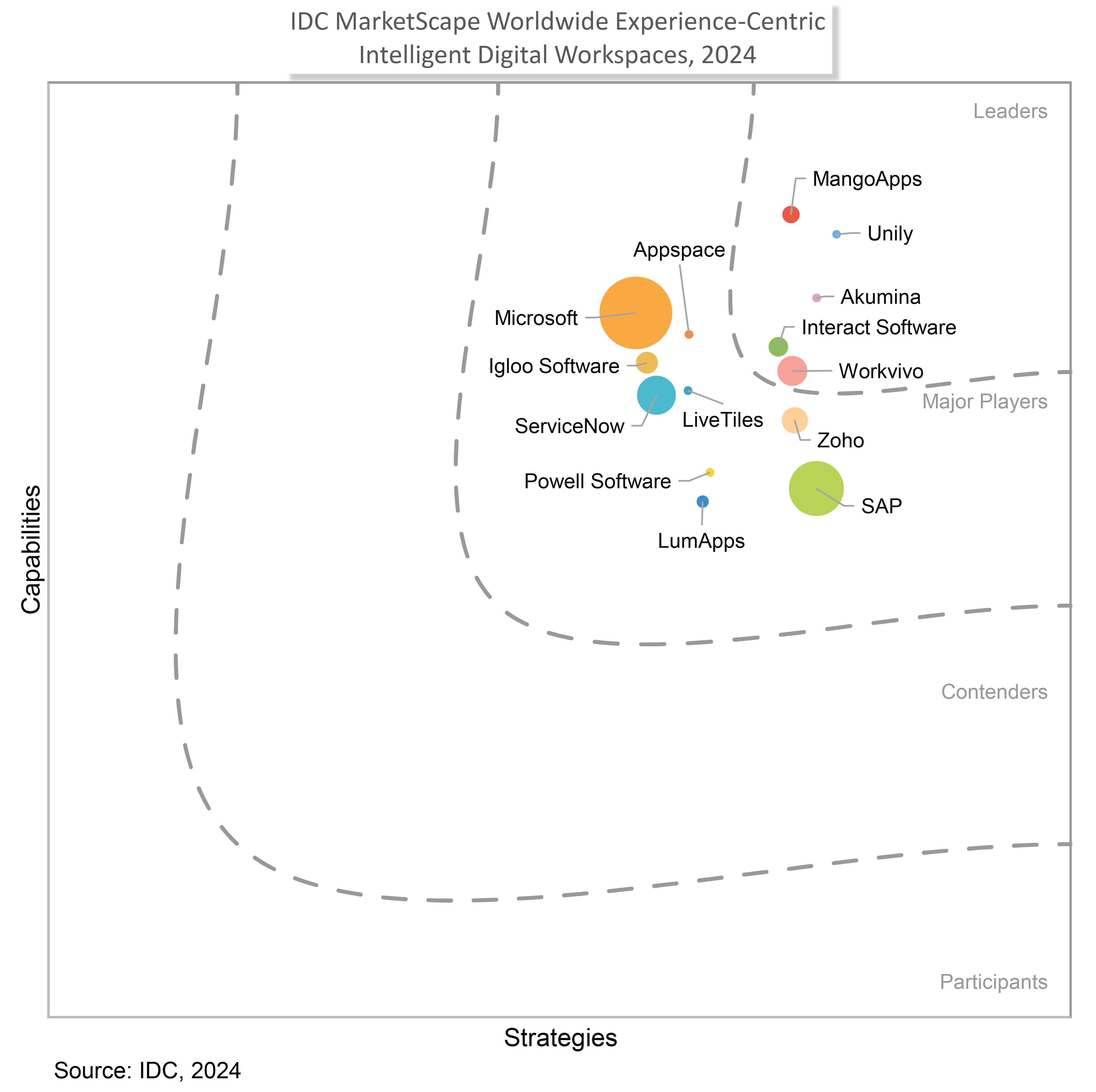
MangoApps has been recognized as a Leader in the IDC MarketScape: Worldwide Experience-Centric Intelligent Digital Workspaces 2024 Vendor Assessment. We are sharing what that designation means in context — not as a credential to display, but as a framework for understanding why experience-centric architecture matters in a market where most intranets fail the employees they are meant to serve.
The analyst recognition is meaningful. But the more useful context for enterprise buyers is what the IDC evaluation criteria reveal about the problem these platforms are built to solve and what separates high-adoption from low-adoption digital workspaces at scale.
The adoption paradox at the center of the intranet market
Per Social Edge Consulting research, 91% of organizations operate an intranet. The same research shows that only 13% of employees use one daily, and nearly a third never log in at all. Per SWOOP Analytics, the average employee spends six minutes per day using intranet tools.
Those three numbers describe the same problem from different angles. Organizations have built digital workspaces and achieved almost no adoption. And non-adoption is not a neutral outcome — it means communication campaigns do not reach the employees they are written for, training content sits in portals nobody opens, and knowledge management investments produce no operational return.
Per IDC research, employees spend an average of 2.5 hours per day searching for information. That number does not move unless the platform designed to resolve it is one employees actually open. A digital workspace that requires a corporate device, a VPN connection, or navigation flows designed for IT administrators rather than frontline workers is a workspace that most of the workforce will route around regardless of how many features it has.
Experience-centric architecture is the IDC MarketScape's framework for what separates platforms that close this gap from those that perpetuate it. The assessment methodology evaluates whether a vendor's architecture puts employee experience at the center in ways that produce measurably different adoption and outcome data — not whether the platform satisfies an RFP checklist.
What the IDC outcome data quantifies
The outcomes data in the IDC MarketScape grounds the recognition in operational terms. Organizations deploying experience-centric intelligent digital workspaces have seen a 40% increase in employee productivity and operational efficiency, a 34% improvement in customer experience, and a 31% enhancement in employee experience.
These are not projected outcomes — they reflect what organizations have measured after deployment. The productivity number maps directly to the information search problem: recovering even a fraction of the 2.5 hours employees currently spend searching for information each day produces measurable output increases without adding headcount or tooling. The customer experience improvement reflects an effect that is indirect but consistent — employees who can access current information and communicate without friction produce better customer outcomes. The employee experience improvement tracks with adoption: platforms employees actually use generate engagement data; platforms they avoid generate disengagement.
The IDC MarketScape assessment scores vendors on both current capabilities and forward strategy. MangoApps' Leader placement reflects where the platform stands today — and, in the assessment's view, where it is positioned to continue delivering as the market evolves.
What the Leader placement reflects architecturally
The IDC assessment identified three platform dimensions in MangoApps that informed the recognition.
Content and personalization. MangoApps provides content authors a block editor to manage branded microsites with templates for consistent production across teams and regions. Generative and general AI capabilities are integrated throughout the platform for information access, writing assistance with source notation, accessibility features, personalized recommendations, compliance controls, and security governance. Frontline workers are supported through a mobile app and interactive forms designed for employees who do not have a company email address — a meaningful distinction in industries where most of the workforce is in the field rather than at a desk.
Data architecture and integration depth. The IDC assessment noted that MangoApps "has been used by clients as a secure unified digital work hub integrated to 200+ enterprise systems allowing them to sunset other costly tools." That integration breadth reflects an architectural choice: MangoApps operates as the layer that consolidates communication, content, task management, and app access into a single authenticated experience rather than adding another tool to an already fragmented stack. Clients extend the platform with custom microapps and API webhooks and can apply CSS-level customization for branding and navigation without requiring engineering resources proportional to the customization scope.
Workspace features for engagement. MangoApps supports employee recognition aligned to company core values, a rewards store, and in-context polls — tools for engagement that operate inside the daily workflow rather than as a separate system requiring a separate login. The mobile experience mirrors the desktop interface for individualized widgets, company-wide mandatory news, and task dashboards, giving frontline workers functional parity with desk-based colleagues rather than a reduced mobile version.
Security and AI as structural differentiators
Per Emergence Capital research, 80% of the global workforce is deskless. That figure reframes the intranet category: a workspace designed for desk-based employees behind a corporate VPN misses the majority of the workforce by architecture. Experience-centric design means reaching employees on a mobile device in a distribution center, on a hospital floor, or at a retail location — with the security guarantees that enterprise IT requires and that frontline workers do not need to think about.
MangoApps' SAML 2.0, OAuth 2.0, and enterprise SSO integrations treat security as infrastructure rather than a configuration option unlocked at higher pricing tiers. Role-based access controls, audit logs, and compliance-grade data handling are part of the standard platform. The IDC designation of MangoApps as a "secure unified digital work hub" reflects a real competitive position: the secure intranet narrative is now contested across multiple vendor categories, and the distinction between security built into the architecture and security marketed as a feature matters for enterprise IT and procurement teams who need documentation, not positioning language.
The AI architecture follows the same structural logic. MangoApps connects to OpenAI, Google Gemini, Anthropic, and Azure OpenAI — multi-engine connectivity that matters when enterprise procurement requirements, data residency rules, or regional compliance constraints limit which AI providers an organization can use. AI capabilities in MangoApps are embedded across search, writing assistance, content recommendations, and accessibility tools — not a standalone module added to a pre-AI platform, but an AI layer integrated into the workflows where the productivity return is actually realized.
Three questions to bring into any digital workspace evaluation
The IDC MarketScape recommends MangoApps for organizations that are "midsize to large enterprise with both desk and deskless workers who need access to multiple apps integrated into a single company-branded AI-enabled digital workspace." That recommendation narrows the evaluation considerably for buyers whose actual criteria include frontline reach, integration breadth, and AI flexibility alongside standard collaboration feature comparisons.
Three questions worth investigating during any active platform evaluation:
What is your current platform's actual daily adoption rate? Per Social Edge Consulting, 13% of employees using an intranet daily is the industry average. If your platform performs at or below that figure, the problem is experience design, not content volume. The American College of Radiology case study walks through what targeted adoption work looked like in a complex, multi-site healthcare organization deploying a unified workspace — the outcomes reflected architectural choices, not publishing frequency.
How does the platform handle frontline access? An employee app built for desk-based workers effectively excludes 80% of the workforce. Evaluate whether the platform's mobile experience is a functional equivalent to the desktop or a reduced version — the difference determines whether communication and task tools actually reach frontline employees, and whether the engagement data you track reflects actual organizational reach or desk-worker-only adoption.
What is your AI dependency model? A platform that routes all AI requests through a single provider gives organizations no optionality when contracts, regional compliance rules, or model performance standards change. Multi-engine AI connectivity is increasingly a procurement requirement rather than a preference — evaluate whether a vendor's AI roadmap includes model flexibility or commits the organization to a single-provider dependency without a migration path.
For independent evaluation criteria applicable to the dimensions the IDC MarketScape assessed, the ClearBox Consulting 2026 Intranet and Employee Experience Platforms Report provides a framework that enterprise technology buyers can apply directly to platform selection decisions.
What this recognition reflects in the broader market
MangoApps has received recognition across multiple independent assessments this cycle. The Forrester Wave intranet platforms evaluation covers overlapping but distinct criteria — the IDC MarketScape focuses specifically on experience-centric architecture and the workforce reach outcomes that architecture produces. Both assessments reflect a consistent picture of where MangoApps positions in a market that is consolidating around unified, AI-enabled, frontline-accessible platforms.
The gap between 91% intranet ownership and 13% daily adoption is not narrowing on its own. Experience-centric architecture is the mechanism that changes that ratio — and the IDC assessment provides an independent framework for evaluating which platforms are actually built to close that gap rather than claiming to. The full excerpt from the IDC MarketScape: Worldwide Experience-Centric Intelligent Digital Workspaces 2024 Vendor Assessment (Doc#US49741923, January 2024) is available through MangoApps' resource library for organizations that want to apply the evaluation criteria to their own platform decisions.
The MangoApps Team
We're the product, research, and strategy team behind MangoApps — the unified frontline workforce management platform and employee communication and engagement suite trusted by organizations in healthcare, manufacturing, retail, hospitality, and the public sector to connect every employee — deskless or desk-based — to the people, tools, and information they need.
We write about enterprise AI for the workplace, internal communications, AI-powered intranets, workforce management, and the operating patterns behind highly engaged frontline teams. Our perspective is grounded in a decade of building for frontline-heavy industries and shipping AI agents, employee apps, and integrated HR workflows that real employees actually use.
For short-form takes, product news, and field notes from customer rollouts, follow Frontline Wire — our ongoing stream on AI, frontline work, and the modern digital workplace — or learn more about MangoApps.
Dive Deeper