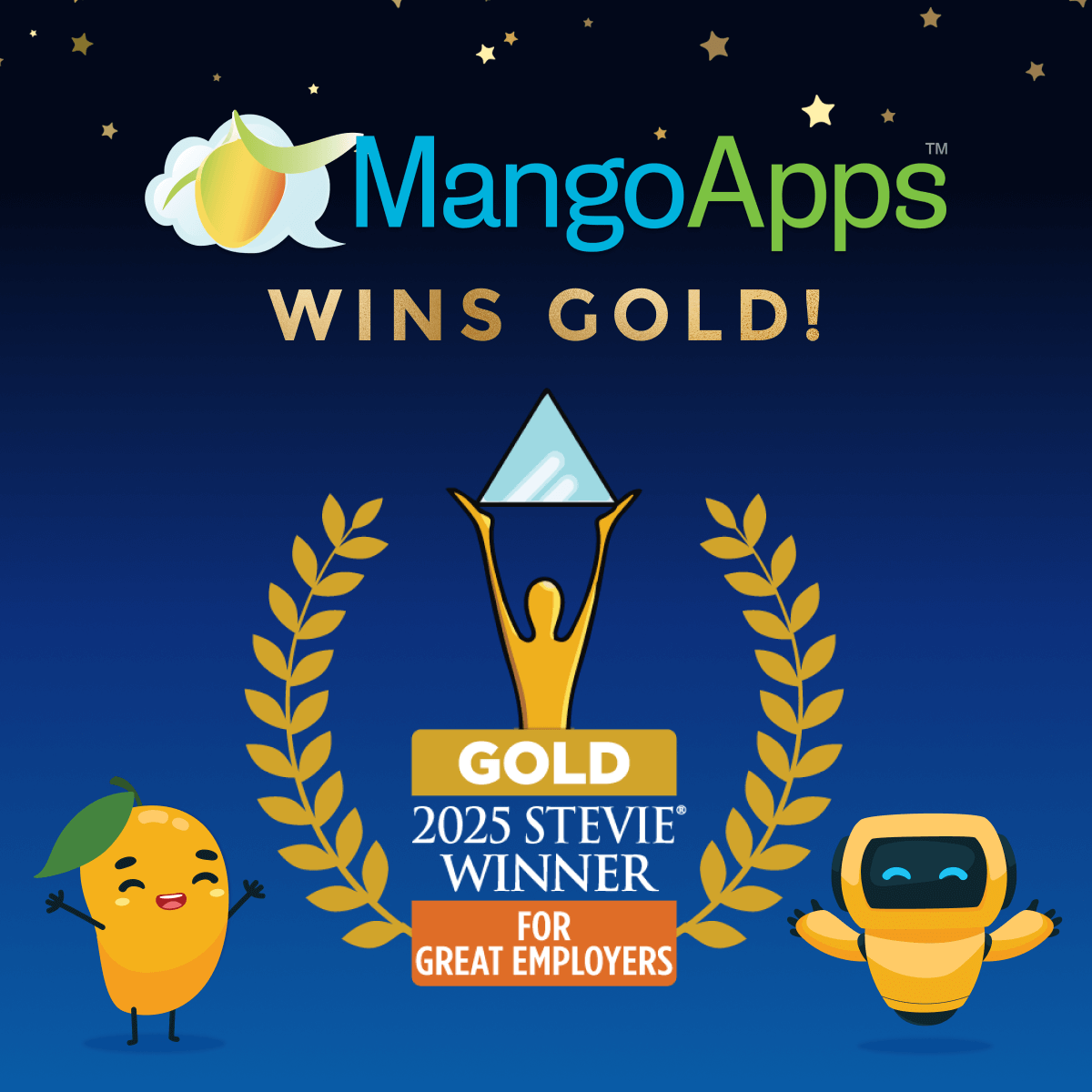
MangoApps has been honored with a Gold Stevie® Award as the top Employee Relations Solution Provider of the Year in the 10th annual Stevie Awards for Great Employers. The jury evaluated more than 1,000 nominations across 35 nations and territories — one of the broadest peer-evaluated HR technology awards in the industry. A gold placement in the Employee Relations Solution Provider category signals that the judges determined MangoApps made the clearest case, in a competitive field of software vendors, consulting firms, and HR service organizations, for measurable impact on the employee-employer relationship. The award was announced July 17, 2025, with a recognition gala scheduled for September 16 at the Marriott Marquis Hotel in New York City.
"We've spent over 15 years building a platform that puts employees first — especially those who have traditionally been left behind by enterprise technology," said Anup Kejriwal, CEO of MangoApps. "This recognition reinforces our commitment to helping organizations transform employee experience at scale, and we're incredibly proud to be named a Gold Stevie Award winner."
What the Stevie judges evaluated — and why this category differs from capability awards
Most vendor recognition programs assess capabilities: feature depth, integration coverage, and market presence. The Stevie Awards for Great Employers are structured around a different question — whether technology has helped organizations build better relationships with their employees through cleaner communication, more accessible information, and more equitable access across different roles and locations. The evaluation is outcome-oriented, not feature-oriented, which is why placement in this category carries a different signal than placement in a product capability matrix.
Judges cited MangoApps specifically for bridging the workforce divide: connecting desk employees and frontline workers through a single platform architecture rather than separate systems deployed in parallel. Two platform developments drew particular attention from the evaluation committee.
MangoApps AI Studio allows organizations to build private, company-specific AI assistants trained on their own content. Rather than routing employee questions through generic AI tools that surface results from the open internet, AI Studio lets HR and IT teams configure assistants with proprietary knowledge — policy documents, onboarding guides, standard operating procedures, and organizational context specific to the company's structure and terminology. When an hourly employee in a distribution center asks about their shift-change policy, AI Studio answers from the actual document that governs that policy, not a generically plausible interpretation. That specificity is what makes AI useful for employee relations rather than a source of additional confusion.
The 19.0 platform release delivered usability improvements specifically for frontline teams: mobile delivery enhancements and AI-powered content surfacing that brings relevant communications, training materials, and schedule updates to workers in context, without requiring them to navigate a portal or log into a browser-based tool on a workstation they may not have consistent access to. For clinical staff, warehouse workers, and retail associates working active shifts, that difference in access model determines whether enterprise communications reach them at all.
Judges described the combination as evidence of a platform designed to foster "more connected, inclusive, and efficient work environments" — language that goes beyond product capabilities to describe observed conditions in customer deployments.
The customer outcomes the judges reviewed
Recognition in the Employee Relations Solution Provider category is validated against specific deployment evidence, not product demonstrations. Two deployments submitted as part of the evaluation produced measurably different outcomes from the benchmarks the industry tracks broadly.
OU Health deployed a branded MangoApps employee app for clinical staff and reached 87% workforce engagement within the first months of deployment. Clinical workers represent one of the most difficult populations for communications technology to reach: they are mobile throughout shifts, have no assigned workstation, and operate under time constraints that leave no space for navigating complex enterprise interfaces. An 87% engagement rate in that population reflects a different access model, not just a different platform.
The Kansas City Chiefs deployed MangoApps for event staff — hourly workers who are on-site intermittently, without corporate email accounts, and without time during active events to check a browser-based tool. They reached 90% adoption among that population. The outcome reflects what happens when enrollment architecture is designed for how workers actually operate — starting from a personal mobile device without a corporate credential — rather than how IT departments prefer to provision access.
Per Social Edge Consulting's intranet benchmark research, 91% of organizations already operate an intranet — but only 13% of employees use it daily, and nearly a third never log in at all. Per SWOOP Analytics, the average employee spends just six minutes per day in intranet tools. The deployments above occupy a different part of the adoption distribution. That difference is what the Stevie judges were assessing when they evaluated whether MangoApps was improving the employee-employer relationship in practice.
Why the frontline access question determines adoption outcomes
Per Emergence Capital research, 80% of the global workforce is deskless. In healthcare, manufacturing, retail, and logistics, that figure is higher. Standard employee experience platforms were designed for workers who check a browser tab between meetings — an interaction model that does not apply to clinical staff, warehouse associates, or retail employees working active shifts without assigned workstations.
The access barrier is structural, not behavioral. Most intranet platforms require a corporate email address to log in. That requirement immediately excludes a large share of frontline workers in the industries where deskless work is most prevalent. MangoApps supports enrollment without corporate email, delivers content on personal mobile devices, enables offline access for workers in low-connectivity environments, and provides schedules and communications through the same unified employee app where knowledge management and HR functions live.
The result is a single platform architecture that does not require organizations to run separate systems for desk-based and frontline employees, or to accept that large segments of their workforce are structurally unreachable through enterprise technology. Per IDC research, employees spend an average of 2.5 hours per day searching for information they cannot easily find — a cost that compounds across departments depending on workers locating policies, procedures, or schedule updates quickly. When access barriers are removed, the information gap that drives that 2.5-hour figure narrows in ways that a platform averaging six minutes of daily usage per employee cannot close.
For HR and operations leaders, the frontline access question is not a secondary consideration for future roadmap planning. An organization where the majority of the workforce cannot reliably reach the employee experience platform does not have an employee experience platform in any functional sense — it has a desk-employee tool with an unaddressed coverage gap.
How the Stevie recognition relates to other independent evaluations
The Stevie Awards for Great Employers assess the employee-employer relationship — a dimension that feature-checklist evaluations, analyst capability matrices, and market-share analyses do not capture. That specificity is what makes recognition in this category useful for buyers interpreting what it actually signals.
MangoApps has also been evaluated across frameworks that surface different dimensions of platform performance. The company was named in a leading research firm's 2026 Intranet Platforms evaluation alongside major enterprise competitors, and received Gold in Reworked's 2026 IMPACT Awards for Excellence in Intranet and Communications Platforms. Each of these assessments uses different evaluation criteria and different evidence standards. Consistent recognition across frameworks with different methodologies is harder to manufacture than optimization for a single award's scoring rubric.
Per the Gallup 2026 State of the Global Workplace analysis, employee engagement is one of the most consequential variables HR teams track — and the platforms organizations choose to support communication and knowledge access are a direct input to that variable. The technology selection is not separate from the engagement outcome; it is part of what determines it. Recognition programs that evaluate platforms on observed engagement outcomes rather than product features are measuring the right thing.
For buyers conducting their own evaluations, the relevant question is not which platform has the most recognitions — it is which recognitions were based on evidence most comparable to the buyer's own workforce profile. A platform that achieves 90% adoption among hourly event staff without corporate email credentials is making a different claim than one that achieves high engagement among office workers with full Microsoft 365 licenses. Both claims can be accurate. They apply to different populations.
What organizations should do with this recognition
The Gold Stevie Award does not change what MangoApps does. It confirms, from an independent jury that reviewed more than 1,000 nominations across 35 countries, that the platform is having the intended effect on how organizations relate to their employees — particularly those who have historically been the hardest to reach through enterprise technology.
For HR and operations leaders currently evaluating employee experience platforms, two questions are worth raising in any vendor conversation. First: what is the measurable adoption rate among frontline or deskless employees in comparable customer deployments — not total user count or average session metrics, but specifically among workers without regular desktop access? Second: how does the platform handle enrollment for workers without corporate email addresses, and what does adoption data look like in those populations?
These questions have specific answers in the MangoApps case. The Kansas City Chiefs event staff, OU Health clinical staff, and comparable deployments across healthcare, manufacturing, and retail represent a factual record that can be examined and compared to any alternative.
The 2026 Internal Communications Trends eBook includes measurement frameworks that HR and communications leaders are using to set 90-day adoption benchmarks and track engagement signals before attrition data starts to move. For organizations working through the vendor evaluation process, those frameworks provide a structure for assessing whether a platform is likely to produce outcomes in the range the Stevie judges recognized — or in the range the six-minute-per-day average describes.
The adoption gap the Stevie judges evaluated is not a fixed condition. It is a function of which platforms organizations select and whether the access model is designed for how their full workforce actually operates — not just the portion that sits at a desk.
Recent from the Wire
All postsThe MangoApps Team
We're the product, research, and strategy team behind MangoApps — the unified frontline workforce management platform and employee communication and engagement suite trusted by organizations in healthcare, manufacturing, retail, hospitality, and the public sector to connect every employee — deskless or desk-based — to the people, tools, and information they need.
We write about enterprise AI for the workplace, internal communications, AI-powered intranets, workforce management, and the operating patterns behind highly engaged frontline teams. Our perspective is grounded in a decade of building for frontline-heavy industries and shipping AI agents, employee apps, and integrated HR workflows that real employees actually use.
For short-form takes, product news, and field notes from customer rollouts, follow Frontline Wire — our ongoing stream on AI, frontline work, and the modern digital workplace — or learn more about MangoApps.