For decades, the intranet has been a destination—a place employees go to find news, look up policies, or download forms. While the technology has improved from clunky, IT-managed portals to slick, mobile-friendly apps, the fundamental model has remained the same: humans create content, organize it, and hope other humans can find it.
That model is now shifting. We have entered the era of the AI-Powered Intranet.
An AI-Powered Intranet is not simply a modern intranet with a chatbot attached. It is a fundamental reimagining of the employee experience where the platform itself actively helps work get done. Instead of just hosting pages, it generates content, answers questions with precision, and automates routine workflows. It transforms the intranet from a passive container of information into an active engine for productivity and retention.
The Evolution of the Intranet
To understand why this shift is so significant, it helps to look at how the technology has matured over the last thirty years. The intranet has moved through three distinct eras, each defined by the limitations and opportunities of its time.
1. The Traditional Intranet Era (1995–2010)

In the early days, intranets were little more than internal websites hosted on corporate servers. They were built with hand-coded HTML, strictly controlled by IT departments, and accessible only from a desktop computer behind the office firewall.
- Primary Goal: Centralize static resources (like PDF handbooks).
- User Experience: Rigid, hard to navigate, and rarely updated.
- Adoption: Often dipped below 30% monthly usage.
2. The Modern Intranet Era (2010–2024)
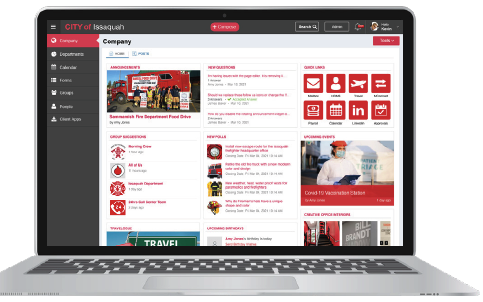
The rise of mobile devices and social media forced a change. "Modern" intranets introduced user-friendly Content Management Systems (CMS) that allowed HR and Internal Comms teams to publish news without coding. They added social features like likes and comments, personalized news feeds, and mobile apps to reach workers outside the office.
- Primary Goal: Drive engagement and culture.
- User Experience: Social, mobile-responsive, and easier to publish.
- Limitation: It still relied entirely on manual effort to create, update, and tag every piece of content. If an admin didn’t post it, it didn’t exist.
3. The AI-Powered Intranet Era (2024–Present)
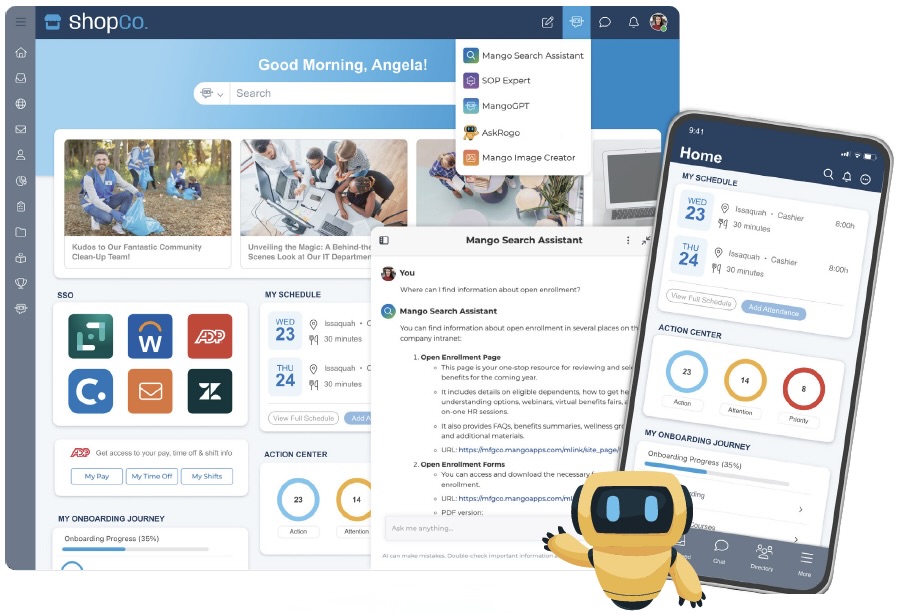
Today, we are in the third wave. An AI-Powered Intranet uses generative AI and a unified data layer to remove the manual bottlenecks of the past. It doesn't just display information; it understands it.
- Primary Goal: Solve problems and automate work.
- User Experience: Conversational, predictive, and personalized.
- Key Shift: The system moves from a "container" to a "co-creator" and "guide."
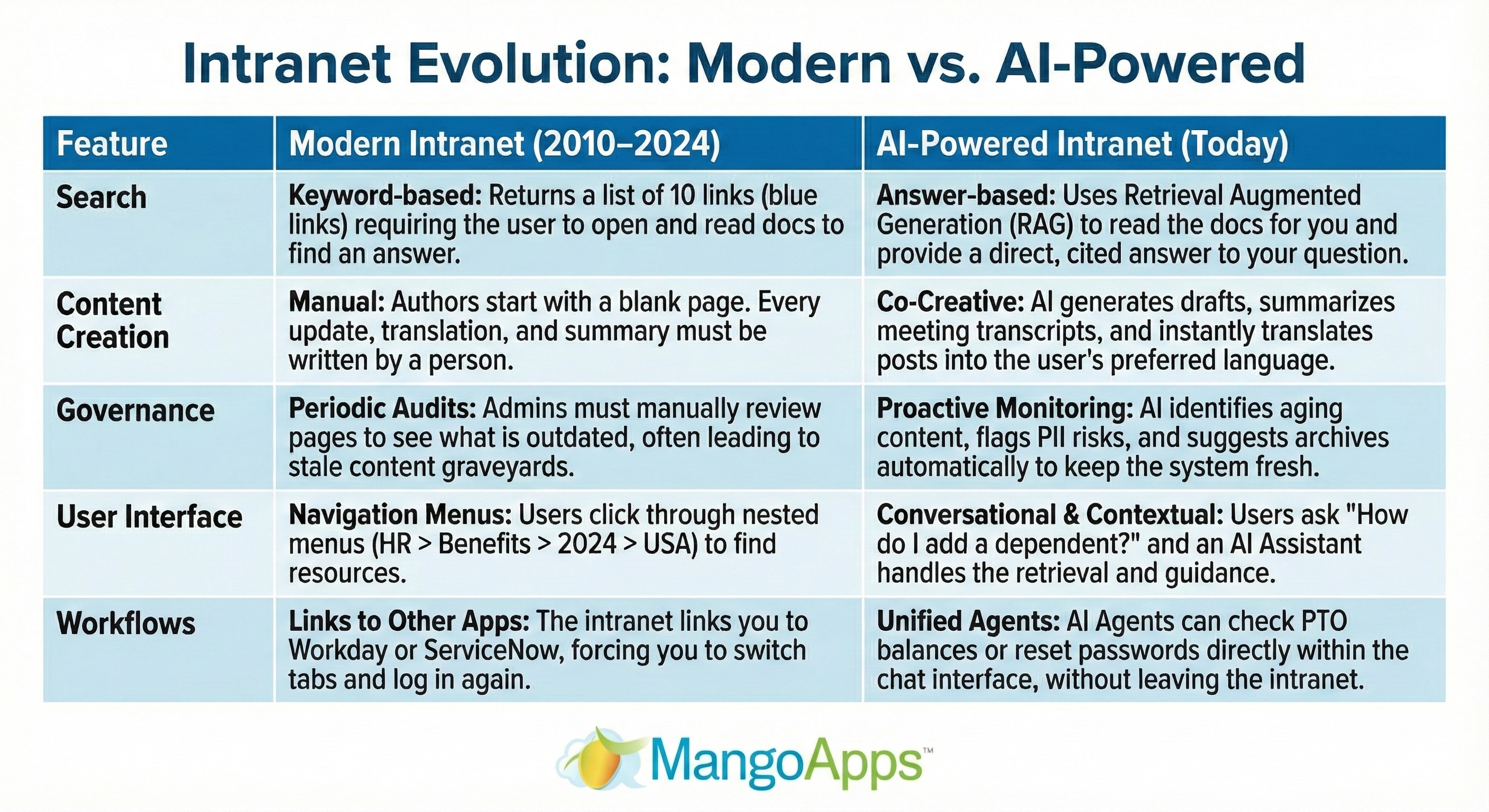
Modern Intranet vs. AI-Powered Intranet: What’s the Difference?
The distinction between a modern intranet and an AI-powered one lies in active vs. passive assistance. A modern intranet waits for you to browse; an AI-powered intranet acts on your behalf.
Why Now? The Role of the Unified Data Layer
Why wasn't this possible before? The challenge has always been data silos. In most organizations, policies live in SharePoint, payroll data in ADP, and training in a separate LMS. An AI cannot give a complete answer if it can only "see" one of these systems.
The MangoApps approach is built on a unified employee data layer. By connecting Intranet, Modern HCM, and Workforce Management into a single platform, our Mango Employee AI has full context. It knows who the employee is, where they work, and what permissions they have.
This allows for true Assistants and Agents that can do real work:
- Search Assistants: Scan the entire knowledge base to answer "What is our remote work policy?"
- Ops Agents: Look up a shift schedule and facilitate a shift swap for a frontline worker.
- Content Assistants: Help internal comms teams turn a rough bulleted list into a polished, localized newsletter in minutes.
The Impact on Retention and Efficiency
The shift to an AI-Powered Intranet is not just a technological upgrade; it is a business imperative. In a time where organizations face turnover rates of 41% (and up to 80% in frontline industries), reducing friction is essential.
When employees can find answers instantly, they feel supported. When frontline workers can access the same tools as headquarters staff via a mobile-first superapp, they feel included. And when leaders have real-time visibility into sentiment and engagement, they can act before people leave.
Research shows that companies with excellent internal communication can see a 40% boost in employee engagement. And, workplaces that are highly engaged experience 78% less absenteeism, 14% higher productivity, and can result in a 23% increase in productivity.
The future of the intranet isn't just about reading news—it's about getting things done.
Ready to see the difference? Learn more about how MangoApps is defining the era of the AI-Powered Intranet.
Frequently Asked Questions (FAQ) About MangoApps AI-Powered Intranet
What is the difference between a chatbot and an AI-Powered Intranet?
A chatbot is typically a single feature overlaid on a website to answer basic questions. An AI-Powered Intranet is a holistic platform where intelligence is woven into the entire experience. It doesn't just answer questions; it proactively suggests content, generates summaries, translates communications, and automates complex workflows across different departments. While a chatbot reacts, an AI-Powered Intranet anticipates and assists.
Is my company data used to train public AI models?
No. Security and data sovereignty are foundational to the MangoApps platform. Your internal data—policies, employee records, and private communications—remains isolated within your environment. It is used solely to provide context for your specific AI Assistants and is never used to train public Large Language Models (LLMs) like ChatGPT or Gemini. We adhere to enterprise-grade security standards, including SOC 2, ISO 27001, and HITRUST certification.
How does an AI-Powered Intranet help with employee retention?
Employee burnout and turnover are often driven by friction—the daily struggle to find information, complete simple tasks, or get help. An AI-Powered Intranet removes this friction by giving employees instant answers and automating administrative work. Furthermore, it gives leadership real-time visibility into sentiment and engagement, allowing them to identify at-risk teams and intervene before turnover happens. When employees feel supported and heard, they are more likely to stay.
Does this replace our existing systems like Workday or Salesforce?
It does not have to. MangoApps is designed to unify your tech stack, not necessarily replace it. Through our unified data layer and integrations, the AI-Powered Intranet connects to systems like Workday, Salesforce, and ServiceNow. It acts as a "single pane of glass," allowing employees to access data and trigger workflows from those systems without constantly switching tabs or logging in and out.
What is a "Unified Data Layer," and why does it matter?
Most companies have data siloed in different places: HR data in one system, operational manuals in another, and company news in a third. A unified data layer connects these disparate sources into a single index that the AI can understand. This context is critical. It ensures that when an employee asks, "How much PTO do I have?", the AI knows who is asking, checks the correct HRIS record, and delivers a precise, personalized answer rather than a generic policy document.
Can AI really generate content that sounds like our brand?
Yes. MangoApps’ AI Assistants can be tuned to your organization’s specific tone and style. Internal communications teams use these tools to draft newsletters, summarize town halls, and rewrite technical updates into engaging posts. The AI acts as a co-pilot, handling the heavy lifting of drafting and formatting, while your team maintains final editorial control to ensure everything stays on-brand.
How helps with frontline workers who don't have desk access?
The AI-Powered Intranet is mobile-first by design. For frontline workers, this levels the playing field. Instead of hunting through binders or waiting for a manager, they can use the mobile app to ask questions via voice or text ("How do I clean this machine?" or "Swap my Tuesday shift") and get instant, accurate answers. Features like instant translation also ensure that language barriers don't prevent frontline teams from staying informed and safe.
The MangoApps Team
We're the product, research, and strategy team behind MangoApps — the unified frontline workforce management platform and employee communication and engagement suite trusted by organizations in healthcare, manufacturing, retail, hospitality, and the public sector to connect every employee — deskless or desk-based — to the people, tools, and information they need.
We write about enterprise AI for the workplace, internal communications, AI-powered intranets, workforce management, and the operating patterns behind highly engaged frontline teams. Our perspective is grounded in a decade of building for frontline-heavy industries and shipping AI agents, employee apps, and integrated HR workflows that real employees actually use.
For short-form takes, product news, and field notes from customer rollouts, follow Frontline Wire — our ongoing stream on AI, frontline work, and the modern digital workplace — or learn more about MangoApps.
Dive Deeper


