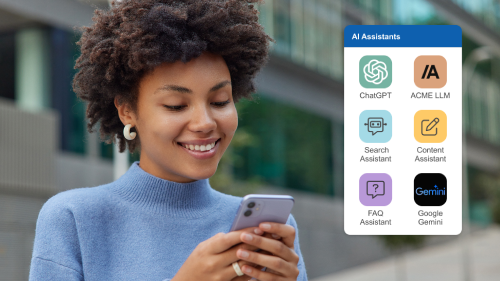
Employees spend an average of 2.5 hours per day searching for information they need to do their jobs (per IDC). AI-powered employee self-service assistants directly cut that time by surfacing answers instantly — from HR policy questions to IT ticket submissions — without requiring employees to know who to call or where to look. This article explains how these assistants work, what they can handle, and what to look for when evaluating them for your organization.
What an AI Employee Self-Service Assistant Actually Does
An AI self-service assistant is a configurable chatbot trained on your company's own data — SOPs, HR policies, IT runbooks, benefits guides, and more. Employees ask questions in plain language and receive accurate, role-appropriate answers in seconds. When the assistant cannot resolve a request, it routes the employee to the right person or submits a ticket automatically.
The practical scope is broader than most teams expect:
- HR queries: leave balances, benefits enrollment, onboarding checklists, policy lookups
- IT support: password resets, software access requests, ticket status updates, common troubleshooting
- Facilities and Procurement: room bookings, supply requests, vendor contacts
- SOP operations: step-by-step procedure guidance pulled directly from your internal knowledge base
A well-configured assistant can handle up to 2,000 frequently asked HR and IT questions automatically, reducing live-agent escalations without custom development (per Beekeeper's chatbot FAQ capacity benchmarks).
Why Traditional HR and IT Service Models Fall Short
Despite the availability of digital tools, most organizations still rely on fragmented, manual processes for employee support. The numbers illustrate the gap clearly:
- 91% of organizations operate an intranet (per Social Edge Consulting), yet only 13% of employees use it daily (per Social Edge Consulting).
- The average employee spends just six minutes per day using intranet tools (per SWOOP Analytics).
- Nearly a third of employees never log in to the intranet at all (per Social Edge Consulting).
These figures point to a structural problem: traditional knowledge management tools are built around the assumption that employees will seek out information proactively. Most won't — especially frontline workers who are away from a desk. 80% of the global workforce is deskless (per Emergence Capital), and those workers rarely have access to a corporate email address or a desktop device to navigate a conventional intranet.
The result is a predictable cycle: employees ask colleagues instead of systems, HR and IT teams field repetitive questions, and institutional knowledge stays locked in documents no one opens.
How AI Assistants Solve the Knowledge Management Problem
Effective knowledge and knowledge management requires more than storing documents — it requires surfacing the right information to the right person at the right moment. AI assistants close this gap in several ways.
Retrieval-Augmented Generation (RAG) on Permissioned Data
Rather than relying on a general-purpose language model, enterprise-grade assistants use Retrieval-Augmented Generation to query your organization's own content. Responses are grounded in your actual policies, not generic internet data. Critically, your data stays on your infrastructure and is never used to train public models.
Persona-Based Targeting
Role, region, and language context determine what each employee sees. A warehouse associate in a Spanish-speaking market gets different self-service options than a corporate finance analyst — reducing noise, misdirected tickets, and the frustration of irrelevant results. Multilingual support is particularly important for distributed and frontline workforces: assistants that support inline translation across dozens of languages remove a significant barrier for non-English-speaking teams.
No-Code Workflow Automation
HR, IT, Facilities, and Procurement teams can build and update self-service workflows — forms, routing rules, escalation paths — without IT involvement. When a policy changes, the team that owns the policy updates the assistant. This is the practical definition of a tool for knowledge management that non-technical teams can actually maintain.
Frontline-First Access
Frontline workers can access self-service tools, submit PTO requests, and manage shift-related tasks without a corporate email address or desktop device (per Beekeeper's deskless worker self-service benchmarks). Mobile-first design is not optional for organizations with large frontline teams — it is the baseline requirement.
For a broader view of how these capabilities fit into workforce management strategy, the operational context matters as much as the technology.
Governed AI: What Enterprise Deployment Actually Requires
The term "AI assistant" covers a wide range of maturity levels. Enterprise deployments require governance that consumer-grade tools do not provide.
Key governance requirements:
- Scoped knowledge: the assistant answers only from content you have explicitly authorized, not from the open web
- Engine flexibility: support for multiple AI engines (OpenAI, Gemini, Anthropic, Azure) so your organization is not locked into a single vendor's roadmap
- Agent routing: when the assistant cannot answer, it escalates to the right human or system — not a dead end
- Performance measurement: admins need dashboards showing which questions the assistant answered correctly, which it escalated, and where knowledge gaps exist
- Role-based access: employees only see content and workflows appropriate to their role, preventing accidental exposure of sensitive HR or compensation data
Without these controls, organizations face a different risk: employees using general-purpose generative AI tools in an unregulated environment, with no visibility into what data is being shared externally.
Deployment Speed and Time to Value
One of the most common objections to AI self-service projects is implementation complexity. Traditional IT-led customization projects can take months before a first assistant goes live. Modern no-code platforms can have a first live assistant running in days — not months — because the configuration layer is owned by the business team, not the IT department.
The business case for moving quickly is concrete:
- Organizations have reported 50% faster new-hire onboarding when self-service training and digitized workflows replace manual HR processes
- Enterprise self-service rollouts have achieved 90% frontline adoption within the first six months
- AI-powered employee experience and self-service consolidation has been attributed to $20M in cost avoidance at large enterprise deployments
These outcomes depend on adoption, which depends on the assistant being genuinely useful from day one — not after a six-month tuning period.
MangoApps AI Assistants: How the Platform Addresses These Requirements
MangoApps AI Assistants are configurable chatbots that live within the MangoApps employee experience platform, accessible from any device. They are trained on your company's data using RAG, support role-based access and persona-based targeting, and connect to your existing IT infrastructure without requiring a rip-and-replace of current systems.
The platform's 15 years of deployment experience in traditional industries — retail, healthcare, manufacturing — shaped design decisions around non-technical user bases, security protocols, and the reporting functionality that enterprise IT and HR teams require before approving any new system.
For HR teams specifically, the no-code environment means that when a benefits policy changes, the HR team updates the assistant — no ticket to IT, no delay between policy change and employee awareness. For IT teams, the assistant handles ticket submissions, status updates, and common troubleshooting autonomously, freeing staff for complex issues.
Beyond HR and IT, any department that manages a data set employees need — Facilities, Legal, Procurement, Compliance — can deploy its own assistant without a technical background. This is what makes the platform a genuine tool for knowledge management rather than a point solution for a single department.
MangoApps also maintains modern HCM integrations so that employee data powering the assistant — org structure, role, location, employment status — stays current without manual synchronization.
For organizations evaluating platforms, the ClearBox Consulting's 2026 Intranet and Employee Experience Platforms Report provides independent analysis of how enterprise intranet and employee experience platforms compare on these dimensions.
Frequently Asked Questions
Can AI self-service assistants work for employees without corporate email or desktop access?
Yes — and this is a non-negotiable requirement for any organization with a significant frontline workforce. Assistants must be accessible via mobile browser or app, without requiring a corporate email address for authentication. Frontline workers can access self-service tools, submit PTO requests, and look up shift information from a personal device. Given that 80% of the global workforce is deskless (per Emergence Capital), a desktop-only self-service strategy excludes the majority of workers in most industries.
How do you measure whether an AI assistant is actually working?
Admin dashboards should show: (1) question volume by category, (2) resolution rate — questions answered without escalation, (3) escalation destinations — which teams are receiving routed requests and why, and (4) knowledge gap reports — questions the assistant could not answer, which become a prioritized list for content updates. Without these metrics, "AI self-service" is a black box. With them, it becomes a continuously improving knowledge management system.
What happens when the assistant doesn't know the answer?
A well-configured assistant does not guess. It acknowledges the limit of its knowledge and routes the employee to the appropriate human contact or submits a support ticket on their behalf. The routing logic should be configurable by department — HR escalations go to HR, IT escalations go to IT — and the employee should receive confirmation that their request is in the queue. This is the difference between an assistant that builds trust and one that erodes it.
The Concrete Next Step
If your organization is evaluating AI self-service assistants, the most productive starting point is an audit of your current knowledge management tools: what content exists, who owns it, how current it is, and which employee questions are generating the most live-agent contacts today. That audit defines the scope of your first assistant and gives you a baseline against which to measure improvement.
The 2026 HR Trends eBook covers how leading HR teams are structuring this kind of audit and what governance frameworks they are putting in place before deploying AI in employee-facing workflows.
For organizations with frontline or distributed workforces, the 2026 Workforce Operations Trends eBook addresses the specific access, language, and device constraints that shape self-service design for non-desk workers.
The goal is not to replace HR and IT teams — it is to give employees faster answers to routine questions so those teams can focus on work that requires human judgment.
The MangoApps Team
We're the product, research, and strategy team behind MangoApps — the unified frontline workforce management platform and employee communication and engagement suite trusted by organizations in healthcare, manufacturing, retail, hospitality, and the public sector to connect every employee — deskless or desk-based — to the people, tools, and information they need.
We write about enterprise AI for the workplace, internal communications, AI-powered intranets, workforce management, and the operating patterns behind highly engaged frontline teams. Our perspective is grounded in a decade of building for frontline-heavy industries and shipping AI agents, employee apps, and integrated HR workflows that real employees actually use.
For short-form takes, product news, and field notes from customer rollouts, follow Frontline Wire — our ongoing stream on AI, frontline work, and the modern digital workplace — or learn more about MangoApps.


