For decades, the corporate intranet was a digital library. It lived on a desktop, sat behind a firewall, and relied on humans to manually organize thousands of documents. Then came the employee app, promising to fix the "last mile" of communication by putting updates in everyone’s pocket.
Today, organizations often feel forced to choose. Do you build a deep, content-heavy intranet for desk workers? Or do you launch a lightweight, accessible app for the frontline?
The rise of AI-powered employee platforms has changed the equation. You no longer have to pick between depth and reach. Instead of building separate silos, modern platforms use AI to unify the experience—delivering the full power of an intranet through the simple interface of an app.
Here is how the two technologies compare and why an AI-powered approach is the future of the employee experience.
The Traditional Intranet: Depth Without Intelligence
Historically, intranets were built for storage. They served as systems of record where HR and Internal Comms teams housed static documents. While they offered depth, they lacked the intelligence to make that information useful.
The Limitation: Legacy intranets rely on manual curation and keyword search. If an employee types "benefits" into the search bar, they might get fifty results ranging from PDFs to old news posts. They have to dig for the answer. This friction is why fewer than 15% of employees use traditional intranets daily.
The Employee App: Reach Without Context
The employee app emerged to solve the accessibility problem. It bypasses email and the desktop to reach frontline and deskless workers directly on their devices.
The Limitation: While apps excel at push notifications and operational tasks, they often lack the "brain" of a full platform. Without a unified data layer or intelligent search, apps can become shallow communication channels where it is difficult to find complex answers or complete multi-step workflows.
The Solution: An AI-Powered Unified Platform
The choice between "intranet" and "app" is a false dichotomy. The most effective strategy is a unified, AI-powered platform that adapts to the user.
MangoApps replaces disjointed tools with a single intelligent system. At its core is Mango Employee AI, which sits on top of your unified data layer. It understands the context of every employee—whether they are a nurse on a floor, a retail associate in an aisle, or an accountant in a home office—and delivers exactly what they need.
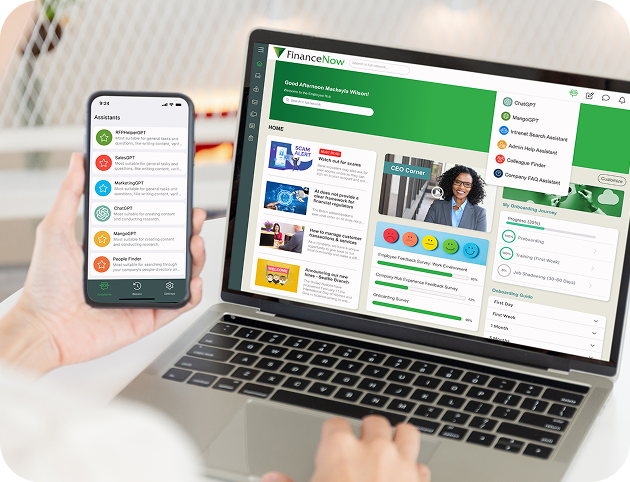
Here is how an AI-powered platform bridges the gap:
1. From Search to Answers
In a traditional intranet, you search for documents. In an AI-powered platform, you ask questions.
Mango Employee AI acts as an intelligent assistant. An employee can ask, "How do I add a dependent to my insurance?" or "What is the store opening procedure?" The AI retrieves the answer from your knowledge base, cites the source, and delivers it instantly—even on a mobile screen.
2. From Static Content to Active Intelligence
Legacy intranets require constant manual updating. MangoApps uses AI to act as a co-creator for your comms and HR teams. It can help draft updates, summarize long policies into digestible news snippets, and even automate routine maintenance to keep content fresh.
3. Parity for Every Worker
AI is the great equalizer. It allows a frontline worker with a smartphone to access the same depth of organizational knowledge as a headquarters employee with a laptop. Because the AI handles the complexity of retrieving information, the mobile interface stays clean and simple while still providing full access to SOPs, policies, and people.
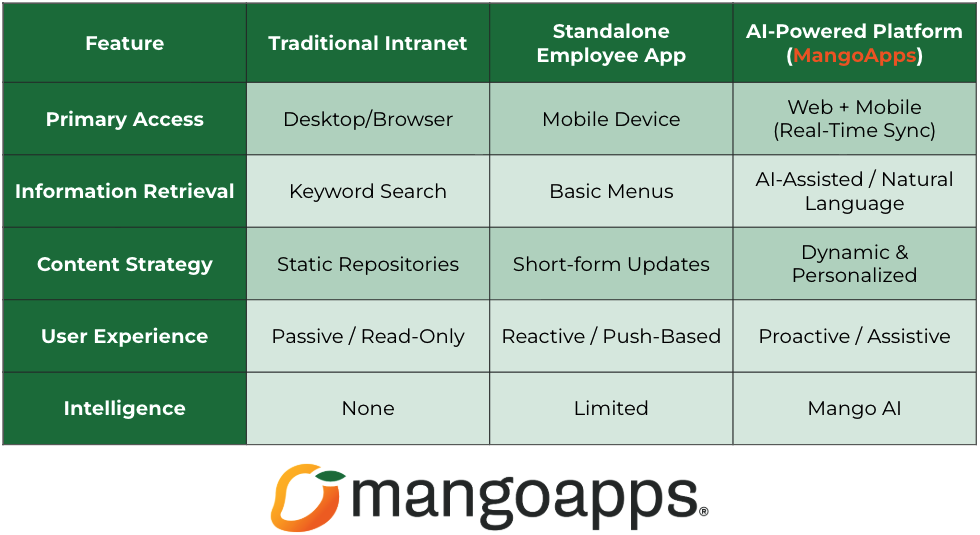
Comparison at a Glance
Why It Matters: Retention and Engagement
The goal isn't just to buy software; it's to keep your people.
Today, 80% of organizations face a significant retention problem despite widespread adoption of HR tools. This is often because legacy tools were built for administrators, not employees.
An AI-powered platform flips this dynamic. By removing the friction of finding information and completing tasks, you help employees feel supported and capable. When a worker can get an instant answer from their phone instead of waiting hours for a manager, they are more productive and less frustrated. That connection builds the kind of engagement that makes people stay.
Don't settle for a static intranet or a shallow app. Move to an intelligent platform that brings your entire workforce together.
Next Steps
- Evaluate your stack: Are your employees wasting time searching for answers across disconnected tools?
- Assess your AI readiness: Could an AI assistant help your frontline teams access policy and procedure data faster?
- Explore our solution: See how MangoApps unifies Intranet, HCM, and WFM into one seamless experience, powered by AI.
- Request a Demo
Related Resources
- MangoApps Unified Intranet & Employee App – Explore the platform that combines an AI-powered intranet, frontline app, and communications suite.
- Customer Success Stories – See real-world examples of how organizations like A.S. Watson and TeamHealth unified their workforce with MangoApps.
- Ultimate Intranet Buyer’s Guide for a Frontline Workforce (2026) – A comprehensive guide to selecting a unified platform that connects your entire workforce, from HQ to the frontline.
- Intranet RFP Template – Save time with a customizable template designed to help you evaluate vendors against modern, AI-powered requirements.
- Intranet Planning Guide – Step-by-step guidance on building a business case, defining requirements, and launching a platform that drives engagement.
Frequently Asked Questions: Intranet vs. Employee App
1. Can an employee app replace a traditional intranet?
Yes, but only if it is built on a unified data layer. A standalone "lite" app often lacks the document management and governance capabilities of a full intranet. However, an AI-powered employee platform like MangoApps replaces both by offering the depth of an intranet (for content and knowledge management) with the accessibility of a mobile app (for frontline reach).
2. Do I need separate platforms for desk and deskless workers?
No. Maintaining separate systems creates information silos and disconnects your workforce. A unified platform allows you to publish content once and have it automatically adapt to the user's device. Desk workers see a full desktop dashboard, while frontline workers receive a streamlined mobile feed, ensuring everyone stays aligned without doubling the administrative workload.
3. Is a mobile employee app secure for accessing company data?
Modern employee apps are designed with enterprise-grade security. MangoApps, for instance, uses a HITRUST, ISO 27001, and SOC 2 Type II certified environment. This allows employees to access sensitive policies, pay stubs, and schedules on personal devices (BYOD) without compromising data security or requiring a VPN.
4. How does AI change the intranet experience?
AI transforms the intranet from a passive "storage unit" into an active assistant. Instead of browsing through folders to find a policy, employees can ask Mango Employee AI a question like, "What is the bereavement leave policy?" The AI retrieves the specific answer from your secure knowledge base and delivers it instantly, saving time and reducing frustration.
5. Will an app really improve frontline retention?
Yes. Frontline turnover is often driven by a lack of support and connection. When employees can easily swap shifts, check their pay, and get instant answers to questions via an app, they feel more empowered and valued. Organizations using unified platforms often see significant improvements in engagement scores and reductions in voluntary turnover.
6. Isn't a unified platform more expensive than just buying an app?
Actually, it is often more cost-effective. A unified platform consolidates multiple subscriptions—intranet, employee app, advocacy tools, and survey platforms—into one budget item. By reducing tool sprawl and administrative overhead, organizations typically lower their total cost of ownership while gaining better data visibility.
The MangoApps Team
We're the product, research, and strategy team behind MangoApps — the unified frontline workforce management platform and employee communication and engagement suite trusted by organizations in healthcare, manufacturing, retail, hospitality, and the public sector to connect every employee — deskless or desk-based — to the people, tools, and information they need.
We write about enterprise AI for the workplace, internal communications, AI-powered intranets, workforce management, and the operating patterns behind highly engaged frontline teams. Our perspective is grounded in a decade of building for frontline-heavy industries and shipping AI agents, employee apps, and integrated HR workflows that real employees actually use.
For short-form takes, product news, and field notes from customer rollouts, follow Frontline Wire — our ongoing stream on AI, frontline work, and the modern digital workplace — or learn more about MangoApps.
Dive Deeper


